Forés @ UVPress


         Universitat de València PRESS -UVPress- weblog for research uses

December 24, 2012

06 EL FUTURO DE LAS LETRAS ESTADOUNIDENSES

EL FUTURO DE LAS LETRAS ESTADOUNIDENSES

Una tensión narrativa que no palidece

La magnética literatura norteamericana se mueve entre dos polos: el realismo de Jonathan Franzen y la experimentación de David Foster Wallace

Una potencia que mantiene su influencia planetaria en un mundo globalizado y cambiante

Madrid 23 DIC 2012 – 14:18 CET9
En el sentido de las agujas del reloj: David Foster Wallace, Jonathan Franzen, Joyce Carol Oates y Jennifer Egan, vistos por Sciammarella. / Agustin Sciamarella

Desaparecidas las figuras colosales de John Updike y Norman Mailer, ¿quiénes son los novelistas norteamericanos vivos más importantes? La unanimidad es imposible, pero un cierto consenso entre quienes tienen autoridad en estos asuntos apunta a que, por la envergadura y peso de sus trayectorias, los narradores estadounidenses más relevantes de nuestro tiempo son Philip Roth, Cormac McCarthy, Don DeLillo y Thomas Pynchon. El hecho de que todos hayan nacido en un intervalo de apenas cuatro años (Roth y McCarthy en 1933, DeLillo en 1936, y Pynchon en 1937) los afianza como los más claros representantes de varias maneras divergentes de entender el arte de la ficción. La lista no resultaría reductiva ni arbitraria, de no ser porque en ella no figura el nombre de una sola mujer. No es un caso aislado. En 2006, The New York Times recabó la opinión de 200 expertos, entre los que figuraba un nutrido número de novelistas, pidiéndoles que identificaran los títulos de las obras de ficción más importantes publicadas en Estados Unidos durante los 25 años anteriores. La novela que obtuvo más votos fue Beloved, de Toni Morrison, seguida de Submundo, de Don DeLillo. Además del de Morrison, la lista incluía tan sólo el nombre de otra escritora, Marilynne Robinson. En cuanto al número de títulos por autor, los tres primeros puestos los ocuparon respectivamente Philip Roth con seis (La contravida, Operación Shylock, El teatro de Sabbath, Pastoral Americana, La mancha humana y La conjura contra América), Cormac McCarthy con cuatro (Meridiano de sangre, más la Trilogía de la frontera) y Don DeLillo con tres (Ruido de fondo y Libra, además de Submundo).

La renuencia a reconocer la importancia de las narradoras carece de justificación. No solo es formidable el elenco histórico de las novelistas norteamericanas (Edith Wharton, Gertrude Stein, Willa Cather, Carson McCullers, Flannery O’Connor, Eudora Welty, Grace Paley), sino que el número de autoras que escriben hoy ficción de calidad es similar, si no superior, al de los narradores. La cuestión de fondo es algo tan sencillo como que la historia crítica de la literatura la sigue controlando un establishment claramente masculino. Al cuarteto de autores antes señalados cabe contraponer otro integrado por novelistas que brillan a una altura similar: Joyce Carol Oates, E. Annie Proulx, Marilynne Robinson y Toni Morrison.

Herman Melville, autor de ‘Moby Dick’ / EL PAÍS

Con casi 60 novelas y centenares de relatos en su haber, además de innumerables incursiones en todos los géneros literarios, Joyce Carol Oates (1938) es la más prolífica y versátil de las narradoras norteamericanas actuales y una de las de mayor talento. E. Annie Proulx (1935), tenía 55 años cuando publicó su primer libro, una colección de relatos. Su novela Atando cabos (1993) obtuvo los premios Pulitzer y Nacional del Libro. La película basada en su relato Brokeback Mountain, galardonada con un Óscar, la lanzó a la fama. Tras la entrega de su primera novela Marilynne Robinson (1943) esperó 24 años antes de publicar Gilead, con la que obtuvo el Pulitzer en 2004. Autora de tan solo tres novelas, su obra narrativa no va a la zaga de la de ningún autor contemporáneo, hombre o mujer. La afroamericana Toni Morrison, ganadora del Premio Nobel de Literatura en 1993 no necesita presentación. Su última novela, Volver (2012) se publicará próximamente en España.

Todos los nombres citados hasta ahora corresponden a figuras con una dilatada trayectoria. Acercándonos a sus herederos con ánimo de discernir en qué dirección se mueve la ficción norteamericana más joven, uno de los nombres clave es el de David Foster Wallace. Su influencia sobre las nuevas generaciones de escritores de todo el mundo es inconmensurable. Autor de La broma infinita (1997), una de las novelas más radicales y audaces de las últimas décadas, Wallace se suicidó en 2008 con tan sólo 46 años. Dejó inacabada El rey pálido.

Wallace también tenía su canon particular, integrado por Pynchon, Don DeLillo y dos altos representantes de la metaficción postmoderna: John Barth y Robert Coover, cuyo legado le resultaba problemático. De los realistas, ni rastro. Wallace abrió su reseña de Hacia el final del tiempo, novela publicada por Updike en 1997 con estas palabras: “Mailer, Updike y Roth son grandes machos narcisistas que vislumbran su propio fin con la muerte de la novela como telón de fondo”.

El radar de Wallace hacía caso omiso de los misiles lanzados desde el realismo por considerar que se trataba de una opción estética totalmente periclitada y por tanto incapaz para narrar de manera adecuada la complejidad de nuestro tiempo. Con respecto a Barth y a Coover, creía que sus experimentos metaficcionales habían llevado a la novela a un callejón sin salida. En deuda por el contrario con Pynchon y DeLillo, de quienes aprendió a mirar hacia el futuro, pensaba que eran de los pocos autores parte de cuya obra quizá se siguiera leyendo dentro de cien años (en una ocasión efectuó la enigmática observación de que quizás se salvara el 25% de la obra de Pynchon).

Situemos todo esto en una perspectiva histórica. En ¿Tolstói o Dostoievski?, su primer libro, George Steiner avanzó la hipótesis de que con el declive de las potencias europeas el testigo de la gran novela pasó a manos de los imperios emergentes de Rusia y los EE UU. Independientemente de que Europa siguió produciendo novelistas de gran envergadura durante mucho tiempo, había algo rabiosamente novedoso en el despertar narrativo de la joven nación norteamericana. A mediados del XIX, una nueva manera de entender el cuento y la novela echan a andar de la mano de Edgar Allan Poe, Herman Melville y Nathaniel Hawthorne, con obras como La letra escarlata y Moby Dick. En el lustro comprendido entre 1850 y 1855 surgen los nombres de Emerson y Thoreau en el ensayo, y Walt Whitman en la poesía. Pocas veces en la historia de la literatura han tenido lugar explosiones de talento de semejante calibre. A lo largo de la centuria siguiente el canon se refuerza con los nombres de Mark Twain y Henry James. Una breve escala en 1925 permite constatar que entre los autores que publicaron aquel año figuraban Hemingway, Faulkner, Scott Fitzgerald y Dos Passos.

Lo que más interesa destacar de estos insólitos estallidos de genio colectivo es la persistencia de una serie de tensiones históricas que mueven el arte de la ficción en direcciones antagónicas (Twain: la voz del pueblo, como Whitman; James: la novela cerebral que se investiga a sí misma como medio; Hemingway, cultivador de una prosa de una claridad rayana en lo imposible frente a la extraordinaria opacidad impregnada de poesía de Faulkner).

Cormac McCarthy prorroga la lección de Faulkner, de cuyas obras fue editor hasta su muerte; Roth es heredero de un linaje que incluye nombres como Saul Bellow o Bernard Malamud. La mayor colisión entre pulsiones narrativas de signo antagónico probablemente tuvo lugar en la década de los cincuenta del siglo pasado. En 1951 se publica El guardián entre el centeno, de J. D. Salinger, la novela más vendida de la historia de la literatura estadounidense, y en 1955, Los reconocimientos, de William Gaddis, probablemente la menos leída. Esta última es, no obstante, una obra fundamental, sin la que no resulta posible entender ni a Pynchon ni a Foster Wallace. También en 1955 vio la luz Lolita, de Vladimir Nabokov, uno de cuyos segmentos (el recorrido de motel en motel por el corazón del paisaje americano efectuado por la ninfa y su seductor) es una de las dos mejores novelas de carretera de todos los tiempos. La otra es En el camino, de Jack Kerouac, publicada dos años después.

Portada de ‘La broma infinita’, de David Foster Wallace. / EL PAÍS

Desde entonces hasta hoy, la vitalidad de la narrativa norteamericana no ha dado en ningún momento síntomas de desfallecer. Las novelas publicadas por los ocho grandes nombres invocados antes recorren la segunda mitad del siglo pasado y lo que llevamos del actual (Philip Roth publicó su primera novela en 1959 y Toni Morrison, la última en 2012). Con respecto a las tensiones que siempre han sido el motor de la tradición narrativa norteamericana, la más significativa de los últimos tiempos probablemente sea la mantenida entre David Foster Wallace y su mejor amigo, Jonathan Franzen, cuyos modos de entender el arte de la ficción no pueden estar más alejados.

Inicialmente, sus posturas coincidían: se trataba de superar tanto el caduco modelo realista como el de los posmodernistas, que se habían olvidado de que debía haber algún tipo de vínculo entre la página y el mundo. Sus primeras novelas, La escoba del sistema (Wallace, 1987) y La ciudad número 27 (Franzen, 1988), respondían a un mismo orden de preocupaciones. Wallace no tiró la toalla nunca, en tanto que Franzen inició un proceso de regresión hacia formas más convencionales de narrar con Las correcciones (2001) y Libertad (2010), dos novelas que miran al pasado. Escrita antes que estas dos, La broma infinita (1997) dirige su mirada resueltamente hacia el futuro. En cierto modo, se puede decir que cuanto acontece en el panorama de la joven narrativa norteamericana actual toma postura frente a las Escila y Caribdis representadas por estas dos maneras antagónicas de novelar.

Las letras estadounidenses siguen sin perder un ápice de vitalidad. El problema mayor a la hora de elaborar una lista de de nombres de interés, es lo que deja fuera. Así las cosas, proclamo que el interés de Richard Powers, Denis Johnson, A. M. Homes y George Saunders obedece a que la audacia de sus innovaciones no ahoga el milagro de su prosa; Chimamanda Adichie y Teju Cole interesan por su visión novelística, no por su raza negra; Jennifer Egan, Colum McCann, Dave Eggers y Jeffrey Eugenides interesan por la potencia de sus narraciones, no por ser blancos; Junot Díaz por su dominio del relato corto, no por ser hispano; la prosa de Thea Obreht cautiva por su vivacidad, no por su jovencísima edad. Por último, confieso que mi admiración por los nativos americanos Louise Erdrich y Sherman Alexie se deriva del hecho de que ambos han sabido preservar en sus historias la voz auténtica de sus tribus.

Eduardo Lago es escritor. Este texto es reflejo de sus investigaciones como Catedrático de Excelencia en la Universidad Carlos III de Madrid

Canon improbable de los últimos 15 años

Partiendo de la gran obra La broma infinita, escrita en 1997 por David Foster Wallace, diseñamos un canon de la mejor narrativa estadounidense del siglo XXI.

Joyce Carol Oates: Blonde (2000).

Michael Chabon. Las asombrosas aventuras de Kavalier y Klay (2000).

George Saunders. Pastoralia (2000).

Richard Russo. Empire Falls (2001).

Richard Powers. El tiempo de nuestras canciones (2003).

Marilynne Robinson. Gilead (2004).

Annie Proulx. Mala tierra: Gente del Wyoming (2004).

William T. Vollman. Europa central (2005).

Dave Eggers. Qué es el qué (2006).

Cormac McCarthy. La carretera (2006).

Denis Johnson. Árbol de humo (2007).

Joshua Ferris. Entonces llegamos al final (2007).

Richard Price. Lush Life (2008).

Thomas Pynchon. Vicio propio (2009).

Colum McCann. Que el vasto mundo siga girando (2009).

Colson Whitehead. Sag Harbor (2009).

Lydia Davies. Cuentos reunidos (2009).

Jonathan Franzen. Libertad (2010).

Jennifer Egan. El tiempo es un canalla (2010).

Chang Rae Lee. Rendidos (2010).

Don De Lillo. Punto Omega (2010).

Téa Obreht. La esposa del tigre (2011).

Junot Díaz. Cómo conseguir que tu chica te abandone (2012).

Louise Erdrich. La casa redonda (2012).

Sherman Alexie. Blasfemia (2012).

December 21, 2012

06 Supreme Court Case Puts Affirmative Action Issue Back in National Media Spotlight

Filed under: economía,future,interesting news,política,recomendaciones — fores @ 9:56 am

The University of Texas at Austin


UT Home > Know > Supreme Court Case…
Know

Friday, Dec. 21, 2012

Supreme Court Case Puts Affirmative Action Issue Back in National Media Spotlight

Published: Oct. 9

UT President Bill Powers

UT President Bill Powers speaks with media after U.S. Supreme Court hearing.Photo: Paul Fetters

Fisher v. The University of Texas at Austin, a case that brings the issue of race in the admissions process back before the Supreme Court for the first time since 2003, was argued Wednesday morning, Oct. 10. (See the University’s news release about the arguments.)

The plaintiff in the case (Abigail Fisher) claims she was denied undergraduate admission to the university in 2008 because she is white, while the university argues that its admissions system, which considers an applicant’s race along with many other factors in an individualized, holistic review, is a constitutional practice that promotes the educational benefits of diversity at the university.

Nearly a decade ago five justices voted to uphold a policy at the University of Michigan that allows an applicant’s race to be one of many factors considered in an admission decision. That case was cited by the university in its brief to the court, filed in early August.

“The educational benefits of diversity are worth fighting for all the way to the Supreme Court. Our lawyers effectively made the case to the justices that diversity — ethnic and otherwise — benefits all students on campus. We made the case that UT has crafted an admissions policy that meets the strict guidelines established by the court in the Grutter decision nine years ago,” President Bill Powers said Wednesday after oral arguments were completed.

“The last time the U.S. Supreme Court heard a case involving The University of Texas’ use of race in admissions was 60 years ago. The issue then was about excluding African Americans and we were on the wrong side of history. The University of Texas lost that case, but the nation won and has benefited ever since as we have grown more inclusive,” Powers said. “Our current admissions process is part of the legacy of that court’s decisions, which sought to eradicate segregation. Our policy adheres to the spirit and letter of the court’s rulings on the use of race in admissions.”

In the run-up to the oral arguments, several national media outlets previewed the case. Here’s a roundup of the coverage, with excerpts from Bloomberg Businessweek, PBS News Hour, the Washington Post and others previewing the session, as well as a sampling of commentary pieces weighing in on both sides of the issue.

Previews


Bloomberg Businessweek: Texas Diversity Tested at Court as Affirmative Action Curbs Loom

At the core of the debate is whether universities can adequately diversify without resorting to racial preferences. Texas admits three-quarters of its freshman class each year on the basis of high school class rank — the ‘top 10 percent rule.’ That system ensures a significant number of minorities because it guarantees slots to students at predominantly Hispanic and black schools.

The university considers race only in admitting the rest of the class. Opponents of preferences say that’s unnecessary, given the success of the class-rank method. Texas counters that even with race-based admissions, a high percentage of its classes have few if any black and Hispanic students.

Should the high court side with opponents, the ruling could set up Texas’s class-rank system as a model for other universities, forcing many to give up preferences.

The Washington Post: Supreme Court may limit use of race in college admissions

The court since 1978 has recognized that promoting diversity on the nation’s campuses allows a limited consideration of race that normally the Constitution would not countenance.

It has imposed restrictions — no quotas, no racial balancing to match demographics, no automatic boost for an applicant because of minority status. But as recently as 2003, the justices reaffirmed the view that “student body diversity is a compelling state interest that can justify the use of race in university admissions.”

But the court has changed dramatically since then, with a conservative majority now highly skeptical of — even hostile to — racial preferences. The justice most likely to decide the case for the divided court — Anthony M. Kennedy — has agreed in principle that diversity is important but has never voted to approve an affirmative-action plan.

At the same time, the national appeal of “diversity” — the goal of producing a legion of future leaders that matches the nation’s changing complexion — has become so ingrained that more than 70 amicus briefs have been filed on UT’s behalf.

Los Angeles Times: Supreme Court to revisit affirmative action in Texas case

Can affirmative action be justified if a university is achieving diversity without using race? The answer could determine the future of affirmative action in college admissions in much of the nation.

The top 10% law, recently amended to admit the top 8% of graduates, has not only boosted diversity, but it has also brought other benefits. Since the mid-1990s, the graduation rate at UT-Austin has risen steadily. Studies showed the graduates admitted under the law outperformed others with higher SAT scores.

“It’s had a profound impact. Before, about 10% of the high schools filled 75% of the freshman class seats here,” said law professor Gerald Torres. Two years ago, the campus announced that for the first time, a majority of its freshmen were minorities: Latinos, Asians or blacks.

PBS NewsHour: SCOTUS Preview: Looking at Affirmative Action

Many are watching for a significant shift in the court’s stance toward affirmative action, given the changes in the court’s roster since the Grutter decision was handed down. O’Connor, the author of the Grutter decision, has since been replaced by Justice Samuel Alito. And Justice John Paul Stevens, another of the five justices in the Grutter majority, has since been replaced by Justice Elena Kagan, the former Solicitor General who already recused herself from the court’s deliberations over whether to even hear the Fisher case.

New York Daily News: University of Texas to argue that it hasn’t reached “critical mass” when it comes to affirmative action 

History isn’t central to the legal issues in the affirmative action debate, but it’s an issue at UT-Austin. The football team didn’t integrate until 1970, and even as minority enrollment expanded, UT little resembled increasingly diverse Texas, leaving minority students feeling isolated.

“It was very seldom three or more were gathered,” said Machree Gibson, who arrived on campus in 1978, earned two degrees and later became the first black female president of the Texas Exes, the university’s powerful alumni group. “We used to joke, ‘Three in a room, we’re a gang.”’

Today, even a short drive through campus leaves Gibson amazed how things have changed.

But UT still doesn’t look like Texas. Of its 52,000 students, 5 percent are black (compared to 12 percent of the state population). Hispanics are 18 percent at UT (38 percent statewide) and Asians 15 percent (4 percent statewide).

Commentary


Inside Higher Ed: Social scientists defend affirmative action in Fisher v. University of Texas

Race-blind admissions policies would harm students from all racial and ethnic groups, a group of scholars who support affirmative action argued Thursday, less than two weeks before the Supreme Court is set to hear a case that could change the landscape of admissions dramatically.

“Race-neutral policies simply do not work at the same level affirmative action does,” said Stella Flores, an assistant professor in Vanderbilt University’s Department of Leadership, Policy & Organizations.

Flores spoke as part of a briefing by the American Educational Research Association, held to discuss the science behind its amicus brief urging the Supreme Court to uphold affirmative action in college admissions in the Fisher v. University of Texas case.

The Chronicle of Higher Education: U. of Texas Stands on Firm Legal Ground – Commentary

Since the founding of the country, the Supreme Court, Congress, and the executive branch have vested individual colleges with the power to make decisions about higher-education practices and principles, including the ability to decide whom to admit.

Out of this freedom has evolved an American system of higher education that is unique. While many other countries control their colleges from a central ministry, the U.S. system of higher education has always been decentralized, with key academic and administrative judgments left to individual institutions.

The result is a richly diverse system of public and private, two-year and four-year, small liberal-arts and large research colleges and universities with a wide array of curricula and missions. It is a system that remains the envy of the world, attracting hundreds of thousands of international students to the United States every year.

Dallas Morning News: Minator Azemi: UT’s diversity is key to its academic excellence

Two years after graduating from the University of Texas at Austin, I recognize that my interactions with students from all walks of life while I was an undergraduate have put me in the best position possible to thrive as a citizen of Texas. And I think about these experiences as the Supreme Court prepares to review UT’s use of race in admissions.

Just as my background as a first-generation college student and Fort Worth native born to Albanian immigrants influenced my views, so too did my classmates’ hometowns, racial and ethnic backgrounds, socioeconomic classes, and family lives. Our differences facilitated thoughtful exchanges that would help us become contributing citizens of Texas and the world after graduation.

Through my service as a university-wide representative in student government — and through an election campaign to represent all UT students — I found myself reaching out to the farthest corners of campus. I worked with student groups representing various academic, professional, ethnic and social interests within the student body.

Through these experiences, I recognized the far-reaching benefit of UT’s diversity, which affects students in an intellectual capacity inside the classroom and in the real world. Now as a UT law student, I appreciate the practical value of diversity within the college setting and the benefits it will bring me when I practice law in Texas after law school.

New York Times: Thomas Espenshade: Moving Beyond Affirmative Action

The racial and socioeconomic gap in academic performance is America’s most pressing domestic issue. When they enter kindergarten, black children are about one year behind white children. When they graduate from high school, black teenagers are four years behind white teenagers.

If affirmative action is abolished, selective colleges and universities will face a stark choice. They can try to manufacture diversity by giving more weight in admissions to those factors that are sometimes close substitutes for race — for example, having overcome disadvantage in a poor urban neighborhood. Or they can take a far bolder step: putting their endowments and influence behind a comprehensive effort to close the learning gap that starts at birth. Higher education has a responsibility for all of education. The job of those atop the academic pyramid is not over once they’ve enrolled a diverse freshman class.

Washington Post: Martha Minow and Robert Post: Why race matters in school admissions

Martha L. Minow is the dean of Harvard Law School. Robert C. Post is the dean of Yale Law School.

Why did we, friendly rivals as deans of great and sometimes competitive law schools, join forces to write a common brief to the U.S. Supreme Court?

Because we both believe that higher education should select the best possible students, because we both believe we can identify such students only if we are free to evaluate the individual experiences and qualifications of each applicant, and because we both believe that this requires us to understand applicants’ own characterizations of their race or ethnicity.

Our reasoning is simple. We admit students to accomplish two goals: to get the best possible students and to assemble the best possible class. These goals require us to examine each applicant in detail.

The Supreme Court has acknowledged that “universities, and in particular, law schools, represent the training ground for a large number of our Nation’s leaders.” The character of our students is relevant to the quality of our leaders. Character is most often revealed in the life circumstances of our applicants. We look to see how candidates have responded to the challenges they have faced.

As a practical matter, we do not understand how a rule forbidding all consideration of race could possibly be enforced. In their personal statements, many applicants discuss how race has influenced their lives. Writers of recommendations frequently mention race in explaining how an applicant has overcome challenges. Would those advocating race-blind admissions have us censor the statements of applicants and their recommenders? How could we carry out such a task, even if we were inclined to do so?

Post a comment One comment

  • Quote 2
    Bob Smith said on Oct. 12 at 11:32 a.m.
    Saying that the University is not sufficiently diverse because some classes have only one Black student is a ridiculous argument. Not because the University should not be fostering diversity, but because it isn’t a valid argument. A walk across the campus reveals a gradient of increasing numbers of Black students as one moves from north to south. Instead of increasing Black enrollment in Business and Education through quotas, why not focus resources on how to get more minority students in science and engineering. Secondly, as someone who experienced the consequences of affirmative action in the UC system, before it was abolished, I feel certain that any institution that places a high priority on promoting diversity at all costs faces a very hard choice: either lower academic standards so all can succeed (the UT way) or set some minority students up to fail horribly. Finally, one has to ask if forcing the population of the preeminent university in the state to have a population mirroring that of the state is a wise goal. All should have access to higher education, and the 8 percent rule is a good way to ensure that all who want it have an opportunity, but as research universities are also the main engines of forward-looking economic development in a state like Texas, should we be trying to promote social goals (with questionable success) at the expense of raising academic standards and promoting excellence?

December 16, 2012

06 Dustin Hoffman: facing down my demons

Filed under: archivo personal,Holístico,politics & literature — fores @ 2:13 am

Dustin Hoffman: facing down my demons

Dustin Hoffman on being difficult, the movies he didn’t make and why he’s finally directing

dustin hoffman

‘Some people are alcoholics, some are drug addicts. Some turn down great moments in their life, and I guess I fell into that category.’ Photograph: David Levene

Dustin Hoffman is on the phone to his wife. I know I shouldn’t eavesdrop, but I can’t help it. It’s the voice. “Where’s your meeting? Good luck. Bye-bye.” So slow and deep and rich, like whipped cream mixed with gravel. Even when he started out 45 years ago in The Graduate, as virginal Benjamin Braddock about to be educated in the ways of love and lust, he had the voice. Hoffman is an extraordinarily convincing actor – when he sweats crazily in Straw Dogs, the sweat’s for real; you can almost smell him as crippled hobo Ratso in Midnight Cowboy; and when he steps into a frock and heels for Tootsie, you know he’s really learned to walk a lady’s walk – but in the end it’s down to the voice.

And to the choices he has made. There are surprisingly few stinkers and a high percentage of classics in the Hoffman catalogue – as well as the aforementioned, there are All The President’s Men, Little Big Man, Marathon Man, Kramer Vs Kramer. When they haven’t been classics, they’ve been Oscar winners (Rain Man, in which he played autistic savant Raymond Babbitt). But in recent years he’s become something of a part-timer, favouring throwaway comedy (Bernie Focker in Meet The Fockers), voiceovers in animated movies such as Kung Fu Panda, or narrating documentaries.

Today, the voice is here to talk about directing more than acting. Thirty-six years after he started making his first film, Hoffman has finally completed one at the age of 75. Quartet is a feelgood movie about a home for retired opera singers, directed with warmth and skill. Which begs the question – why has it taken him so long?

“It’s one of my demons, I guess. It has been, until now,” he says. By way of an explanation, he takes me back to the mid-70s, when he bought the rights to a book called No Beast So Fierce, about a recidivist in San Quentin jail. He spent two years raising money, casting and crewing the film, by now called Straight Time, then he started directing. And the actor who is famous for telling film-makers when they haven’t got it right found he couldn’t make a decision to save his life. “I did a take that I was in and I said, ‘What do you guys think?’ And the cinematographer would nod his head and say move on, the editor would say it’s no good, and that happened over and over again, until finally I couldn’t tell. I lost my objectivity. I fired myself because we didn’t have playbacks.” Ach, that’s rubbish, he says – just an excuse. He fired himself because he lost his bottle.

I tell him I’d heard he’d sacked himself because he didn’t have anybody to shout at. He laughs. “It’s a good story, but it’s not true. I don’t shout as a director. I don’t shout as an actor. I have been known to shout at producers and heads of studios, but I don’t think it’s good to shout at people who can’t shout back. The shouters I dislike are what I call the pigeon kickers; that is, directors who yell at extras and people who have to take it.”

Was he right to give himself the boot? “No.” Why not? “Well, because people were able to make movies and be in them before me. Citizen Kane – Orson Welles didn’t need a monitor, and I should not have let that stop me. But I did.” He talks with great intensity. He listens with equal intensity, particularly to praise, which he devours eagerly.

Straight Time was eventually directed by Ulu Grosbard and released in 1978, with Hoffman in the lead. He is proud of the film, but was never asked to direct another. “I felt I’d blown the chance. I felt somehow I wasn’t allowed to direct; I’m allowed to be an actor, I’m not allowed to be a director. We all do that; we put things off because we don’t feel we’re entitled to do it. Unless you’re one of the few who have no demons.”

Hoffman has a history of blown chances. The list of films he has failed to make is easily as impressive as those he has made. The thing is, he says, he never planned on being a movie star – and that has stuck. When he made The Graduate, he was hardly a regular Hollywood hunk – short, twitchy, hamsterish – but he had an appealing diffidence, was boyishly handsome and, of course, there was the voice. Directors were queuing up to work with him, but he turned down virtually all of them. He didn’t think he was right for the movies, didn’t like the hoo-ha and wanted to go back to theatre. Two years later, in 1969, he returned to prominence, and a second Oscar nomination, in Midnight Cowboy. It couldn’t have been a more unexpected role – after clean-cut Benjamin Braddock, here he was seedy, whiny and twisted. Mike Nichols, who directed The Graduate, asked what the hell he was doing – he had given him this great break and he was throwing it back in his face. “He called me up and said, ‘Why you taking this ugly guy? That’s a supporting part.’ And I said, ‘Well, I just like it.’ Look, I started acting 12 years before The Graduate came along and made me an instant star. After that, I got scripts sent to me daily, whereas before I had none sent to me, and I just said no. There’s a lot of movies I turned down.”

I’ve heard, I say. “Yes. Yes, that’s another demon. I’ve turned down some wonderful projects.” For example? “You wanna list?” And he starts counting them out. Not the movies he didn’t make, just those he regrets not making. “Ingmar Bergman, The Touch, because my first wife was pregnant and didn’t want to leave her obstetrician in New York to go to Sweden.” Is that really why he turned Bergman down? “Oh. I’ve always had great rationalisations. They rarely are the truth. You can find reasons not to do anything.” Back to the list: “Close Encounters. Spielberg says I’ve turned him down more than any other actor. We finally did Hook together.” Blimey, you could have chosen a better Spielberg film. “I just finally had to say yes! I’m glad I did it. So there’s Close Encounters, the one about slaves and a love story Richard Dreyfuss did, and Schindler.” Who would he have played in that? “Oh, Ben Kingsley’s role.” I tell him I’d have preferred to have seen him as Schindler’s accountant. “I wish you’d tell him that.” He laughs. “Yes, call him up now. Sir Ben!”

And he’s back to his fingers. “Um, I turned Fellini down.” Why on earth would he turn Fellini down? “That’s a question I’d ask myself in later years. There is a reason.” He looks embarrassed. “He didn’t shoot with regular sound. He’d shoot just with a guide track because everything is dubbed there, and I thought it would compromise the performance. I said I’d pay for it to be done in direct sound, and he said no, that’s not the way he worked. I love Fellini, and I turned him down.” That’s ridiculous, I say. He nods. “I always looked for reasons not to do something.”

He’s getting into his stride now. “I have a better one than that.” I’m not sure if he’s boasting or beating himself up. “Hold on a second,” I say, “I’ve not finished with Fellini yet.”

“OK,” he says, “it’s your therapeutic session.”

“Do you think you were right to stand your ground about the sound?”

“At that time. But not now.”

“When did you realise you were wrong?”

“Slowly. Slowly. It was called City Of Women. Not one of his best films.” It’s as if he’s still trying to justify it to himself.

Now Hoffman’s champing at the bit, desperate to top the Fellini and Bergman snubs. “At one point I was supposed to meet Samuel Beckett in a bar in Paris to do a revival of Godot, and I stood him up. I just kept walking round the block, I couldn’t go in the door.”

You stood up Samuel Beckett, I ask, outraged. “Yes.” He chuckles so quietly you can barely hear it. “I pretended, ‘Oh, I didn’t know it was today.'” He stops. “I wish I had known the man.” He says it with longing. “Ashamed of myself.”

Did you go back home to your wife and admit what you’d done? “My first wife.” he clarifies. “No, my memory is she said, ‘Don’t you have an appointment today with Samuel Beckett?’ And I said, ‘No, it was just tentative, it was never set.'” When did you admit to her you’d stood him up? “Never. It was to myself, and it took a few years.”

If those opportunities came along now, would you… He answers before the question is out. “Oh, I wouldn’t be making these mistakes. Some people are alcoholics, some people are drug addicts. Some people turn down great moments in their life, and I guess I fell into that category.”

I ask if it was because he was lazy, and he says no, anything but. He can only explain it in a complicated loop that takes him back to childhood. “It wasn’t an excuse not to work… it was hard for me to allow myself success. I would have been much more comfortable barely making a living out of acting, which is all I expected to do. I called The Graduate a freak accident, so I think I tried to disown it for many, many years after that.”

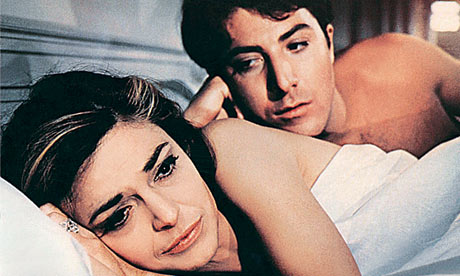
the graduateWith Anne Bancroft in The Graduate. Photograph: Allstar/Cinetext/EmbassyHoffman was born in Los Angeles to Jewish parents – his mother, Lillian, was a part-time actress and jazz pianist, and his father, Harry, dug ditches, worked as a props man in a film studio, was made redundant the day Dustin was born, became a small businessman, went bankrupt and ended up selling furniture. “We had cornflakes for dinner a lot,” he has said. When Hoffman starred in Death Of A Salesman, he based his Willy Loman on his father. Young Dustin was a talented musician and Lillian wanted him to train as a classical pianist, but he preferred jazz, changed class, and soon decided he wasn’t good enough to make it.
Hoffman wasn’t a great student, didn’t get the grades to go to university, and took up drama at junior college only because a friend told him, “They don’t flunk you, it’s like gym, nobody gets an F.” He took to acting immediately, saying it was “the first thing I ever did that wasn’t painful”. He went on to study in LA at the Pasadena Playhouse alongside Gene Hackman. He moved to New York in the 1950s, shared a flat with Hackman and Robert Duvall, studied under Lee Strasberg, did any number of odd jobs (attendant in a psychiatric hospital, waiter, dishwasher, typist, coat-man in a theatre, Times Square headline crier during a newspaper strike, Macy’s toy salesman) and worked whenever he could in theatre. But he was still drowning in uncertainties. He compared his acne-ravaged face to a rifle range, he suffered from polyps, his mouth was wired with a brace and he was short. Yes, he thought he could just about make a living from acting, but that was all.

Did he think he was leading man material when he started out? “Oh my God no. My God no. You’re told what you are.” When he said he wanted to act, his aunt Pearl said he wasn’t good-looking enough. What did casting directors tell him? “I was told I was a character juvenile.” A character Jew or juvenile? He grins. “That’s what I mean. That’s the code. You’re the funny-looking Jew that’s alongside Robert Redford.” Did you want to be Redford? “Before I even thought about acting, I saw Rebel Without A Cause and I wanted to be James Dean.” Why not Brando? “Brando was the icon. You had to be an idiot to think you could be Brando. Dean, you could buy a red jacket and look in the mirror. In the second year of acting class, I said to myself if I looked like James Dean, I could make it; that’s the only thing stopping me.”

He seems so plagued by doubt that I’m surprised he’s so opinionated on set. Not really, he says, it’s all of a piece – knowing there are options, striving for perfection. “I don’t ever think there is just one way to do a scene.” Ah, retakes. Hoffman is always demanding them, and he knows just how difficult that can be for film-makers. “There’s nothing more insulting to a director than for them to be satisfied and want to move on, and for you to say, ‘No, it’s not good enough; we can do better.'”

Hoffman divides directors into two types. “Those who want to be surprised and those who don’t. You can tell the directors who don’t want to be surprised, because you see them mouthing the words while the scene is going on. And you know you’re in deep trouble. He’s shot it already in his head. He doesn’t want any other intonation.”

Is his reputation for being hard work deserved? “The media are lazy. It becomes the truth if you repeat it over and over.” So is he difficult? He uhms and ahs. “There are a few directors I’ve worked with where we’ve clashed, but they are certainly in the minority. Some of those directors have been very verbal about it. I don’t do that. I think it’s immoral, cowardly, to wash your dirty linen in public. So I don’t answer them in print.” Well, not often. “There are directors I’ve fought with where the film has turned out to be very, very good.” Sydney Pollack, who directed Tootsie, for example? “That’s one. Basically, Sydney was not a collaborative director. He was a very good director, but he was the arsonist and the fire chief, and only he knew how to put out the fire. It’s too bad, because there are directors who would rather fail in a film they could say was completely their own than collaborate and share the victory. It’s an interesting phenomenon. And there are directors who aren’t like that. Barry Levinson, for example, is extremely collaborative.”

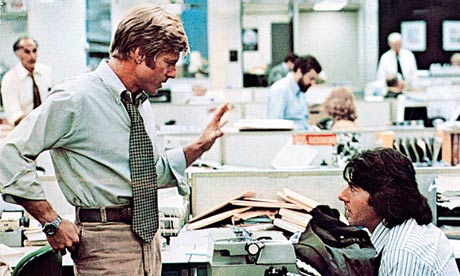
all the president's menWith Robert Redford in All The President’s Men. Photograph: Ronald Grant ArchiveHe’s still thinking about his reputation. “I was the ‘difficult actor’. That was the word, ‘difficult’.” Actually, he says, the more he thinks about it, the more ridiculous it seems. “I live in a community where there are much more objectionable things being done than disagreeing with a director. I mean, Jack Nicholson threw a television set at Roman Polanski, Bill Murray picked up the producer and threw her in the water, and Gene Hackman would throw a director from one end of the room to another, and I always thought, why have I got this reputation…”

You never threw a director? He looks down at himself, then at me. “No, I’m Jewish! Jews usually do it by negotiation. Hehehe!” OK, we’ll set the record straight; you’re not violent or nasty, just slightly verbal. He gives me another look. “Slightly verbal? I don’t know what slightly verbal means. If you disagree, you disagree.”

The publicist walks into the room and says time is up. Hoffman looks peeved, tells her we’re enjoying ourselves and we want to go on longer. Ach, he says, the industry has changed – years ago, you could natter for hours on end. Now, they expect you to do interviews in five minutes.

So we talk about the new film, and how he finally banished that demon. Unlike the first time he tried to direct, he doesn’t appear in Quartet. While the film, an adaptation of the Ronald Harwood play, makes the point that old age is not for sissies, it is also a hymn to the human spirit. Conventional and rather old fashioned, what emerges is Hoffman’s ability to get the best out of his starry British cast (Michael Gambon, Billy Connolly, Pauline Collins, Maggie Smith). It’s funny that somebody with your reputation has cast the fearsome Smith in one of the lead roles, I say. Was he scared of her? “I was forewarned.” Of what? “Oh, that she can destroy you if you bullshit her, and I said, ‘Well, that I certainly won’t do.’ And when we met, we sat on a couch and I said to her, ‘I think we both have the same reputation of being hard on directors.’ And she said, ‘Some.’ And I said, ‘Yes, I can say the same thing.’ And she’s brilliant.”

He has said he doesn’t enjoy acting; it’s too intense. Today, he says, he’d adore it if only there didn’t have to be an end result. “I wish we never had to let the film out. I’d love acting if it was just something you went to work at every day. The same with plays: rehearsals are the best fun in the world.”

As a director, this time round he found it easier to let go. “It was a relief to do what most directors don’t do – let an actor come over who was ambivalent about his work and say, ‘Have a look at the monitor, put the earphones on. If you don’t like it, we’ll do it again, but I think we’ve got it.’ Directors don’t let you near the monitor usually, they like to keep you subservient.”

The publicist is back. Time really is up now, she says: he’s got to be somewhere else. Just a bit longer, he says; there’s so much to talk about. So he chats about his second wife, Lisa, whom he married 32 years ago, the pride he takes in his six grown-up kids, his grandchildren, how he likes to spend time in London when he’s not in LA. I ask if Lisa works. He grins. “Oh yeah, and now you have given me an opportunity.” If you want to do me a big favour, he says, give her beauty company a name-check.

That’s bonkers, I say, I can’t just drop it in. Think of a context, he says. He’s sat there, laughing, belly pushed out as far as it will go. And somehow he still looks good for his years. OK, I say, how do you look so young at 75? “Thank you. I use my wife’s skin product… lisahoffmanbeauty.com.” And he’s in stitches.

Meanwhile, the publicist is dragging him to his next appointment. “Go on, ask me your favourite question you haven’t asked.” Earlier this year, newspapers reported that Hoffman had saved a runner’s life after he’d had a heart attack in Hyde Park. “Ha!” he says, hardly saved his life. So what did happen? “He looks as if he’s resting, and then boom! He hits the concrete and his face gets totally bloodied up and I realise something is wrong – his eyes are open, he’s dazed, he can barely breathe, and I just happen to be the one there. So I start yelling out: ‘Do you have 911 here, what’s your equivalent of 911?’ and someone comes over and calls it, and I say, ‘I don’t think you should move him.’ He’s on his side. The paramedics got there within four minutes. It was across the road from the Albert Hall. They come running out, they’ve got the defibrillator, and a portable cardiac thing, they cut open his shirt, they defibrillate him, it’s like clockwork. Then I go out to get the papers the next morning and it says I saved somebody’s life… I was there! That’s all.”

As the publicist ushers him out, he says that the film has been cathartic. “I’ve been in therapy for a number of years,” he says. And that was the focus? “Yes.” How long had he seen the therapist about his inability to direct? “About 10 years.” With a good therapist, he says, you can achieve anything. “You know, I’d like to be in therapy even after I die.” And, with that, he finally agrees to go.

• Quartet is released on 1 January 2013.

December 13, 2012

06 Insecticide regulators ignoring risk to bees, say MPs

Insecticide regulators ignoring risk to bees, say MPs

A parliamentary inquiry has uncovered evidence that links widespread use of neonicotinoid pesticides to decline in bees

Damian blog on bees : Farm tractor spraying insecticide onto green fields

A farm tractor sprays insecticide on to green fields near Lyth Hill, Shropshire. Photograph: Peter Barritt/Alamy

The safety of the world’s most widely used insecticide has been questioned by a parliamentary inquiry, with MPs accusing regulators of “turning a blind eye” to the risk for bees.

A growing body of scientific evidence has linked the widespread use of neonicotinoid pesticides on crops to a serious decline in the bees and other pollinators, which are vital in producing a third of all food. The inquiry has uncovered evidence, apparently ignored by regulators, that the toxic insecticide can build up in soil to levels likely to be lethal to most insects, including the bees that overwinter in soil.

“European regulators seem to have turned a blind eye to data on the danger that one of the world’s biggest selling pesticides could pose to bees and other pollinators,” said Joan Walley MP, chair of the Environmental Audit Committee (EAC). “Evidence seen by the committee raises serious questions about the integrity, transparency and effectiveness of EU pesticides regulation. Data available in the regulators’ own assessment report shows it could be 10 times more persistent in soils than the European safety limit.”

The insecticide in question is called imidacloprid and is manufactured by Bayer. Prof Dave Goulson, an ecologist at the University of Stirling, said: “The data show unequivocally that imidacloprid breaks down very slowly in soil, so that concentrations increase significantly year after year with repeated use, accumulating to concentrations very likely to cause mass mortality in most soil-dwelling animal life.”

The decline of bees has previously been blamed on starvation as meadows and other habitats are ploughed up, and from diseases and parasites, such as the varroa mite. But a flurry of peer-reviewed studies in 2012 have singled out the harmful effects of neonicotinoids, from making bees lose their way home to failing to produce enough queens. The European Food Safety Authority (EFSA), which assesses the risks of pesticides accepted earlier in 2012 that current “simplistic” regulations contain “major weaknesses”. But the UK government has failed to follow countries including France, Germany, Italy and Slovenia in suspending the use of some neonicotinoids, although it has accelerated its research on the issue.

The environment minister Lord De Mauley told the EAC on Wednesday: “The advice to government has been and remains that there are no unacceptable effects. If new work gives rise to a change in advice, we will take it.” He added: “At the moment, I am satisfied that [European regulatory system] is working properly.”

Imidacloprid was first approved for use in the EU in 1991 but was re-evaluated in 2006 with Germany, where Bayer is based, selected to carry out the assessment. Based on six-year trials in the UK done in the 1990s, it concluded that imidacloprid concentrations in the soil built up but reached a plateau. However, as part of the approval process, this report was then assessed by the EFSA, which reached a contradictory conclusion stating that “experts considered a plateau had not been reached”.

Furthermore, EFSA calculated the half-life of the insecticide – the time for half to degrade – in the soil at 1,333 and 1,268 days in the UK trials, performed on winter barley. A half-life of more than a year means annual application of the insecticide can lead to a dangerous build-up in the soil. The EFSA failed to highlight the issue of soil accumulation as an action point or a cause for concern in its report and imidacloprid was re-approved by member states in December 2008.

Julian Little, communications manager at Bayer, said: “The UK study used relatively high levels of treatment and involved six successive years of barley growing; something that is not by any means considered ‘normal’ in the UK. The data derived would be expected to be right at the extreme end of the spectrum of possibilities.” He pointed out other studies conducted at the same time in Germany found a half-life of 182-288 days.

However, other national regulators have reported a very long half-life for imidacloprid, with Canada’s authority recording a half-life “on the order of one to two years” and the US environmental protection agency once extrapolating a half life of 7,000 days. In Australia, the pesticide authority identified a half life of up to 1,400 days. In 2009, the EU introduced a new regulation requiring any plant protection substance approved for use to have a half life of less that 120 days.

Referring to the 2006 report written by German officials, Walley said: “EU rules allowing member states to give the green light to pesticides manufactured in their own countries may now need to be changed.”

Evidence submitted to parliament cites a long list of failings in current regulations. They include that it is only the effects on honeybees that are considered, despite 90% of pollination being performed by different species, such as solitary or bumblebees, hoverflies, butterflies, moths and others. Another is that the regime was set up for pesticide sprays, not systemic chemicals like neonicitinoids that are used to treat seeds. Even the National Farmers Union (NFU), which argues that there is no need for a change of approach to neonicitinoids, told MPs: “It is very well known that the current pesticide risk assessment systems for bees were not developed to assess systemic pesticides.”

December 12, 2012

06 2011 census: key statistics (pdf)

Filed under: economía,Holístico,módulo básico,política — fores @ 12:54 am

2011 census data – key points

England and Wales 2011 census figures on religion, ethnicity, living arrangements and economic activity published – here are the main findings
• 2011 census: key statistics (pdf)

A copy of the 2011 census being posted.

A copy of the 2011 census being posted. Photograph: Graham Turner for the Guardian

The Office for National Statistics released its second set of findings from the 2011 census (pdf) for England and Wales this morning, covering religion, ethnicity, living arrangements and economic activity, among other areas. You can find the full details on our live blog here, but here are the key points:

Population

• Population of England and Wales was 56.1m in 2011.

• Population up 7% since 2001. Population grew in all regions.

• 23.4 million households; 2.4 residents per household.

Religion

• Christians down 13 percentage points to 59%.

• Respondents with no religion up 10 points to 25%.

• Muslim population up from 3% to 5%.

Ethnicity

• White ethnic group down five points to 86%.

• Whites in London 59.8%.

• 80% in England and Wales are white British, down seven points.

• In London white British figure is 45%, down from 58% in 2001.

• Other ethnic groups in England and Wales: Asian (Pakistani, Indian, Bangladeshi, other) 6.8% (2001: 4.4%), black 3.4% (2001: 2.2%), Chinese 0.7% (2001: 0.4%), Arab 0.4% (2001: not listed), other 0.6% (2001: 0.4%).

• 2.2% in England and Wales are mixed race (up from 1.27% in 2001).

• 12% of households had partners or household members of different ethnic groups, three points up from 2001.

Nationality

• 37% of Londoners born in foreign country.

• Figure is 5% for north-east.

• 13% in England and Wales born outside UK.

• Just over half of these arrived in last 10 years.

• India, Poland and Pakistan are top three countries foreign-born people in England and Wales come from.

• 7.4% of people in England and Wales hold non-UK passport.

Language

• In 91% of households, everyone speaks English. In 4% no one speaks English as main language.

Age

• 16% are 65 or over (an increase of 0.9 million).

• 0.8% are 90 or over (up from 0.7%).

• 6% are under five (increase of 406,000 since 2001, although same proportion).

Home ownership

• Number of households with a mortgage falls from 39% to 33%.

• Home ownership (including owning home outright) falls from 69% to 65%.

• Those owning home outright rises from 29% to 31%.

• Private renters rise from 9% to 15%.

• Renting from council drops from 13% to 9%.

• In inner London more people rent than have mortgages (29.2% v 19.4%).

Marriage

• 46.6% are married, down from 50.9% in 2001.

• 0.2% (105,000) in a civil partnership.

Health

• 81% in good or very good health. (Category changed since 2001.)

• 18% have a limiting long-term illness (same figure as 2001).

• 10% say they provide unpaid care for someone with an illness or disability (same figure as 2001).

Education

• 27% have degree-level qualifications; 23% have no qualifications.

Transport

• Number of cars and vans has increased from 11 per 10 households to 12 per 10 households.

• London only region where number of cars and vans is lower than number of households.

  • Print this


« Previous Page — Next Page »

WPMU Theme pack by WPMU-DEV.