Forés @ UVPress


         Universitat de València PRESS -UVPress- weblog for research uses

June 12, 2012

05 Otro rescate bancario

Filed under: economía,future,módulo básico,política — fores @ 4:30 am
OPINIÓN

Otro rescate bancario

Los bancos españoles sí que necesitaban un rescate. España estaba claramente al borde de un “bucle de desgracias”

11 JUN 2012 – 17:24 CET464

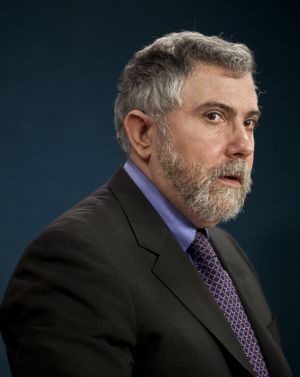
Paul Krugman, premio Nobel de Economía 2008 / Corbis

Vaya, otro rescate bancario, esta vez en España. ¿Quién lo habría imaginado?

La respuesta, por supuesto, es que todo el mundo. De hecho, toda esta historia empieza a parecerse a un manido número de comedia: una vez más la economía se hunde, el paro se dispara, los bancos tienen problemas, los Gobiernos se apresuran a acudir al rescate; pero, por alguna razón, se rescata solo a los bancos, no a los parados.

Para dejar las cosas claras, los bancos españoles sí que necesitaban un rescate. España estaba claramente al borde de un bucle de desgracias; un proceso bien conocido en el que la preocupación por la solvencia de los bancos obliga a los bancos a vender activos, lo cual empuja a la baja el precio de dichos activos, lo cual hace que la gente se preocupe aún más por la solvencia. Los Gobiernos pueden poner fin a esos círculos viciosos con una inyección de capital; en este caso, sin embargo, la propia solvencia del Gobierno de España estaba en duda, de modo que el capital tenía que venir de un fondo europeo más grande.

Así que no hay nada necesariamente malo en este último rescate (aunque muchas cosas dependen de los detalles). Lo que llama la atención, sin embargo, es que al mismo tiempo que los dirigentes europeos acordaban este rescate, estaban enviando señales claras de que no tienen intención de cambiar las políticas que han dejado sin trabajo a casi una cuarta parte de los trabajadores españoles (y a más de la mitad de los jóvenes).

Y lo más curioso: la semana pasada, el Banco Central Europeo se negaba a bajar los tipos de interés. Todo el mundo se esperaba esta decisión, pero eso no debería impedirnos ver el hecho de que es algo tremendamente extraño. El paro se ha disparado en la eurozona y todo indica que el continente se encamina hacia una nueva recesión. Mientras tanto, la inflación se ralentiza y las expectativas del mercado en cuanto a la inflación futura se han hundido. De acuerdo con cualquiera de las normas habituales de la política monetaria, la situación exige una rebaja drástica de los tipos de interés. Pero el banco central se niega.

Y eso ni siquiera tiene en cuenta el riesgo cada vez mayor de un colapso del euro. Durante años, a España y a otros países europeos con problemas se les ha dicho que solo pueden recuperarse mediante una combinación de austeridad fiscal y “devaluación interna”, lo que esencialmente significa rebajar los salarios. Ahora está absolutamente claro que esta estrategia no puede funcionar a menos que haya un crecimiento sólido y, sí, un grado moderado de inflación en el “núcleo” europeo, principalmente en Alemania (lo que da otra razón más para mantener bajos los tipos de interés e imprimir montones de billetes). Pero el banco central se niega.

Mientras tanto, los funcionarios de alto rango afirman que la austeridad y la devaluación interna realmente funcionarían simplemente con que la gente creyese de verdad en su necesidad.

Fíjense, por ejemplo, en lo que Jörg Asmussen, el representante alemán en la junta directiva del Banco Central Europeo, acaba de decir en Letonia, que se ha convertido en el ejemplo perfecto de la austeridad supuestamente exitosa. (Antes lo era Irlanda, pero la economía irlandesa sigue negándose a recuperarse). “La diferencia esencial entre, por ejemplo, Letonia y Grecia”, decía Asmussen, “radica en el grado de apropiación nacional del programa de ajuste, no solo por parte de los responsables políticos, sino también de la propia población”.

Podríamos llamarlo el planteamiento de Darth Vader de la política económica; a todos los efectos, Asmussen está diciéndoles a los griegos: “Vuestra falta de fe me parece preocupante”.

Ah, y ese éxito letón consiste en un año de crecimiento bastante bueno después de un declive económico con categoría de depresión a lo largo de los tres años anteriores. Es verdad que un crecimiento del 5,5% es mucho mejor que nada. Pero merece la pena señalar que la economía de Estados Unidos creció casi el doble (¡el 10,9%!) en 1934, cuando salía de la peor fase de la Gran Depresión. Pero la depresión distaba mucho de haber terminado.

Junten todo esto y tendrán una imagen de una élite política europea siempre dispuesta a entrar en acción para defender a los bancos pero, por lo demás, absolutamente reacia a admitir que sus políticas están fallando a las personas a las que se supone debe servir la economía.

Y nosotros, ¿estamos mucho mejor? La perspectiva a corto plazo de Estados Unidos no es tan sombría como la de Europa, pero los pronósticos de la propia Reserva Federal apuntan a una inflación baja y un paro muy alto en los próximos años (precisamente las circunstancias en las que la Reserva debería estar entrando en acción para estimular la economía). Pero la Reserva Federal se niega.

¿Qué explica esta parálisis transatlántica frente a un continuo desastre humano y económico? Sin duda la política forma parte de la explicación; digan lo que digan, las autoridades de la Reserva Federal se sienten claramente intimidadas por las advertencias de que toda política expansiva será vista como si la Reserva acudiese al rescate del presidente Obama. De modo que también se trata de una mentalidad que ve el sufrimiento económico como una redención, mentalidad que un periodista británico apodó en cierta ocasión “sadomonetarismo”.

Independientemente de cuáles sean las raíces profundas de esta parálisis, está quedando cada vez más claro que hará falta una catástrofe sin paliativos para que haya alguna acción política real que vaya más allá de los rescates bancarios. Pero no desesperen: al paso al que van las cosas, especialmente en Europa, la catástrofe sin paliativos podría estar a la vuelta de la esquina.

Paul Krugman es profesor de Economía de Princeton y Premio Nobel 2008.

(c) New York Times Service 2012. Traducción de News Clips

más información

June 11, 2012

05 Slavoj Žižek: ‘Humanity is OK, but 99% of people are boring idiots’

Slavoj Žižek: ‘Humanity is OK, but 99% of people are boring idiots’

A genius with the answers to the financial crisis? Or the Borat of philosophy? The cultural theorist talks about love, sex and why nothing is ever what it appears to be

  • Slavoj Žižek at his home in Lubljana.


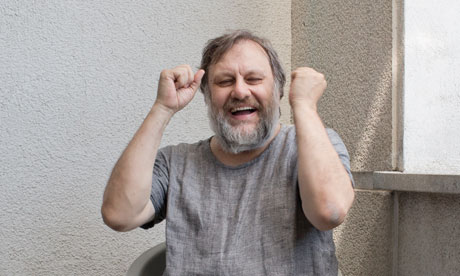
    Slavoj Žižek at his home in Lubljana. Photograph: David Levene for the Guardian


    Less Than Nothing: Hegel and the Shadow of Dialectical Materialism by Slavoj Zizek

    Waving the photographer off, he points in the distance across the Slovenian capital. “Over there, that’s a kind of counter-culture establishment – they hate me, I hate them. This is the type of leftists that I hate. Radical leftists whose fathers are all very rich.” Most of the other buildings, he adds, are government ministries. “I hate it.” Now he’s back in the living room, a clinically tidy little sliver of functional space lacking any discernible aesthetic, the only concessions being a poster for the video game Call Of Duty: Black Ops, and a print of Joseph Stalin. Žižek pours Coke Zero into plastic McDonald’s cups decorated in Disney merchandising, but when he opens a kitchen cupboard I see that it’s full of clothes.

    “I live as a madman!” he exclaims, and leads me on a tour of the apartment to demonstrate why his kitchen cabinets contain only clothing. “You see, there’s no room anywhere else!” And indeed, every other room is lined, floor to ceiling, with DVDs and books; volumes of his own 75 works, translated into innumerable languages, fill one room alone.

    If you have read all of Žižek’s work, you are doing better than me. Born in 1949, the Slovenian philosopher and cultural critic grew up under Tito in the former Yugoslavia, where suspicions of dissidence consigned him to academic backwaters. He came to western attention in 1989 with his first book written in English, The Sublime Object of Ideology, a re-reading of Žižek’s great hero Hegel through the perspective of another hero, the psychoanalyst Jacques Lacan. Since then there have been titles such as Living in the End Times, along with films – The Pervert’s Guide To Cinema – and more articles than I can count.

    By the standards of cultural theory, Žižek sits at the more accessible end of the spectrum – but to give you an idea of where that still leaves him, here’s a typical quote from a book called Žižek: A Guide for the Perplexed, intended to render him more comprehensible: “Žižek finds the place for Lacan in Hegel by seeing the Real as the correlate of the self-division and self-doubling within phenomena.”

    At the risk of upsetting Žižek’s fanatical global following, I would say that a lot of his work is impenetrable. But he writes with exhilarating ambition and his central thesis offers a perspective even his critics would have to concede is thought-provoking. In essence, he argues that nothing is ever what it appears, and contradiction is encoded in almost everything. Most of what we think of as radical or subversive – or even simply ethical – doesn’t actually change anything.

    “Like when you buy an organic apple, you’re doing it for ideological reasons, it makes you feel good: ‘I’m doing something for Mother Earth,’ and so on. But in what sense are we engaged? It’s a false engagement. Paradoxically, we do these things to avoid really doing things. It makes you feel good. You recycle, you send £5 a month to some Somali orphan, and you did your duty.” But really, we’ve been tricked into operating safety valves that allow the status quo to survive unchallenged? “Yes, exactly.” The obsession of western liberals with identity politics only distracts from class struggle, and while Žižek doesn’t defend any version of communism ever seen in practice, he remains what he calls a “complicated Marxist” with revolutionary ideals.

    To his critics, as one memorably put it, he is the Borat of philosophy, churning out ever more outrageous statements for scandalous effect. “The problem with Hitler was that he was not violent enough,” for example, or “I am not human. I am a monster.” Some dismiss him as a silly controversialist; others fear him as an agitator for neo-Marxist totalitarianism. But since the financial crisis he has been elevated to the status of a global-recession celebrity, drawing crowds of adoring followers who revere him as an intellectual genius. His popularity is just the sort of paradox Žižek delights in because if it were down to him, he says, he would rather not talk to anyone.

    You wouldn’t guess so from the energetic flurry of good manners with which he welcomes us, but he’s quick to clarify that his attentiveness is just camouflage for misanthropy. “For me, the idea of hell is the American type of parties. Or, when they ask me to give a talk, and they say something like, ‘After the talk there will just be a small reception’ – I know this is hell. This means all the frustrated idiots, who are not able to ask you a question at the end of the talk, come to you and, usually, they start: ‘Professor Žižek, I know you must be tired, but …’ Well, fuck you. If you know that I am tired, why are you asking me? I’m really more and more becoming Stalinist. Liberals always say about totalitarians that they like humanity, as such, but they have no empathy for concrete people, no? OK, that fits me perfectly. Humanity? Yes, it’s OK – some great talks, some great arts. Concrete people? No, 99% are boring idiots.”

    Most of all, he can’t stand students. “Absolutely. I was shocked, for example, once, a student approached me in the US, when I was still teaching a class – which I will never do again – and he told me: ‘You know, professor, it interested me what you were saying yesterday, and I thought, I don’t know what my paper should be about. Could you please give me some more thoughts and then maybe some idea will pop up.’ Fuck him! Who I am to do that?”

    Žižek has had to quit most of his teaching posts in Europe and America, to get away from these intolerable students. “I especially hate when they come to me with personal problems. My standard line is: ‘Look at me, look at my tics, don’t you see that I’m mad? How can you even think about asking a mad man like me to help you in personal problems, no?'” You can see what he means, for Žižek cuts a fairly startling physical figure – like a grizzly bear, pawing wildly at his face, sniffing and snuffling and gesticulating between every syllable. “But it doesn’t work! They still trust me. And I hate this because – this is what I don’t like about American society – I don’t like this openness, like when you meet a guy for the first time, and he’s starting to tell you about his sex life. I hate this, I hate this!”

    I have to laugh at this, because Žižek brings up his sex life within moments of our first meeting. On the way up in the lift he volunteers that a former girlfriend used to ask him for what he called “consensual rape”. I had imagined he would want to discuss his new book about Hegel, but what he really seems keen to talk about is sex.

    “Yeah, because I’m extremely romantic here. You know what is my fear? This postmodern, permissive, pragmatic etiquette towards sex. It’s horrible. They claim sex is healthy; it’s good for the heart, for blood circulation, it relaxes you. They even go into how kissing is also good because it develops the muscles here – this is horrible, my God!” He’s appalled by the promise of dating agencies to “outsource” the risk of romance. “It’s no longer that absolute passion. I like this idea of sex as part of love, you know: ‘I’m ready to sell my mother into slavery just to fuck you for ever.’ There is something nice, transcendent, about it. I remain incurably romantic.”

    I keep thinking I should try to intervene with a question, but he’s off again. “I have strange limits. I am very – OK, another detail, fuck it. I was never able to do – even if a woman wanted it – annal sex.” Annal sex? “Ah, anal sex. You know why not? Because I couldn’t convince myself that she really likes it. I always had this suspicion, what if she only pretends, to make herself more attractive to me? It’s the same thing for fellatio; I was never able to finish into the woman’s mouth, because again, my idea is, this is not exactly the most tasteful fluid. What if she’s only pretending?”

    He can count the number of women he has slept with on his hands, because he finds the whole business so nerve-racking. “I cannot have one-night stands. I envy people who can do it; it would be wonderful. I feel nice, let’s go, bang-bang – yes! But for me, it’s something so ridiculously intimate – like, my God, it’s horrible to be naked in front of another person, you know? If the other one is evil with a remark – ‘Ha ha, your stomach,’ or whatever – everything can be ruined, you know?” Besides, he can’t sleep with anyone unless he believes they might stay together for ever. “All my relationships – this is why they are very few – were damned from the perspective of eternity. What I mean with this clumsy term is, maybe they will last.”

    But Žižek has been divorced three times. How has he coped with that? “Ah, now I will tell you. You know the young Marx – I don’t idealise Marx, he was a nasty guy, personally – but he has a wonderful logic. He says: ‘You don’t simply dissolve marriage; divorce means that you retroactively establish that the love was not the true love.’ When love goes away, you retroactively establish that it wasn’t even true love.” Is that what he did? “Yes! I erase it totally. I don’t only believe that I’m no longer in love. I believe I never was.”

    As if to illustrate this, he glances at his watch; his 12-year-old son, who lives nearby, will be arriving shortly. How is this going to work when he gets here? Don’t worry, Žižek says, he’s bound to be late – on account of the tardiness of his mother: “The bitch who claims to have been my wife.” But weren’t they married? “Unfortunately, yes.”

    Žižek has two sons – the other is in his 30s – but never wanted to be a parent. “I will tell you the formula why I love my two sons. This is my liberal, compassionate side. I cannot resist it, when I see someone hurt, vulnerable and so on. So precisely when the son was not fully wanted, this made me want to love him even more.”

    By now I can see we’re not going to get anywhere near Žižek’s new book about Hegel, Less Than Nothing: Hegel and the Shadow of Dialectical Materialism. Instead, he tells me about the holidays he takes with his young son. The last one was to the Burj Al Arab hotel, a grotesque temple to tacky ostentation in Dubai. “Why not? Why not? I like to do crazy things. But I did my Marxist duty. I got friendly with the Pakistani taxi driver who showed to me and my son reality. The whole structure of how the workers there live was explained, how it was controlled. My son was horrified.” This summer they are off to Singapore, to an artificial island with swimming pools built on top of 50-storey skyscrapers. “So we can swim there and look down on the city: ‘Ha ha, fuck you.’ That’s what I like to do – totally crazy things.” It wasn’t so much fun when his son was younger. “But now, we have a certain rhythm established. We sleep ’til one, then we go to breakfast, then we go to the city – no culture, just consumerism or some stupid things like this – then we go back for dinner, then we go to a movie theatre, then we play games ’til three in the morning.”

    I wonder what all Žižek’s earnest young followers will make of this, and worry they will be cross with me for not getting anything more serious out of him. But to Žižek, Dubai tells us just as much about the world as a debate about the deficit, say, ever can. When his sweet-looking, polite young son arrives, I try to steer Žižek on to the financial crisis, and to the role his admirers hope he will play in formulating a radical response.

    “I always emphasise: don’t expect this from me. I don’t think that the task of a guy like me is to propose complete solutions. When people ask me what to do with the economy, what the hell do I know? I think the task of people like me is not to provide answers but to ask the right questions.” He’s not against democracy, per se, he just thinks our democratic institutions are no longer capable of controlling global capitalism. “Nice consensual incremental reforms may work, possibly, at a local level.” But localism belongs in the same category as organic apples, and recycling. “It’s done to make you feel good. But the big question today is how to organise to act globally, at an immense international level, without regressing to some authoritarian rule.”

    How will that happen? “I’m a pessimist in the sense that we are approaching dangerous times. But I’m an optimist for exactly the same reason. Pessimism means things are getting messy. Optimism means these are precisely the times when change is possible.” And what are the chances that things won’t change? “Ah, if this happens then we are slowly approaching a new apartheid authoritarian society. It will not be – I must underline this – the old stupid authoritarianism. This will be a new form, still consumerist.” The whole world will look like Dubai? “Yes, and in Dubai, you know, the other side are literally slaves.”

    There is something inexplicably touching about all Žižek’s mischievous bombast. I hadn’t expected him to be so likable, but he really is hilariously good company. I had hoped to find out if he was a genius or a lunatic – but I fear I leave none the wiser. I ask him how seriously he would recommend we take him, and he says he would rather be feared than taken for a clown. “Most people think I’m making jokes, exaggerating – but no, I’m not. It’s not that. First I tell jokes, then I’m serious. No, the art is to bring the serious message into the forum of jokes.”

    Two years ago his front teeth came out. “My son knows I have a good friend; none of us is gay, just good friends. So when he saw me without teeth, he said: ‘I know why.’ My son! He was 10! You know what he told me? Think, associate, in the dirtiest way.” I think I can guess. “Yes! Sucking! He said my friend complained that my teeth were in the way.” Žižek roars with laughter, great gales of paternal pride.

    “And you know what was tragicomic? After he told me this, he said: ‘Father, did I tell this joke well?'”

    A 24-hour launch event for Less Than Nothing takes place on 15 June at Cafe Oto, London.
June 10, 2012

05 Rebel US nuns in showdown with Rome over women’s role

Filed under: archivo personal,future,Holístico,módulo básico — fores @ 4:46 pm

De nuevo ataca la Santa Inquisición. Esta vez contra las monjas por ‘feministas radicales’. Traducido al castellano se han permitido usar su propio cerebro, han desarrollado opiniones propias y no aceptan la autoridad castrada, castradora y reprimida de la santa inquisición. Terrible pecado inducido por la famosa lascivia de las monjas que se dejan seducir por el diablo.


Rebel US nuns in showdown with Rome over women’s role

Catholic church in US divided after Rome seeks to crack down on ‘radical feminism’

  • in Rome
  • guardian.co.uk, Saturday 9 June 2012 10.52 EDT
  • Comments (72)
  • Cardinal William Levada

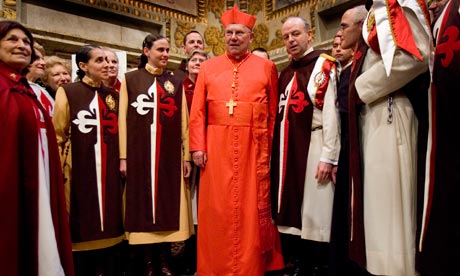
    Cardinal William Levada, centre, will meet with Sister Pat Farrell in Rome. Photograph: Alessandra Benedetti

    She is the American nun who after 15 years spent working with war refugees in El Salvador now leads the majority of the 57,000 Catholic sisters in the US. He is the American cardinal who marched in San Francisco protesting against gay marriage and was accused of turning a blind eye to paedophile priests before he took over the Vatican‘s doctrinal office, the modern version of the Inquisition.

    On Tuesday, Pat Farrell and William Levada will clash in Rome at the climax of a raging row over what Catholicism means for women. It will be a confrontation that pits America’s increasingly independent and broad-minded nuns against the Vatican’s male guardians of the faith. “Pat Farrell knows it will be daunting, but she sees the importance of this meeting for the whole Catholic community,” said her spokeswoman, Sister Annmarie Sanders.

    The showdown follows the claim by Levada’s department that Farrell’s Leadership Conference of Women Religious, the umbrella organisation for most US orders, has been promoting “radical feminism” and glossing over the Vatican’s hard line on gay marriage and abortion.

    To set the sisters straight, Levada plans to send an archbishop to rewrite the group’s statute and institute re-education programmes to combat heterodox thinking. The reaction from Farrell, the group’s president, was swift, denouncing the Vatican move as causing “pain and scandal”. “We’re all hurt by this,” she told the National Catholic Reporter.

    “Nuns accusing the Vatican of causing scandal is nothing short of incredible,” said US priest Father Jim Martin, who organised a Twitter drive defending the sisters. The Levada report follows an “apostolic visitation” to US orders to check on nuns’ “quality of life”.

    “A lot of nuns are now in their 70s and it is demoralising to them that the Vatican should be asking them how often they pray. It’s like investigating your grandmother,” said Martin. As American Catholicism recovered from paedophile scandals that scared off believers and crippled the church with lawsuits, nuns were “the glue that keeps the church together in the US”, he said.

    Americans have been quick to back the nuns with protest vigils outside churches and a 50,000-strong petition, while seven groups of US Franciscan friars denounced the Vatican crackdown as “excessive”. “The support has shown the sisters are valued in ways they didn’t even know,” said Sanders.

    But few expect Farrell, who will be accompanied by the leadership conference’s executive director, Sister Janet Mock, to change Levada’s mind. “Nuns are lay people. They take vows of poverty and chastity, but they are not ordained, which is why they have no power,” said Kenneth Briggs, author of Double Crossed: Uncovering the Catholic Church’s Betrayal of American Nuns. “They are between a rock and a hard place.” A Vatican spokesman insisted that Rome was merely helping the nuns. “It’s not a standoff,” he said.

    Farrell will report back to the leadership conference assembly in August and has not ruled out severing ties between the group and Rome. “The option is always there,” said Farrell, who is a member of the Sisters of St Francis in Iowa, an order founded in Germany in 1864 to care for orphans and the elderly.

    Levada, a former archbishop of San Francisco, has shrugged off doubts about his record over catching abusive priests to become head of Congregation for the Doctrine of the Faith, making him the most powerful American at the Vatican. He has a habit of rapping nuns’ knuckles. Last week the congregation condemned Sister Margaret Farley, a professor emeritus of Christian ethics at Yale University, for a book in which she approved of gay marriage and divorce and praised female masturbation. The Vatican said the book treated Catholic doctrine “as one opinion among others”, and took issue with Farley’s claim that “self-pleasuring” could help marriages, calling it instead a “gravely disordered action”.

    “It has become abundantly clear that, particularly in matters related to the pelvic zone, the hierarchy is not interested in exploring questions or engaging in dialogue,” columnist Jamie Manson wrote in the National Catholic Reporter. On Thursday, the 1,500-strong Catholic Theological Society of America also backed Farley against the Vatican.

    The Vatican’s crackdown has a whiff of politics, since many sisters backed Barack Obama’s healthcare plan in the face of opposition from bishops over measures on contraception.

    There were 185,000 nuns in the US in 1965 and conservative orders say the dramatic drop in numbers since is due to the move away from hardline Catholicism. Conservative orders make up about 20% of nuns in America, are more likely to live in convents and wear habits, and are not members of the leadership conference. “The Nashville Dominicans tend to be the model conservative group held up to show how bad the liberals are,” said Briggs. The conflict between liberals and the Vatican has built up since the mid-1960s Second Vatican Council, which handed nuns new freedoms.

    “Many nuns stopped wearing habits and moved out of their convents, going into new professions instead of just teaching and working in hospitals,” said Briggs. “The Vatican handed them freedom, they took it, but then the boys in the office noticed.”

June 7, 2012

05 Nace el Huffington Post en España

Filed under: future,Holístico,módulo básico,política,tecnología — fores @ 5:22 am
BLOGS DESTACADOS
Montserrat Domínguez

Directora Editorial, El Huffington Post

Somos una redacción convencida de que el rigor es compatible con la inmediatez que exige la información online; conscientes de que lo global es tan importante como lo local; sin complejos a la hora de realzar lo mejor que nuestros colegas publican en otros medios, y dispuestos a que nuestro trabajo crezca con la aportación de los lectores. Entren, participen, debatan con nosotros. Porque solo entre todos podremos construir un medio de comunicación nuevo.

Destacados
1 de 2
SuzsBovAY2c%3D
Arianna Huffington

Arianna Huffington, 07/06/12

¡Hola! Estoy encantada de anunciar el lanzamiento de El Huffington Post, una aventura en colaboración con El País que va a aunar la mezcla de noticias, blogs, comunidad y participación social que caracteriza The Huffington Post con la legendaria tradición periodística de El País.

Juan Luis Cebrián

Juan Luis Cebrián, 07/06/12

Consejero delegado y presidente de la Comisión Delegada, PRISA y presidente, El País

Romper el euro es infinitamente más costoso y caro que salvarlo, y la primera víctima de ese proceso sería precisamente quien más aparentemente lo dificulta: la Alemania de Merkel.

María A. Blasco

María A. Blasco, 07/06/12

Directora, Centro Nacional de Investigaciones Oncológicas

Me resulta sorprendente saber que los tests sobre el perfil genético del cáncer no son práctica médica común en España, ya que no están cubiertos ni por la Seguridad Social ni las compañías de seguros médicos.

Alfredo Pérez Rubalcaba

Alfredo Pérez Rubalcaba, 07/06/12

Secretario general, PSOE; exvicepresidente del Gobierno y profesor de Química Orgánica

Uno de los rasgos que definen la actual situación en España es el de una generalizada pérdida de confianza. ¿Ha contribuido Mariano Rajoy a esa pérdida? Son muchas las evidencias de que, en efecto, así ha sido.

Alex de la Iglesia

El Monopoly

Alex de la Iglesia, 07/06/12

Director, productor y guionista de cine

Los que llevan la banca están deseando que caigamos en sus casillas llenas de hoteles. ¿Hay una manera de evitarlo? Podemos y debemos utilizar blogs, Facebook y Twitter como vías de escape.

Leer artículo | Comentarios

June 4, 2012

05 El programa de la austeridad

Filed under: economía,future,Holístico,módulo básico,política — fores @ 4:15 am
OPINIÓN

El programa de la austeridad

Recortar el gasto mientras la economía está en recesión es una estrategia contraproducente

Protestas ante el Parlamento británico contra el presupuesto / Paul Hackett (Reuters)

“El auge económico, y no la crisis, es el momento adecuado para la austeridad”. Eso afirmaba John Maynard Keynes hace 75 años, y tenía razón. Aun cuando se tenga un problema de déficit a largo plazo —¿y quién no lo tiene?—, recortar drásticamente el gasto mientras la economía está profundamente deprimida es una estrategia contraproducente porque no hace más que agravar la depresión.

¿Y por qué el Reino Unido está haciendo exactamente lo que no debería hacer? A diferencia de los Gobiernos de, por ejemplo, España o California, el Gobierno británico puede adquirir préstamos con total libertad a unos tipos de interés más bajos que nunca. Así que, ¿por qué el Gobierno está reduciendo drásticamente la inversión y eliminando cientos de miles de puestos de trabajo en el sector público en vez de esperar a que la economía sea más fuerte?

En los últimos días he planteado esa pregunta a algunos defensores del Gobierno del primer ministro David Cameron, unas veces, en privado, y otras, en la televisión. Y todas esas conversaciones han seguido la misma pauta: han empezado con una mala metáfora y han terminado con la revelación de los motivos ocultos.

La mala metáfora —que seguramente habrán escuchado muchas veces— equipara los problemas de deuda de una economía nacional con los problemas de deuda de una familia individual. Una familia que ha asumido una deuda excesiva, cuenta la historia, debe apretarse el cinturón. De modo que si el Reino Unido en su conjunto ha asumido una deuda excesiva (cosa que ha hecho, aunque es, en su mayoría, deuda privada, más que pública), ¿no debería hacer lo mismo? ¿Qué tiene de malo esta comparación?

Keynes advertía que el auge  era el momento para la austeridad

La respuesta es que una economía no es como una familia endeudada. Nuestra deuda es en su mayoría dinero que nos debemos unos a otros; y lo que es aún más importante, nuestros ingresos provienen principalmente de lo que nos vendemos unos a otros. Sus gastos son mis ingresos y mis gastos son sus ingresos.

¿Y qué pasa si todo el mundo simultáneamente reduce drásticamente el gasto en un intento de pagar lo que debe? La respuesta es que los ingresos de todo el mundo se reducen; mis ingresos disminuyen porque ustedes están gastando menos, y sus ingresos disminuyen porque yo estoy gastando menos. Y, a medida que nuestros ingresos se hunden, nuestro problema de deuda se agrava, no mejora.

Esto no es nada nuevo. El gran economista estadounidense Irving Fisher ya lo explicó allá por 1933, y resumió lo que él llamaba “deflación de la deuda” con el conciso y expresivo eslogan: “Cuanto más pagan los deudores, más deben”. Los acontecimientos recientes, sobre todo la mortal espiral de la austeridad en Europa, han ilustrado de manera trágica la verdad de las ideas de Fisher.

Y hay una moraleja clara en esta historia: cuando el sector privado intenta desesperadamente pagar lo que debe, el sector público debería hacer lo contrario, y gastar cuando el sector privado no puede o no quiere. Desde luego que debemos equilibrar nuestro presupuesto una vez que la economía se haya recuperado, pero no ahora. La expansión, y no la crisis, es el momento adecuado para la austeridad.

Si el sector privado intenta pagar lo que debe, el sector público debería hacer lo contrario

Como ya he dicho, esto no es nada nuevo. Así que ¿por qué tantos políticos insisten en aplicar medidas de austeridad durante la crisis? ¿Y por qué no cambian de estrategia ni siquiera cuando la experiencia confirma las lecciones de la teoría y la historia?

Bueno, aquí es donde la cosa se pone interesante. Porque cuando uno presiona a los defensores de la austeridad haciéndoles ver lo malo de su metáfora, casi siempre se refugian en afirmaciones como: “Pero es esencial que reduzcamos el tamaño del Estado”.

Ahora bien, estas afirmaciones suelen ir acompañadas de aseveraciones sobre que la propia crisis económica demuestra la necesidad de reducir el Estado. Pero eso es manifiestamente falso. Fíjense en los países europeos que han capeado mejor el temporal y, en lo alto de la lista, encontrarán naciones con grandes Estados como Suecia o Austria.

Y si se fijan, por otro lado, en los conservadores del país admirados antes de la crisis, encontrarán que George Osborne, ministro de Economía y Hacienda del Reino Unido y arquitecto de la actual política económica del país, describe Irlanda como “un magnífico ejemplo del arte de lo posible”. Mientras tanto, el Instituto Cato elogia los bajos impuestos de Islandia y espera que otros países industrializados “aprendan del éxito de Islandia”.

Así que la defensa de la austeridad en el Reino Unido no tiene en realidad nada que ver con los déficits; tiene que ver con usar el pánico al déficit como excusa para desmantelar programas sociales. Y esto es, por supuesto, exactamente lo mismo que ha estado pasando en EE UU.

Para ser justos con los conservadores del Reino Unido, no son tan toscos como sus homólogos estadounidenses. No claman contra los males de los déficits para, acto seguido, exigir enormes reducciones de impuestos para los ricos (aunque, de hecho, el Gobierno de Cameron ha rebajado considerablemente los tipos impositivos más altos). Y, en general, parecen menos decididos que la derecha estadounidense a ayudar a los ricos y castigar a los pobres. Aun así, la dirección de la política es la misma; y también la esencial falta de sinceridad de los llamamientos a favor de la austeridad.

La gran pregunta aquí es si la evidente incapacidad de la austeridad para producir una recuperación económica conducirá a un plan B. Es posible. Pero sospecho que, aun cuando se anuncie dicho plan, no supondrá gran cosa. Porque la recuperación económica nunca ha sido el objetivo; la defensa de la austeridad siempre ha pretendido utilizar la crisis, no resolverla. Y sigue siendo así. J

Paul Krugman es profesor de Economía de Princeton y Premio Nobel 2008.

(c) New York Times Service 2012.

Traducción de News Clips.

« Previous Page — Next Page »

WPMU Theme pack by WPMU-DEV.