Forés @ UVPress


         Universitat de València PRESS -UVPress- weblog for research uses

March 12, 2012

05 Doonesbury strip on Texas abortion law dropped by some US newspapers

Filed under: archivo personal,Holístico,módulo básico,política — fores @ 5:34 pm

Doonesbury strip on Texas abortion law dropped by some US newspapers

Several papers decline to use cartoon strip, which depicts state-required sonograms as Republican-approved rape

  • in Washington
  • guardian.co.uk, Sunday 11 March 2012 15.11 EDT
  • Article history
  • Doonesbury cartoon

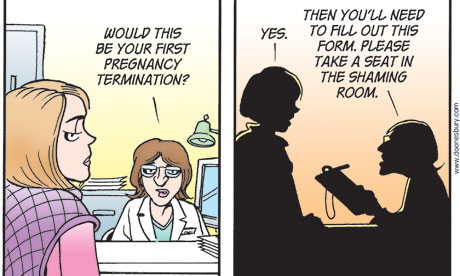
    Part of the strip which has been rejected by several papers. Photograph: Doonesbury

    Doonesbury cartoonist Garry Trudeau has defended his cartoon strip about abortion, which several US newspapers are refusing to run, saying he felt compelled to respond to the way Republicans across America are undermining women’s healthcare rights.

    The strip, published on Monday and scheduled to run all week, has been rejected by several papers, while others said they were switching it from the comic section to the editorial page.

    In an email exchange with the Guardian, Trudeau expressed dismay over the papers’ decision but was unrepentant, describing as “appalling” and “insane” Republican state moves on women’s healthcare.

    About 1,400 newspapers, including the Guardian, take the Doonesbury cartoon. The Guardian newspaper is running the cartoon as normal on Monday.

    The strip deals specifically with a law introduced in Texas and other states requiring a woman who wants to have an abortion to have an ultrasound scan, or sonogram, which will show an image of the foetus and other details, in an attempt to make her reconsider.

    It portrays a woman who turns up at an abortion clinic in Texas and is told to take a seat in “the shaming room”. A state legislator asks if she has been at the clinic before and, when she says she had been to get contraceptives, he replies: “Do your parents know you’re a slut?”

    Later, she says she does not want an intrusive vaginal examination but is told by a nurse: “The male Republicans who run Texas require that all abortion seekers be examined with a 10-inch shaming wand.” The nurse adds: “By the authority invested in me by the GOP base, I thee rape.”

    The Kansas City Star is among the papers not running the cartoon in its normal slot. “We felt the content was too much for many of the readers of our family-friendly comic page,” an editor told Associated Press. The Star will use a replacement strip offered by the organisation that syndicates Doonesbury, Universal Uclick, and move the abortion one to its editorial pages.

    Sue Roush, managing editor of Universal Uclick, said: “I can’t say how many papers will choose ultimately to run or not run the series, but we’ve had inquiries from 30 to 40 papers asking about the substitutes.”

    Abortion, contraception and other social issues have resurfaced in politics in recent weeks, partly because they have been highlighted by the Republican candidates in the presidential race. Conservative talk-show host Rush Limbaugh referred to a student giving evidence to a congressional hearing in support of contraception as “a slut”.

    Trudeau told the Guardian he thought the issue of reproductive freedom had been settled while he had still been at school: the supreme court 1973 ruling Roe v Wade, which removed restrictions on abortion.

    Trudeau wrote: “Ninety-nine percent of American women have or will use contraception during their lifetimes. To see these healthcare rights systematically undermined in state after state by the party of ‘limited government’ is appalling. “In Texas, the sonograms are the least of it. The legislature has also defunded women’s health clinics all over the state, leaving 300,000 women without the contraceptive services that prevent abortions in the first place. Insanity.”

    Trudeau is dismayed by the newspaper reaction. “I write the strip to be read, not removed. And as a practical matter, many more people will see it in the comics page than on the editorial page,” he wrote.

    “I don’t mean to be disingenuous. Obviously there’s some profit to controversy, especially for a satirist. If debate is swirling around a particular strip, and if its absence creates blowback, then I’m contributing to the public conversation in a more powerful way. But I don’t get up in the morning and scheme about how to antagonise editors. Some of these folks have supported me for decades.”

    Asked about the use of the word “rape” to describe what was happening to women seeking abortions in Texas, he said it was perfectly apt for the compulsory insertion of an object into the vulva. “That falls within the legal definition of rape. Coercion need not be physically violent to meet the threshold. Many people here are now referring to trans-vaginal sonograms as ‘state rape’. That seems about right to me,” he wrote.

    “However, if you just mean the topic of rape generally, it’s not something I would avoid simply because I work on a page where children can occasionally be found. People know what to expect in Doonesbury. Certainly children do, which is why they never read it. And editors have long known what they’re getting; I first wrote about rape in the late ’70s, devoting an entire week to a mock rape trial.”

    The Texas governor Rick Perry, who dropped out of the Republican presidential candidates race in January, signed the abortion measure into law in May 2010.

    His press spokeswoman, Catherine Frazier, asked about the Doonesbury strip, said: “The decision to end a life is not funny. There is nothing comic about this tasteless interpretation of legislation we have passed in Texas to ensure that women have all the facts when making a life-ending decision.”

March 11, 2012

05 After Kony, could a viral video change the world?

After Kony, could a viral video change the world?

The startling global success of family films and homemade pastiches on YouTube demonstrate its global reach. Now a viral campaign against the Ugandan warlord Joseph Kony foreshadows how that power could be turned to political ends

  • Kony 2012 videograb

    Kony 2012, the video campaign raising awareness about child soldiers in Uganda, is a world away from previous YouTube hits involving children, animals and popular-culture pastiche.

    The mainstream media were transfixed last week by a meme – an infectious idea. Hard-bitten news editors – the professionals who pride themselves on knowing what will happen before it happens – were discomfited to discover that their teenage kids knew something they didn’t know. That something was a YouTube video that had been spreading at an astonishing rate. Entitled Kony 2012, it is a 30-minute film made by a campaigning organisation called Invisible Children.

    Its goal was to raise awareness of the activities of Joseph Kony, a Ugandan warlord who leads the Lord’s Resistance Army, in the hope of bringing him to justice. Kony and his LRA are distinguished by their violence and brutality, their weird ideology and – crucially for the purposes of the video – their practice of abducting children and turning them into child soldiers. This last practice has led to the bizarre phenomenon of “night commuting”, in which Ugandan children leave their villages at night in order to sleep in towns, where they are supposedly less vulnerable to kidnapping by Kony and his goons.

    Invisible Children is a US-based campaigning group, founded in 2004 by film-makers, which has been working in Uganda – building radio networks, monitoring LRA movements and helping displaced children and families.

    It has focused on raising awareness of the LRA and on influencing US government policy towards the region. It is believed that its campaigning was at least partly responsible for Barack Obama’s decision in 2010 to send 100 military advisers to the Ugandan military to assist in capturing Kony.

    The YouTube video is a brilliant piece of film-making, in two ways. First, it has a compelling, simple narrative: Kony is a really bad guy and his capture will end suffering for the people of northern Uganda. If US viewers do their bit by influencing their politicians, the world’s superpower will take action and Kony will be captured.

    Second, it conveys this message in a seductive way, with film-maker Jason Williams explaining to his five-year-old son that this Kony is a monster and that dad’s job is capturing him. What’s not to like?

    Jason’s message was released last Monday. By Thursday it had amassed 26 million views. When I last looked at it on Saturday it was up to 63 million views (with 1,212,109 “likes” and only 59,702 “dislikes”). So, in the jargon of the day, it’s “gone viral”. In that sense, it represents the most successful manipulation of our new media ecosystem to date because “virality” is what every huckster, politician and advertiser now craves – but very few achieve.

    Viral dissemination has been a feature of the internet almost from the beginning, but the deliberate exploitation of it dates from Independence Day in the US in 1996, when Hotmail was launched by Sabeer Bhatia and Jack Smith. It was the first “webmail” system (allowing people to send and receive email using an internet browser) and its makers had the brilliant idea of appending a footer to every message sent stating that it had been sent by Hotmail and inviting the recipient to “get a free Hotmail account” at www.hotmail.com.

    Viral dissemination received a really powerful boost with the launch of YouTube in 2005. Thereafter, people were able to post striking, amusing or daft videos online and the service made it easy to “share” anything that viewers liked. This is what led to the LOLcat explosion and the astonishing viewing totals for charming videos like Charlie Bit My Finger, which has been watched more than 12 million times since it first appeared in 2007.

    Viral dissemination was also responsible for making Bruno Ganz, the actor who played Adolf Hitler in Downfall, the 2004 film about the last days of Hitler, into the most famous German actor in the world – though in this case the makers of the film came to regard its online notoriety as a mixed blessing as parodies of one of its climactic scenes started to spread virally across the network.

    According to YouTube, 60 hours of video material are uploaded to it every minute – an hour a second. In the midst of such abundance, how can anything get noticed? Attention is now the scarcest commodity in cyberspace – which explains why virality is so craved by those with things to sell or messages to transmit. In that sense, the most significant thing about the Kony video is that it represents the most successful exploitation of virality to date. But when you delve deeper, it turns out that its success owes something to network theory as well as to storytelling craft.

    Many years ago, the Stanford sociologist Mark Granovetter published a seminal article in the American Journal of Sociology on the special role of “weak ties” in networks – links among people who are not closely bonded – as being critical for spreading ideas and for helping people join together for action.

    An examination of the spread of the Kony video suggests that one weak tie in particular may have been critical in launching it to its present eminence. Her name is Oprah Winfrey and she tweeted: “Have watched the film. Had them on show last year” on 6 March, after which the graph of YouTube views of the video switches to the trajectory of a bat out of hell. Winfrey, it turns out, has 9.7 million followers on Twitter.

    The Kony video and the assumptions behind it have been subjected to searching criticism by scholars like Ethan Zuckerman, who have challenged its simplistic analysis of a complex country and its ideological biases – for example its implicit assumption that Africans are hopeless and that the only solutions to their problems can come from white foreigners. Some have suggested that the Ugandan president, Yoweri Museveni, is no angel either. And there has been a fierce online debate about the ethical dilemmas of viral transmission.

    “Kony is like a Rorschach test on to which we inscribe our own simplistically naive ethical calculus,” wrote one commentator. Others observe that “sharing” the video gives people the opportunity of salving their consciences without doing anything serious about the problem of northern Uganda. And so on.

    The dissemination of the Kony meme does raise interesting questions for the future. It’s the most dramatic demonstration so far of how an idea can spread over the globe via a channel that is beyond the reach and control of established media outlets. YouTube can’t compete with conventional broadcasting at reaching billions of people instantaneously. But it operates outside the control of conventional gatekeepers and editorial sieves. And a third of the world’s population now uses the internet, so the video could, in time, reach an awful lot of people.

    And what about truth, lies and propaganda? The Kony video was made by people whose intentions seem good, even if their ideology and analysis may be a touch simplistic. But what if a video with more sinister antecedents were to get this kind of viral boost? It suggests the old saying that “a lie can run round the world before the truth has got its boots on” is acquiring a chilling new resonance.

    The really interesting question, though, is whether this kind of development will further ratchet up the pressure on democratic politicians. The last two decades have shown how 24/7 media coverage of foreign atrocities can lead western leaders to morally driven interventionism.

    There comes a point when the shouting that “something must be done” can no longer be ignored. We saw this in Kosovo and Libya and we are now hearing it about Syria. If the Kony video does lead to increased US pressure on the Ugandan regime to catch the LRA leader then we’ll know that the era of network power has finally arrived. But I wouldn’t bet on it.

    John Naughton’s book From Gutenberg to Zuckerberg: What You Really Need to Know about the Internet has recently been published by Quercus Books

March 10, 2012

05 Passion vs puritanism as America is gripped by a war over sexuality

Filed under: economía,future,interesting news,módulo básico — fores @ 8:03 pm
The Guardian home
The Observer home

Passion vs puritanism as America is gripped by a war over sexuality

US politics is overshadowed by bitter debates over sexual politics, from abortion to contraception and personal morality. But it is not just rightwingers who fear the increasing sexualisation of society.

  • in New York
  • guardian.co.uk, Saturday 10 March 2012 11.26 EST
  • Article history
  • Sandra Fluke

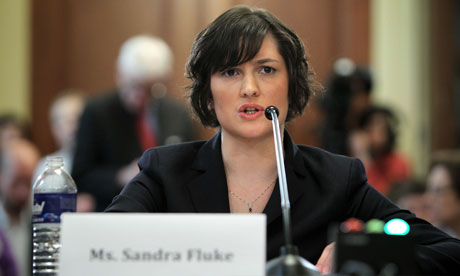
    Sandra Fluke’s testimony to Congress on contraception brought a vitriolic response from radio shock jock Ross Limbaugh. Photograph: Alex Wong/Getty Images

    Dr Marty Klein pulled no punches when it came to what he thought of the ferocious debate in America over contraception. As the nation’s political classes veer between condemning government funding for birth control and defending it as a basic women’s right, the California sex therapist and author of America’s War on Sex bluntly said his country was on a perilous path.

    “America has entered a new dark age where people are proud of their ignorance,” he told the Observer. “The US is careering towards a society that is reshaping women’s reproductive rights. It used to be abortion. Now it’s contraception. How can contraception be a battleground? It is crazy.”

    That might be so, but the spat is white hot and part of a much larger argument. Only last week protests broke out in Texas, Arizona, Utah, Georgia and Alabama that all involved some aspects of sex and sexuality. In Utah, it was over the passing of a law that means the only sex education children will get in school will be about abstinence. In Texas, it was about cuts to health insurance that covers birth control. In Georgia, eight of the nine women in the state senate walked out over a bill that attacked abortion rights.

    Barely a day has gone by in recent weeks without some fresh fight breaking out over sexual politics. The most fierce was over radio shock jock Rush Limbaugh‘s comments on Georgetown University law student Sandra Fluke, who had testified in Congress on the importance of government funding for birth control. Limbaugh told millions of conservative listeners that this made Fluke a “slut” and “prostitute”.

    He said: “If we are going to pay for your contraceptives and thus pay for you to have sex, we want something. We want you to post the videos online so we can all watch.” The comments sparked outrage, triggered an advertiser boycott of Limbaugh’s show and dragged in all the Republican nomination candidates and Barack Obama.

    Limbaugh apologised, but many liberals saw it as a sign of the powerful forces on the right determined to undo decades of advancement in sex and women’s rights. Few people symbolise that more than former Pennsylvania senator Rick Santorum, who is now the main challenger to Mitt Romney for the Republican presidential nomination.

    A devout Catholic and hardened culture warrior, Santorum is a hero to conservatives for his hardline views on abortion and contraception. For Nancy Cohen, author of the current hit book Delirium: How the Sexual Counter-Revolution is Polarising America, Santorum’s rise is the inevitable result of decades of backlash against 1960s sexual liberation. “It is insanity to be having this conversation in our politics when you are a world power. The rest of the world is watching with their jaws agape,” she said.

    But the image of America gripped by a fervent new puritanism is not the full picture. Any survey of the wider cultural landscape reveals sex has never been more prevalent in American life. On television and in movies sex is everywhere.

    Reality shows like The Jersey Shore show their cast members coupling with each other and random strangers. Stars such as Paris Hilton and Kim Kardashian, built lucrative businesses on the back of sex tapes. Gossip websites debate the sex lives of celebrities with a prurient detail that would shock even the most infamous of scandal rags from Hollywood in the 1930s, and they do it for an audience online of millions.

    Sex sells like never before, even for the most tangential of products. In sport there is even a Lingerie Football League, whose female players done skimpy outfits and teams have names like the Los Angeles Temptation.

    The American sex industry is said to be worth more than $12bn a year. Recent regulations in California aimed at ensuring all porn actors have to use condoms saw protests that such a law would see the industry relocate, with a resultant loss of jobs and taxes. At the same time porn actor James Deen has been cast as the lead in a new Hollywood film The Canyons. Deen has now become such a popular porn star – especially with young women – that he was the subject of a segment on ABC’s headline news show Nightline.

    In fact, sexual freedom in America has gone so far that conservatives are not the only ones wringing their hands. The sexualisation of young girls – such as Bratz dolls with their bee-stung lips and short skirts – has outraged liberals and feminists, as has the growth of a casual “hook up” culture on American college campuses. Even Klein admits that – sexually speaking – Americans have never been so inventive. “The range of things that people do in their bedrooms is without doubt getting broader and the entertainment options around sex are also broader,” he said. But how to explain such vibrant sexual freedoms alongside such a widespread backlash? “Two words: mental illness!” joked Klein. “When people ask me is America getting more progressive sexually or is it getting more conservative, I just answer: ‘Yes’.”

    Cohen has a thesis. In her book she describes a “shadow movement” that has aggressively campaigned to set back women’s rights, focused on issues around sex and birth control. It is, she says, largely motivated by religion. That gives it a powerful motivation and it has developed sophisticated techniques to influence mainstream politics, especially via the social-conservative wing of the Republican party.

    Klein believes it gives the movement power far beyond its numbers and a louder voice than a more silent majority. “These people are brilliant political organisers. They are ideologues and holy crusaders. They believe that if they lose, then civilisation hangs in the balance,” he said.

    Unique factors in American history also help to explain the situation. Religion continues to play a big role in public life, which stands in stark contrast to many European countries. About 43% of Americans regularly go to church and it is hard to have a political career in the US without professing a deep faith. The power of religion provides a ready-made vehicle for campaigning on sexual mores. It also means sex is the one part of life where the normal rules of the free market are given a willful pass. “The only place in life in America where more freedom of choice is seen as bad is sex,” said Klein.

    Many commentators say the hardline Protestantism of 17th-century settlers casts a long shadow over modern sexuality, leading to a distrust of sexual behaviour as pleasure and seeing it as a religious duty for reproduction. Certainly Santorum’s pronouncements on the evil of contraception fit this narrative. Despite his Catholicism, Santorum is a huge hit with the evangelicals. But others say the Puritans have been misjudged by history.

    “There is evidence they understood and celebrated sex within certain confines, like marriage,” said Professor Thomas Foster, a cultural history expert at the Catholic DePaul University in Chicago. “Puritans talk about the clitoris. My classes are always amazed when they hear about that,” he added.

    Another theory is that American ideas about public and private morality are rooted in the nations’ founding fathers. Whereas in France and Italy, there is little link seen between a politician’s private life and political behaviour, in America the reverse is true. “There was a sense with the founding fathers that the person who is virtuous in their private life is able to be virtuous in their public life,” Foster said. Thus Bill Clinton’s affair with a White House intern nearly destroyed his presidency.

    A final theory holds that, because America was founded as a revolutionary experiment against the autocracies of Europe, it has a very different sense of “modernism”. While European countries have organically evolved social mores over centuries, America has always been in turmoil at the previous generation’s social behaviour because such fights are locked into the nation’s sense of self-invention. In this view, the current battle over contraception is simply yet another part of the American experience.

    “These debates are old. They are as old as the first colonies,” said Foster. Or to put it another way, the only thing more American than having sex is arguing about it.

    What’s your take on the so-called sexual counter-revolution? Is there a war on women? We want to hear your thoughts. Join our People’s Panel and share your perspective.

    THE LAWMAKERS’ BATTLEGROUND

    There have been numerous clashes in the US over reproductive rights that many liberals have called a “war on women”:

    ■ The “Blunt amendment” was a failed attempt by Republicans to allow firms with moral objections to opt out of providing healthcare covering birth control.

    ■ The state senate in Virginia has passed a law requiring a woman to have an ultrasound before having an abortion. Originally the law had also mandated a vaginal probe aimed at detecting a heartbeat in the foetus.

    ■ In Utah politicians have passed a local law that bans sex education that mentions homosexuality, birth control techniques and any discussion of sex outside marriage. Instead schools will be required to give sex education on the grounds of “abstinence only” or they can not mention the subject at all.

    ■ In Texas, governor Rick Perry has cut planned parenthood out of the state’s women’s health programme. The move could trigger the federal government to axe 90% of funds, threatening a service which provides breast cancer screenings and birth control advice.

05 Homeless single moms struggle to make ends meet

Filed under: economía,módulo básico,política — fores @ 6:30 am

Homeless single moms struggle to make ends meet

Angelica Cervantes, 36, sits on a rock in the campground where she has been staying with her aunt Benita Guzman, 40, and their children, in Santa Paula, some 65 miles northwest of Los Angeles, California February 28, 2012. REUTERS-Lucy Nicholson
Angelica Cervantes, 36, cleans up in the campground where she has been staying with her aunt Benita Guzman, 40, and their children, in Santa Paula, some 65 miles northwest of Los Angeles, California February 28, 2012. REUTERS-Lucy Nicholson
Twelve-year-old Melinda Guzman's Therapeutic Behavioral Services certificate is seen on the ground of the campground where she has been living with her mother and aunt, in Santa Paula, some 65 miles northwest of Los Angeles, California February 28, 2012. REUTERS-Lucy Nicholson

1 of 32. Angelica Cervantes, 36, sits on a rock in the campground where she has been staying with her aunt Benita Guzman, 40, and their children, in Santa Paula, some 65 miles northwest of Los Angeles, California February 28, 2012.

Credit: Reuters/Lucy Nicholson

By Lucy Nicholson

LOS ANGELES | Fri Mar 9, 2012 1:53pm EST

LOS ANGELES (Reuters) – On her second day of camping near the coast northwest of Los Angeles, Benita Guzman lit a match, threw it on a pile of logs, and poured gasoline on top.

As flames engulfed her hand and foot, her niece, Angelica Cervantes, rushed to throw sand over her. Benita thrust her burning hand into a pile of mud, and took a deep breath.

Camping’s not easy. It’s a whole lot rougher when you’re a pair of homeless single mothers trying to keep seven children fed, clothed, washed and in school while living in a tent. A typical day is filled with ups and downs and learning to relish simple things like a hot cup of coffee or a snack for your kids.

“It’s scary, especially at night,” Guzman told Reuters about her new life. “I’ve always been spoiled. I have a large family and when we went on camping trips, I was the princess.”

Guzman said she now lives “moment by moment, day by day.” If she does break down, she tries to hide it from her kids.

“They tell me, ‘If you crack, we all crack. If you break Mom, we all break, because you’re the one who holds us together.’ So that’s what keeps me going.”

A tear rolled slowly down her cheek.

Guzman, 40, and two of her children are living with Cervantes, 36, and five of her kids. The two banded together in an effort to keep their families together.

Three of Guzman’s children and one of Cervantes’ are already staying with relatives, and neither wants their other kids taken away and placed in foster homes.

They all are part of a disturbing trend in the United States. One in 45 children, totaling 1.6 million, is homeless, the highest number in U.S. history, according to a 2011 report from the National Center on Family Homelessness.

“Homeless children have far more chronic and acute medical issues,” said the organization’s president Dr. Ellen Bassuk. “While in school it’s hard for homeless kids to pay attention. Many of them come in tired and hungry.

“Psychologically, homeless kids tend to be much more stressed,” she said. “Many have been exposed to a high level of violence, so many have a lot of anxiety and depression.”

A DAY OF HIGHS AND LOWS

After three weeks of sleeping at a campsite, Guzman and Cervantes decide they will no longer be able to afford the rental van to ferry the kids to school. They will need a new place to stay. So at dawn the two women load the children into the minivan and leave the tents at the campground.

They shuttle between schools, drop off the kids, then find a public restroom to clean up. Guzman struggles to douse her thick curly hair with drops of cold water from the tiny sink. Both women slip into stalls to change clothes.

They stop at a café for coffee. Guzman’s hair is wet and she shivers as she cradles her hot cup. They had tried to cook meals on the campfire, but it was difficult keeping their bellies full. At one point recently, Cervantes said, her weight had dropped from 180 to 152 lbs.

After coffee, they drive to a shelter that they hope will take Cervantes with all her children and not reject the teenage boy. But they are told to return the next morning.

Cervantes became homeless after a series of problems that included her husband going to jail and her kids being put in foster homes. She struggled to hold down low-paying jobs, but owed more money to the foster care system than she was making.

“I barely had any income,” she said. “I didn’t have food stamps, so I was taking money I saved for rent to feed my kids.”

After being evicted, she and her children moved in with Guzman, who had been living alone with her kids since her husband moved out five years ago.

But Guzman’s son Richard fought at school, and she missed her annual appointment for housing benefits to attend his probation hearing. She called to reschedule, but twice was sent letters with an appointment only to find the dates had already passed because she had received the letters too late.

She was evicted this past Christmas.

“In some states there are prevention services so that low income families who are on the edge don’t end up being evicted,” said Bassuk. “Because once homeless, it’s very hard to get back into the community and find permanent housing.”

Affordable, long-term housing isn’t all that’s needed. Bassuk said transportation and child services are also necessary so single moms can go to work and feel comfortable in knowing their kids are being looked after.

FIRST BED IN WEEKS

The women, who get by on government subsidies and welfare programs, decide to find a cheap motel room for the night so the children can walk to school in the morning.

By the time they check in that evening, Cervantes can’t stop clutching her aching head. Guzman carries a box of snacks – carrots, oranges, chips – and a cooler of sodas.

The children rush excitedly toward the first bed they’ve seen in weeks and begin bouncing on it while trying to work the television remote control.

“Let’s see in the drawers, if they have clothes for us,” says 6-year-old Tomas Cervantes.

His 9-year-old sister, Veronica, lies down on the bed and pulled out a wobbly tooth.

“The tooth fairy’s not going to come,” taunts Tomas.

The children become hungrier as the night wears on while they wait for Guzman to return with dinner.

Preciosa Cervantes, 8, climbs from the refrigerator onto a high shelf where the snacks are stored. Her mother tells her to get down. By the time Guzman returns with a bucket of fried chicken, a couple of the kids are already sleeping.

Tomas drowsily bites into piece after piece. He burrows under the covers in the only remaining space at the foot of the bed and falls asleep with a bag of chips in his hand.

His brother Francisco Gona, 15, tries to do his homework, but looks up occasionally at “The Dukes of Hazzard” on TV.

“I’ve taught them all – you finish school,” said Guzman. “I think it’s going to help them grow. When they get older and they end up in a situation, they will have skills that a lot of kids don’t have. They’re going to learn unity.”

(Reporting By Lucy Nicholson; Editing by Bob Tourtellotte)

March 9, 2012

05 Ignorance Is Strength

Filed under: economía,future,Holístico,módulo básico,política — fores @ 6:12 pm

March 8, 2012

Ignorance Is Strength

By PAUL KRUGMAN
One way in which Americans have always been exceptional has been in our support for education. First we took the lead in universal primary education; then the “high school movement” made us the first nation to embrace widespread secondary education. And after World War II, public support, including the G.I. Bill and a huge expansion of public universities, helped large numbers of Americans to get college degrees.

But now one of our two major political parties has taken a hard right turn against education, or at least against education that working Americans can afford. Remarkably, this new hostility to education is shared by the social conservative and economic conservative wings of the Republican coalition, now embodied in the persons of Rick Santorum and Mitt Romney.

And this comes at a time when American education is already in deep trouble.

About that hostility: Mr. Santorum made headlines by declaring that President Obama wants to expand college enrollment because colleges are “indoctrination mills” that destroy religious faith. But Mr. Romney’s response to a high school senior worried about college costs is arguably even more significant, because what he said points the way to actual policy choices that will further undermine American education.

Here’s what the candidate told the student: “Don’t just go to one that has the highest price. Go to one that has a little lower price where you can get a good education. And, hopefully, you’ll find that. And don’t expect the government to forgive the debt that you take on.”

Wow. So much for America’s tradition of providing student aid. And Mr. Romney’s remarks were even more callous and destructive than you may be aware, given what’s been happening lately to American higher education.

For the past couple of generations, choosing a less expensive school has generally meant going to a public university rather than a private university. But these days, public higher education is very much under siege, facing even harsher budget cuts than the rest of the public sector. Adjusted for inflation, state support for higher education has fallen 12 percent over the past five years, even as the number of students has continued to rise; in California, support is down by 20 percent.

One result has been soaring fees. Inflation-adjusted tuition at public four-year colleges has risen by more than 70 percent over the past decade. So good luck on finding that college “that has a little lower price.”

Another result is that cash-strapped educational institutions have been cutting back in areas that are expensive to teach — which also happen to be precisely the areas the economy needs. For example, public colleges in a number of states, including Florida and Texas, have eliminated entire departments in engineering and computer science.

The damage these changes will inflict — both to our nation’s economic prospects and to the fading American dream of equal opportunity — should be obvious. So why are Republicans so eager to trash higher education?

It’s not hard to see what’s driving Mr. Santorum’s wing of the party. His specific claim that college attendance undermines faith is, it turns out, false. But he’s right to feel that our higher education system isn’t friendly ground for current conservative ideology. And it’s not just liberal-arts professors: among scientists, self-identified Democrats outnumber self-identified Republicans nine to one.

I guess Mr. Santorum would see this as evidence of a liberal conspiracy. Others might suggest that scientists find it hard to support a party in which denial of climate change has become a political litmus test, and denial of the theory of evolution is well on its way to similar status.

But what about people like Mr. Romney? Don’t they have a stake in America’s future economic success, which is endangered by the crusade against education? Maybe not as much as you think.

After all, over the past 30 years, there has been a stunning disconnect between huge income gains at the top and the struggles of ordinary workers. You can make the case that the self-interest of America’s elite is best served by making sure that this disconnect continues, which means keeping taxes on high incomes low at all costs, never mind the consequences in terms of poor infrastructure and an undertrained work force.

And if underfunding public education leaves many children of the less affluent shut out from upward mobility, well, did you really believe that stuff about creating equality of opportunity?

So whenever you hear Republicans say that they are the party of traditional values, bear in mind that they have actually made a radical break with America’s tradition of valuing education. And they have made this break because they believe that what you don’t know can’t hurt them.

© 2012 New York Times

« Previous Page — Next Page »

WPMU Theme pack by WPMU-DEV.