Forés @ UVPress


         Universitat de València PRESS -UVPress- weblog for research uses

January 23, 2012

05 The Iranian oil embargo: does this mean war?

Filed under: economía,George Lakoff,Holístico,módulo básico,política — fores @ 7:12 pm

The Iranian oil embargo: does this mean war?

The EU has decided on sanctions that Tehran has long said would represent a declaration of war. What will follow?

European Union foreign minsters meeting in Brussels on Monday have given preliminary approval to ban Iranian crude oil imports Link to this video

The decision to impose an EU oil embargo on Iran, agreed on Monday by European foreign ministers, sets a potential bomb ticking, timed to detonate on 1 July.

On that day, according to the package of measures on the table in Brussels, Europe will stop importing oil from Iran, about a fifth of the country’s total exports. At about the same time, US sanctions targeted at the global financing of Iran’s oil trade will also kick in. Iran could still export some of its oil to Asia, but at big discounts.

Unlike previous sanctions on Iran, the oil embargo would hit almost all citizens and represent a threat to the regime. Tehran has long said such actions would represent a declaration of war, and there are legal experts in the west who agree.

The threat of an immediate clash in the Gulf appeared to recede over the weekend when the USS Lincoln aircraft carrier and its task force, including the British frigate HMS Argyll and a French warship, travelled through the strait of Hormuz without incident. This was despite warnings earlier this month from the Iranian Islamic Revolutionary Guard Corps (IRGC) that it would oppose the return of a US carrier to the region.

But tensions are almost certain to build again as the effective date of the oil sanctions approaches. The US has already begun beefing up its military presence in the region, and the IRGC is planning new naval war games next month. Rear Admiral Ali Fadavi told the Fars news agency earlier this month that the upcoming exercises, codenamed “the Great Messenger”, would be different from previous war games, without going into detail.

Iran’s oil supply

The strait of Hormuz is the kink in the hose of the Gulf’s oil supply to the world. A small amount of pressure can have a disproportionate effect, sending world crude prices soaring and starving the world’s oil-dependent economies.

At its narrowest point, between the Oman peninsula and the Iranian islands off Bandar Abbas, the strait is 20 miles wide, but the channels down which more than a third of the world’s ocean-borne oil flows – 17m barrels – are even more tenuous. The tanker lanes going in each direction are just 2 miles wide in parts, through the deep water off Oman and then again, further west, inside Iranian territorial waters.

This is where oil tankers are most vulnerable to an Iranian attempt to turn off the global petrol pump. It was enough for an Iranian official to simply raise the prospect of closing the strait, in retaliation for the threat of sanctions, for the world price of crude to rise to $115 (£74) a barrel. Maintained over the long term, that is costly enough to strangle any hint of a global economic recovery.

That is what makes Iranian naval action in the Gulf such a potent weapon. But it is a decidedly double-edged one, potentially more lethal to Iran than its adversaries. For, while Saudi Arabia can bypass the strait by pipeline, all of Iran’s oil terminals are west of the choke point. Iran would cut off its own lifeblood, which accounts for more than 60% of its economy.

Furthermore, the US has made clear that interruption to sea traffic in the Gulf would be a “red line”, triggering an overwhelming military response in which Iran’s nuclear facilities would be on the target lists. Until now, the US military has ruled out strikes on the nuclear programme, as the costs of starting a war with Iran outweigh the gains of setting the programme back, in defence secretary Leon Panetta’s estimation, one or two years at most. But if the US was going to war anyway over oil, that cost-benefit analysis would change.

So closing the strait outright would be – if not suicidal – an exercise in extreme self-harm for Iran. But the choice facing Tehran is not a binary one.

There is a spectrum of options falling well short of total closure; forms of harassment of the oil trade that would drive the price of crude up and keep it up, very much to Iran’s benefit, but fall short of a casus belli for war. However, exercising such options requires subtlety and fine judgment on all sides and that is by no means a given.

In a period of sustained high tension, an over-zealous Iranian Revolutionary Guards commander could seize his moment to start a war, or a nervous American captain, his vessel just seconds from Iran’s anti-ship missiles, could just as easily miscalculate. The last time Iran and America played chicken in this particular stretch of water, in 1988, a missile cruiser called the USS Vincennes shot down an Iranian Airbus, killing 290 civilians including 66 children.

The shadow of Iran Air 655 hangs over the current standoff, as a reminder of how even the world’s mightiest and most advanced militaries cannot necessarily control a situation in which tensions have been allowed to escalate.

US military options

There is no doubting the overwhelming firepower at America’s disposal. The US Fifth Fleet, whose job it is to patrol the Gulf, is expected to be beefed up from one to two aircraft carriers. Meanwhile, as it has pulled its troops out of Iraq, the Pentagon has quietly boosted its army’s presence in Kuwait. The Los Angeles Times reported that it now has 15,000 troops there, including two army brigades and a helicopter unit. The US is also bolstered by the significant naval presence of its British and Gulf allies.

The Iranian military looks puny by comparison, but it is powerful enough to do serious damage to commercial shipping. It has three Kilo-class Russian diesel submarines which run virtually silently and are thought to have the capacity to lay mines. And it has a large fleet of mini-submarines and thousands of small boats armed with anti-ship missiles which can pass undetected by ship-borne radar until very close. It also has a “martyrdom” tradition that could provide willing suicide attackers.

The Fifth Fleet’s greatest concern is that such asymmetric warfare could be used to overpower the sophisticated defences of its ships, particularly in the narrow confines of the Hormuz strait, which is scattered with craggy cove-filled Iranian islands ideal for launching stealth attacks.

In 2002, the US military ran a $250m (£160m) exercise called Millennium Challenge, pitting the US against an unnamed rogue state with lots of small boats and willing martyr brigades. The rogue state won, or at least was winning when the Pentagon brass decided to shut the exercise down. At the time, it was presumed that the adversary was Iraq as war with Saddam Hussein was in the air. But the fighting style mirrored that of the Iranian Revolutionary Guard.

In the years since, much US naval planning has focused on how to counter “swarm tactics” – attacks on US ships by scores of boats, hundreds of missiles, suicide bombers and mines, all at once.

“Every couple of weeks in Washington you can go to a different conference on swarming,” said Sam Gardiner, a retired US air force colonel who has taught strategy and military operations at the National War College. “War games have shown that swarming, missiles and mines all together put a strain on the capacity of ships to defend themselves. Your challenge is how to protect your minesweepers from swarming techniques.”

One of the US naval responses has been to develop a new kind of fighting vessel, the littoral combat ship (LCS), tailor-made for countering Iran’s naval tactics. The LCS is sleek, small and agile with a shallow draft and high speeds, allowing it to operate along island-pocked coastlines.

At the low-tech end of the scale, the Fifth Fleet is reported to have deployed a significant number of dolphins trained to seek out mines.

Ultimately, the US response to swarming will be to use American dominance in the air and multitudes of precision-guided missiles to escalate rapidly and dramatically, wiping out every Iranian missile site, radar, military harbour and jetty on the coast. Almost certainly, the air strikes would also go after command posts and possibly nuclear sites too. There is little doubt of the effectiveness of such a strategy as a deterrent, but it also risks turning a naval skirmish into all-out war at short notice.

Iranian tactics

For that reason, most military analysts argue that if Iran does decide to exact reprisals for oil sanctions, it is likely to follow another route. Gardiner believes the most likely model will be the “tanker war” between Iran and Iraq from 1984 to 1987. The aim would be to raise insurance premiums and other shipping costs, and so boost oil prices as a way of inflicting pain on the west and replacing revenues lost through the embargo.

“They wouldn’t necessarily do anything immediately. If they do what they did in the tanker war, a mine would be hit and it wouldn’t be clear exactly how long it had been there. Things like that push up the price of oil. People talk about a spike in oil prices, but it might be more like a plateau,” Gardiner said.

“The answer is not to escalate. You start protecting tankers and searching for mines.”

Even if Iran decides on retaliation, there is no reason for it to be confined to an immediate response in the strait. It could target the oil price with acts of sabotage aimed at Arab state oil facilities along the southern shore of the Gulf, or western interests could be targeted anywhere around the world, months or years after the imposition of an embargo.

Adam Lowther, of the US air force’s Air University, pointed out recently on the Diplomat blog that Iran’s “ministry of intelligence and national security (MOIS), Iran’s espionage service, is among the most competent in the world”.

“Over the past 30 years, MOIS agents have successfully hunted down and assassinated dissidents, former officials of the shah’s government, and real or perceived threats to the regime. MOIS is still capable of carrying out assassinations, espionage, and other kinetic attacks against government and civilian targets. The spy service is also likely to have covert agents in the United States,” Lowther said.

Ehsan Mehrabi, an Iranian journalist specialising in military and strategic issues who recently left the country, wrote on the Inside Iran website: “I recall a famous Iranian idiom that was quite popular among the military officials: ‘If we drown, we’ll drown everyone with us’. They were pretty clear about their intention. If attacked by a western power, the war would not be contained within the Iranian borders. The entire world would become Iran’s battleground – at least this was their thinking.”

Obama administration officials believe that last year’s Washington bomb plot, in which Revolutionary Guard officials are alleged to have planned to kill the Saudi ambassador to the US by blowing up his favourite restaurant in the American capital, could have been an attempt to settle scores for some past incident.

Bruce Riedel, a former senior CIA official said recently at a seminar in Washington organised by the Atlantic Council: “One of the ways Iran can hurt us which is not often talked about is Iranians’ capacity to hurt us in Obama’s war, in Afghanistan. The Iranians are already superbly placed to make the war in the Afghanistan – which is already difficult – impossible.”

All these options however represent high-risk strategies, fraught with risks of miscalculation. In the tanker war scenario, maintaining the line between war and peace would, in effect, be delegated to relatively junior officers, forced to make high-stakes decisions in a matter of seconds, the exact set of circumstances that led to the 1988 Airbus disaster. Even if Washington and Tehran remain determined to avoid an all-out war, with every passing month there is a rising chance of one breaking out by accident.
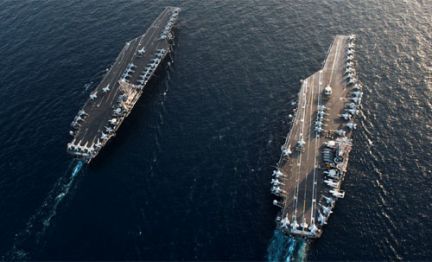
05 El portaaviones Abraham Lincoln ha atravesado el estrecho de Ormuz

Filed under: archivo personal,future,Holístico,política — fores @ 4:43 am

El portaaviones estadounidense Abraham Lincoln ha atravesado el estrecho de Ormuz en una maniobra “rutinaria de seguridad” según el Pentágono. Irán había amenazado a los buques estadounidenses que atravesaran el paso. La foto muestra el buque, a la izquierda, el pasado 19 (AFP)

Foto del mensaje
Hace 25 minutos

By David Alexander

WASHINGTON | Sun Jan 22, 2012 6:07pm EST

The aircraft carrier USS Abraham Lincoln (CVN 72) sails in the Indian Ocean near Indonesia, February 3, 2005.  REUTERS-U.S. Navy-Timothy Smith
A general view of an oil dock is seen from a ship at the port of Kalantari in the city of Chabahar, 300km (186 miles) east of the Strait of Hormuz January 17, 2012. REUTERS-Raheb Homavandi

1 of 2. The aircraft carrier USS Abraham Lincoln (CVN 72) sails in the Indian Ocean near Indonesia, February 3, 2005.

Credit: Reuters/U.S. Navy/Timothy Smith


(Reuters) – A U.S. aircraft carrier sailed through the Strait of Hormuz and into the Gulf without incident on Sunday, a day after Iran backed away from an earlier threat to take action if an American carrier returned to the strategic waterway.

The carrier USS Abraham Lincoln completed a “regular and routine” passage through the strait, a critical gateway for the region’s oil exports, “as previously scheduled and without incident,” said Lieutenant Rebecca Rebarich, a spokeswoman for the U.S. Fifth Fleet.

The Lincoln, accompanied by strike group of warships, was the first U.S. aircraft carrier to enter the Gulf since late December and was on a routine rotation to replace the outgoing USS John C. Stennis.

The departure of the Stennis prompted Iranian army chief Ataollah Salehi to threaten action if the carrier passed back into the Gulf.

“I recommend and emphasize to the American carrier not to return to the Persian Gulf. … We are not in the habit of warning more than once,” he said.

The threat led to a round of escalating rhetoric between the two sides that spooked oil markets and raised the specter of a military confrontation between Iran and the United States.

Iran threatened to close the strait, the world’s most important oil shipping gateway, while the United States warned such a move would require a response by Washington, which routinely patrols international sea lanes to ensure they remain open.

Iran appeared to ease away from its earlier warnings on Saturday, with Revolutionary Guard Corps Deputy Commander Hossein Salami telling the official IRNA news agency that the return of U.S. warships to the Gulf was routine and not an increase in its permanent presence in the region.

“U.S. warships and military forces have been in the Persian Gulf and the Middle East region for many years and their decision in relation to the dispatch of a new warship is not a new issue and it should be interpreted as part of their permanent presence,” Salami said.

Pentagon officials declined to comment directly on Salami’s remarks, but reiterated that continued U.S. presence in the region reflected the seriousness with which Washington takes its security commitments to partner nations in the region and to ensuring free flow of international commerce.

The Lincoln’s arrival in the Gulf was unrelated to Iran’s statement on Saturday.

Tensions between Iran and the United States have been escalating in recent weeks as President Barack Obama prepares to implement new U.S. sanctions against Iran over its nuclear enrichment program, which Tehran says is for energy production but the West believes is aimed at producing atomic weapons.

The EU is preparing to intensify sanctions against Tehran with an embargo on Iran’s oil exports and possibly freezing the assets of Iran’s central bank. Obama is preparing new U.S. sanctions that target foreign financial institutions that do business with Iran’s central bank.

Both sides tried to scale down the rhetoric last week. The White House emphasized the United States was still open to international talks on Iran’s nuclear program, even as it denied Iranian assertions that discussions were under way about resuming a dialogue.

The White House would not confirm or deny Iranian reports that Obama had sent a letter to Iranian leaders, but spokesman Jay Carney said any communications with Tehran would have reinforced the statements Washington has made publicly.

The United States supports talks between Iran and the so-called P5 + 1, the five permanent members of the U.N. Security Council – Russia, China, France, England and the United States – plus Germany.

Carney urged Iran to respond to the letter sent in October on behalf of the P5 +1 by European Union foreign policy chief Catherine Ashton.

“If the Iranians are serious about restarting talks, then they need to respond to that letter,” Carney told a White House briefing. “That is the channel by which … the restarting of those talks would take place.”

(Reporting By David Alexander; Editing by Peter Cooney and Stacey Joyce)


US aircraft carrier sails through Strait of Hormuz into Persian Gulf; Navy says it’s routine

By Associated Press, Published: January 23

WASHINGTON — Amid heightened tensions with Iran, an American aircraft carrier has sailed through the Strait of Hormuz into the Persian Gulf. The Navy says it’s a routine maneuver.

Cmdr. Amy Derrick-Frost said the USS Abraham Lincoln entered the Gulf on Sunday without incident to conduct scheduled maritime security operations. Derrick-Frost is a spokeswoman for the Navy’s 5th Fleet, based in the Gulf state of Bahrain.

U.S. warships frequently operate in the Gulf. But when the carrier USS John Stennis departed the Gulf in late December, Iranian officials warned the U.S. not to return. On Saturday, however, Iran indicated that it viewed U.S. naval operations in the Gulf as normal.

Iran recently suggested it might use military force to close the Strait in retaliation for new international economic sanctions.

Copyright 2012 The Associated Press. All rights reserved. This material may not be published, broadcast, rewritten or redistributed.


CNN US

USS Abraham Lincoln sails into waters off Iran

January 19, 2012|By Barbara Starr, CNN Pentagon Correspondent

The aircraft carrier USS Abraham Lincoln arrived in the Arabian Sea on Thursday, Navy officials said, a likely prelude to testing Iran’s recent warning against sending a U.S. carrier through the Strait of Hormuz.

The Lincoln joins the USS Carl Vinson, already in the region, returning the U.S. Navy its standard two-carrier presence there. The carrier USS John Stennis left in the past few days and is now traveling back through the western Pacific.

The Lincoln’s arrival puts into place all the elements for a U.S. carrier to travel back into the Persian Gulf through the Strait of Hormuz for the first time since recent tensions with Iran escalated.

U.S. military officials have told CNN the United States will continue its long-standing military commitment to having an aircraft carrier in the Gulf, but will not say when the transit will take place in light of security concerns about Iran.

Several weeks ago, as the Stennis left the Gulf, Iranian officials warned the United States not to send in another carrier. In recent years, the United States has kept one carrier in the Gulf and one in the North Arabian Sea for much of the time.

Secretary of Defense Leon Panetta said that the U.S. naval and military presence in the region will not change and the current level is sufficient to deal with any situation that could arise.

“We have always maintained a very strong presence in that region,” Panetta said Wednesday. “We have a Navy fleet located there. We have a military presence in that region. And … we have continually maintained a strong presence in the region to make very clear that we were going to do everything possible to help secure the peace in that part of the world.”

A senior U.S. official acknowledged the Pentagon continues to see the Iranian naval forces controlled by the Iranian Revolutionary Guard Corps inside the Persian Gulf as more aggressive than regular naval forces.

U.S. military intelligence has been tracking the record of Iranian Revolutionary Guard commanders in the region and remains concerned about whether they are all firmly under the control of the most senior commanders in Teheran, the official said.

Out of concern that a confrontation could escalate unnecessarily, the United States recently suggested that a direct channel of communication be opened between the two governments.


January 22, 2012

05 Star Spanish Judge Garzón on the Defensive

Filed under: archivo personal,módulo básico,política — fores @ 4:39 pm

Spain
Related articles, background features and opinions about this topic.
PrintE-MailFeedback
01/20/2012

Prosecuting the Prosecutor
Star Spanish Judge Garzón on the Defensive

By Helene Zuber in Madrid

REUTERS
Baltasar Garzón (left) sits with his lawyer at the start of his Supreme Court trial in Madrid.
Many hailed crusading Spanish judge Baltasar Garzón as a hero for going after powerful criminals around the world. But this week saw him sitting at the defense table in what was the first of several trials stemming from his efforts to confront the power elite in his own country.

Spanish star judge Baltasar Garzón came on foot to his execution on the first day of his trial. The proceedings, which were to put an end to his celebrated career, were heard this week in Madrid before Spain’s Supreme Court. Garzón became famous for his dogged pursuit of dictators and others who had committed crimes against humanity across the world. But now he was the one standing trial — for having attempted to dig up the darkest secrets of the powerful in his own country. Now he must pay the price.

As in Germany, the worst accusation that can be leveled against a judge is “perversion of justice.” This judge, who is as vain as he has been successful, is accused of having committed “sustained perversion of justice” by using controversial methods in his efforts to shed light on a corruption scandal that has absorbed the Spanish political establishment for years. He had conversations between suspects — thought to belong to a network of corruption — and their lawyers secretly taped. In Spain, as elsewhere, such a violation of rights is only permitted in extreme cases.
The victims of these secret recordings struck back by filing a joint complaint against Garzón. And they have powerful friends. Indeed, among those accused in the bribery scandal are some in the upper ranks of the conservative Popular Party, whose leader, Mariano Rajoy, became the country’s prime minister in late December. The main suspect in the case is Francisco Correa. Investigators dubbed the case the “Gürtel Affair,” taking the German translation of Correa’s last name, which means “belt.”

The plaintiffs’ lawyers employed a special provision from Spanish procedural law to file a complaint “from the people,” which allowed the action against Garzón to go forward. The public prosecutor’s office, on the other hand, doesn’t see anything about Garzón’s actions that warrants criminal prosecution and has instead argued for his acquittal.

‘Perverse World of Spain’

On Tuesday, the first day of oral hearings against Garzón before the Supreme Court in Madrid, his supporters welcomed him outside the Supreme Court building in Madrid at 10 a.m. with placards, clapping and chants, such as: “The perverse world of Spain (where) the corrupt and the fascists allow a judge to be put on trial.”

Garzón then entered the ostentatiously adorned courtroom, the site of several major cases that he himself had been a part of. There, he was met by colleagues from the National Court next door, who had come in a show of support. For almost 23 years, Garzón had served as an investigating magistrate in the National Court in cases against terrorists, drug gangs and organized crime. But, in May 2010, he was indefinitely suspended from his position.

Tuesday afternoon, Spain’s best-known judge was forced to put aside the black judge’s robe with the white lace cuffs that he had worn into the proceedings and been allowed to keep on during the morning’s proceedings. He was also forced to move from the wine-red velvet seat he had enjoyed next to his defense attorney. Standing across from the seven judges trying his case, he was asked to state his name and age. Then, for two-and-a-half hours, he found himself in the embarrassing position of sitting in the chair reserved for the accused answering questions. He compared the feeling to being brought before a firing squad. As he subsequently explained to his relatives with a bit of gallows humor, “I asked for someone to remove the blindfold from my eyes so I could look straight forward.”

Should the Supreme Court judges side with those who brought the complaint, it could mean the end of Garzón’s career because he faces a maximum sentence of being removed from the bench for 17 years.

But, even if he is acquitted, the chances are slim that he will ever be allowed to hunt down criminals again from his office in the fifth chamber of the National Court. Indeed, this trial was just a prequel to the trial against him that will start next Tuesday in the same ornate courtrooms of the Supreme Court, which is housed in the former convent known as the Palacio de las Salesas.

Back-to-Back Trials

These back-to-back trials have led Gaspar Llamazares, the former head of the leftist coalition United Left and a member of the Communist Party of Spain, to describe it as having a cluster-bombing effect. While demonstrating in support of Garzón outside the courthouse, Llamazares said: “If they don’t get him for the one thing, he’ll fall over the next one.”

In the second case, Garzón is once again being accused of perverting justice for responding to complaints of victims’ relatives by investigating what happened to the roughly 114,000 regime opponents who disappeared during the dictatorship of General Francisco Franco, who ruled Spain from 1936 till his death in 1975. Luciano Varela, the Supreme Court magistrate spearheading the case against Garzón, accuses him of “inexcusably ignoring” the amnesty law of 1977, which forgives all political crimes committed during Franco’s dictatorship.

Varela is one of the seven judges who will pass judgment on Garzón for the wiretapping affair. What’s more, another one of the seven judges is leading yet another probe against Garzón. He is suspected of corruption for allegedly accepting money from Banco Santander, Spain’s largest bank, as fees for seminars he led at New York University.

Reed Brody, a lawyer and spokesman for Human Rights Watch in Brussels, says that it is a “bitter irony” that Garzón “is being prosecuted for trying to apply at home the same principles he so successfully promoted internationally.” Indeed, Garzón’s foreign colleagues have celebrated him as representing the global conscience since he issued an international warrant that led to the 1998 arrest of former Chilean dictator Augusto Pinochet in London. The case was the first to apply the principle of universal jurisdiction for crimes against human rights. As Luis Moreno Ocampo, the head prosecutor at the International Criminal Court (ICC) in The Hague, has said, the case was “groundbreaking” in terms of bringing an end to exemption from prosecution.

Though his investigations of Argentine junta leaders, Garzón helped to end Argentinean amnesty laws that protected military officials who had committed crimes against humanity. More recently, he stoked the ire of many in the United States by trying to call US President George W. Bush and six advisers to account for abusive interrogation techniques practiced at the prison camp in Guantánamo Bay. Documents released by the whistle-blowing platform WikiLeaks have revealed that US Embassy officials made repeated attempts to get Spanish authorities to rein in Garzón’s investigations.

Breaking a Taboo

ICC prosecutor Ocampo, though, insists that the world needs judges like Garzón, ones that are fearless when it comes to confronting the powerful around the world. After Garzón was forced to vacate his office in the ugly purpose-built structure in the heart of Spain’s capital, Ocampo hired him to serve as an adviser to the ICC on Latin American issues. It was, ironically, this position that led to the criminal accusations that three ultra-right Francoist organizations, including the openly fascist Falange Española de las JONS, leveled against Garzón.

The charges resulted from Garzón’s decision to break a taboo — and the unspoken pact of all parties when it came to the Spanish Civil War and the Franco dictatorship. He chose to ignore the Spanish amnesty law of 1977 in favor of international law — and allow investigations into the tens of thousands of Franco opponents who went missing.

Still, the witch hunt against Garzón only really got going in earnest two years ago, when he brought to light illegal financing activities related to the Popular Party. At that time, even judges with reputations for being progressive saw an opportunity for finally getting rid of Garzón. For the crusading judge had also made himself an unpopular figure among the socialists on the other side of the political divide. In the mid-1990s, he led a series of investigations into whether senior Interior Ministry officials in the governments of Socialist Prime Minister Felipe González (1982-1996) organized death squads against ETA, the Basque separatist militant group.

Indeed, by picking fights with people across the entire political spectrum, the gung-ho investigating magistrate has earned the nickname “the prince,” an unflattering nod to Machiavelli’s ruthless and conniving character, and stoked the jealousy of many.

Don’t Pick Fights with the Powerful

In the eyes of Garzón’s supporters, Spain’s Supreme Court has moved forward with the wiretapping case so as to not expose itself to international criticism. Indeed, it might mark the first time that an investigating magistrate is being tried before the Supreme Court for ordering potentially unlawful surveillance activities.

When speaking in his own defense this week, Garzón spoke in a hoarse and raspy voice brought on by the flu. He repeatedly asserted that he had ordered the wiretapping of the leaders of a “criminal organization” because “there was no other possibility” for preventing them from continuing their money-laundering activities from within their cells. He also added that officials with the special prosecutor’s office charged with investigating corruption and police misconduct had told him that the prisoners’ lawyers were playing “a key role” in these activities. “I didn’t have the defense lawyers but, rather, the incarcerated investigated,” Garzón asserted. On the second day of the trial, witnesses even confirmed that Garzón gave instructions for the parts of the conversations dealing with defense strategies in the tape transcripts to be redacted.
On Thursday, Garzón delivered his closing argument and proclaimed his innocence. The judges will deliver their verdict within the coming weeks. Hardly anyone believes that the Supreme Court judges deciding the case will be satisfied with merely having forced Garzón to go through the humiliating ordeal of sitting on the bench reserved for the accused.

When it comes to the Gürtel Affair, one of the biggest corruption scandals in the history of Spain’s democracy, no one has yet been convicted. The case of Garzón, the star judge, could be a warning to his colleagues: Don’t pick fights with the powerful.

Translated from the German by Josh Ward

January 20, 2012

05 We must stop this corporate takeover of American democracy

Filed under: Holístico,Karl Rove,módulo básico,política — fores @ 9:29 pm
The Guardian home
The Guardian Comment is free User comments Web

We must stop this corporate takeover of American democracy

Unless we can reverse the supreme court’s dreadful Citizens United decision, US politics will become a plutocrats’ plaything

  • David Koch and Charles G. Koch of Koch Industries, Inc

    David Koch and Charles G Koch: the US supreme court’s Citizens United decision has enabled the industrialists to fund conservative groups to the tune of $200m already in this electoral cycle. Photograph: Getty

    The corporate barbarians are through the gate of American democracy. Not satisfied with their all-pervasive influence on our culture, economy and legislative processes, they want more. They want it all.

    Two years ago, the United States supreme court betrayed our Constitution and those who fought to ensure that its protections are enjoyed equally by all persons regardless of religion, race or gender by engaging in an unabashed power-grab on behalf of corporate America. In its now infamous decision in the Citizens United case, five justices declared that corporations must be treated as if they are actual people under the Constitution when it comes to spending money to influence our elections, allowing them for the first time to draw on the corporate checkbook – in any amount and at any time – to run ads explicitly for or against specific candidates.

    What’s next … a corporate right to vote?

    Don’t laugh. Just this month, the Republican National Committee filed an amicus brief in a US appeals court contending that the natural extension of the Citizens United rationale is that the century-old ban on corporate contributions directly to candidates and political parties is similarly unconstitutional. They want corporations to be able to sponsor candidates and parties directly while claiming with a straight face this would not result in any sort of corruption. And while, this month, they take no issue with corporations being subject to the existing contribution limits, anyone paying attention knows that eliminating such caps will be corporate America’s next prize in its brazen ambition for absolute control over our elections.

    The US Constitution has served us very well, but when the supreme court says, for purposes of the first amendment, that corporations are people, that writing checks from the company’s bank account is constitutionally-protected speech and that attempts by the federal government and states to impose reasonable restrictions on campaign ads are unconstitutional, our democracy is in grave danger.

    I am a proud sponsor of a number of bills that would respond to Citizens United and begin to get a handle on the problem. But something more needs to be done – something more fundamental and indisputable, something that cannot be turned on its head by a rightwing supreme court.

    That is why I have introduced a resolution in the Senate (introduced by Representative Ted Deutch in the House) calling for an amendment to the US Constitution that says simply and straightforwardly what everyone – except five members of the United States supreme court – understands: corporations are not people with constitutional rights equal to flesh-and-blood human beings. Corporations are subject to regulation by the people. Corporations may not make campaign contributions – the law of the land for the last century – or dump unlimited sums of money into our elections. And Congress and states have broad power to regulate all election spending.

    I did not introduce this lightly. In fact, I have never sought to amend the Constitution before. The US Constitution is an extraordinary document that, in my view, should not be amended often. In light of the supreme court’s Citizens United decision, however, I see no alternative. The ruling has radically changed the nature of our democracy. It has further tilted the balance of power toward the rich and the powerful at a time when the wealthiest people in this country have never had it so good.

    At a time when corporations have more than $2tn in cash in their bank accounts, make record-breaking profits and swarm Washington with their lobbyists 24 hours a day, seven days a week, for the highest court in the land to suggest that there is just not enough corporate “speech” in our system defies the bounds of reason and sanity. The ruling already has led to plans, for example, by industrialist brothers David and Charles Koch to steer more than $200m – potentially much more – to conservative groups ahead of election day 2012. Karl Rove has similar designs.

    Does anybody really believe that that is what American democracy is supposed to be about?

    I believe that the Citizens United decision will go down as one of the worst in our country’s history – and one that demands an amendment to our Constitution in order to restore sovereign power to the people, as our nation’s founders intended.

    If we do not reverse it and the culture of corporate dominance over our elections that it has exacerbated, there will be no end to the impact that corporate interests have on our campaigns and our democracy.

January 18, 2012

05 SOPA and PIPA – Learn more From Wikipedia, the free encyclopedia

Filed under: módulo básico — fores @ 8:30 am

SOPA and PIPA – Learn more

From Wikipedia, the free encyclopedia
Jump to: navigation, search


About the action

  • The Wikipedia community has blacked out the English version of Wikipedia for 24 hours on January 18th to raise awareness about legislation being proposed by the U.S. Congress — the Stop Online Piracy Act (SOPA) in the U.S. House of Representatives, and the PROTECT IP Act (PIPA) in the U.S. Senate — and to encourage readers to speak out against it. This legislation, if passed, will harm the free and open Internet. If you are in the United States, let your congressional representative know what you think of the proposed legislation by clicking here.
  • The blackout will last 24 hours — from midnight to midnight EST (05:00 UTC Wed to 05:00 UTC Thu).
  • This decision was made by Wikipedia’s global community of editors — the people who built Wikipedia. The Wikimedia Foundation, the non-profit organization that operates Wikipedia, also opposes SOPA and PIPA, and supports the editors’ blackout.
  • SOPA and PIPA are real threats to the free and open Internet. Although recent media reports have suggested that the bills are losing support, they are not dead. On January 17th, SOPA’s sponsor said the bill will be discussed and pushed forward in early February. PIPA could be debated in the U.S. Senate as soon as next week. There is a need to send a strong message that bills like SOPA and PIPA must not move forward: they will cause too much damage.
  • Although the bills have been amended since their introduction, they are still deeply problematic. Among other serious problems in the current draft of the bills, the requirement exists for US-based sites to actively police links to purported infringing sites. These kinds of self-policing activities are non-sustainable for large, global sites – including ones like Wikipedia. The legislative language is ambiguous and overly broad, even though it touches on protected speech. Congress says it’s trying to protect the rights of copyright owners, but the “cure” that SOPA and PIPA represent is worse than the disease.

Make your voice heard!

Bookmark with Facebook Share on Twitter Share on reddit.com Share on Digg.com

More information

Questions and Answers

What exactly is Wikipedia doing?
On January 18, 2012, the English Wikipedia community is protesting SOPA and PIPA with a global blackout of the English Wikipedia. Readers who come to English Wikipedia from the United States will see a message from Wikipedia about SOPA and PIPA that encourages them to contact their representatives or senators, and readers everywhere will be encouraged to share their views via social media. This protest will last 24 hours – from midnight to midnight EST.
Why is this happening?
The English Wikipedia community is opposed to SOPA/PIPA. In an unprecedented decision, the Wikipedia community has chosen to blackout the English version of Wikipedia for 24 hours, in protest against proposed legislation in the United States — the Stop Online Piracy Act (SOPA) in the U.S. House of Representatives and PROTECT IP Act (PIPA) in the U.S. Senate. If passed, this legislation will harm the free and open Internet and inhibit people’s access to information online.
Why? SOPA and PIPA put the burden on website owners to police user-contributed material and call for the unnecessary blocking of entire sites. Small sites won’t have sufficient resources to defend themselves. Big media companies may seek to cut off funding sources for their foreign competitors, even if copyright isn’t being infringed. Foreign sites will be blacklisted, which means they won’t show up in major search engines. SOPA and PIPA build a framework for future restrictions and suppression.
For over a decade, Wikipedians have spent millions of hours building the largest encyclopedia in human history. This proposed legislation could seriously damage Wikipedia, and your ability to access information online.
Isn’t SOPA dead? Wasn’t the bill shelved, and didn’t the White House declare that it won’t sign anything that resembles the current bill?
No, SOPA and PIPA are not dead. On January 17th, SOPA’s sponsor said the bill will be discussed in early February. There are signs PIPA may be debated on the Senate floor next week. The threat of SOPA and PIPA remains, and the English Wikipedia community wants to send a strong message that such attacks on the free and open web are not welcome.
Aren’t SOPA/PIPA as they stand not even really a threat to Wikipedia? Won’t the DNS provisions be removed?
The Electronic Frontier Foundation has a great post about this here. SOPA and PIPA are still alive, and they’re still a threat to the free and open web, which means they are a threat to Wikipedia. For example, in its current form, SOPA would require U.S. sites to take on the heavy burden of actively policing third-party links for infringing content. And even with the DNS provisions removed, the bill would give the U.S. government extraordinary and loosely-defined powers to take control over content and information on the free web. Taking one bad provision out doesn’t make the bills okay, and regardless, Internet experts agree they won’t even be effective in their main goal: halting copyright infringement.
What can users outside of the U.S. do to support this effort?
Users outside of the U.S. can contact their local State Department, Ministry of Foreign Affairs, or similar branch of government. Tell them that you oppose the draft US SOPA and PIPA legislation, and all similar legislation. SOPA and PIPA will have a global effect – websites outside of the U.S. would be impacted by legislation that hurts the free and open web. And, other jurisdictions are grappling with similar issues, and may choose paths similar to SOPA and PIPA.
Is it still possible to access Wikipedia in any way?
The Wikipedia community, as part of their request to the Wikimedia Foundation to carry out this protest, asked us to ensure that we make English Wikipedia accessible in some way during an emergency. The English Wikipedia will be accessible on mobile devices and smart phones. Because the protest message is powered by JavaScript, it’s also possible to view Wikipedia by completely disabling JavaScript in your browser.
In carrying out this protest, is Wikipedia abandoning neutrality? Can I still trust Wikipedia?
We hope you continue to trust Wikipedia. We are staging this blackout because, although Wikipedia’s articles are neutral, its existence actually is not. Wikipedia’s existence depends on a free, open and uncensored Internet. We are shutting Wikipedia down for you, our readers. We support your right to freedom of thought and freedom of expression. We think everyone should have access to educational material on a wide range of subjects, even if they can’t pay for it. We believe people should be able to share information without impediment. We believe that new proposed laws like SOPA and PIPA (and other similar laws under discussion inside and outside the United States) don’t advance the interests of the general public. That’s why we’re doing this.
Personal tools
Namespaces
Variants
Actions
  • Wikimedia Foundation
  • Powered by MediaWiki
« Previous Page — Next Page »

WPMU Theme pack by WPMU-DEV.