Forés @ UVPress


         Universitat de València PRESS -UVPress- weblog for research uses

December 20, 2010

02 Top Secret – Monitoring America

Filed under: archivo personal,future,política — fores @ 3:09 pm

Monitoring America

Nine years after the terrorist attacks of 2001, the United States is assembling a vast domestic intelligence apparatus to collect information about Americans, using the FBI, local police, state homeland security offices and military criminal investigators.

The system, by far the largest and most technologically sophisticated in the nation’s history, collects, stores and analyzes information about thousands of U.S. citizens and residents, many of whom have not been accused of any wrongdoing.

The government’s goal is to have every state and local law enforcement agency in the country feed information to Washington to buttress the work of the FBI, which is in charge of terrorism investigations in the United States.

Other democracies – Britain and Israel, to name two – are well acquainted with such domestic security measures. But for the United States, the sum of these new activities represents a new level of governmental scrutiny.

This localized intelligence apparatus is part of a larger Top Secret America created since the attacks. In July, The Washington Post described an alternative geography of the United States, one that has grown so large, unwieldy and secretive that no one knows how much money it costs, how many people it employs or how many programs exist within it.

Today’s story, along with related material on The Post’s Web site, examines how Top Secret America plays out at the local level. It describes a web of 4,058 federal, state and local organizations, each with its own counterterrorism responsibilities and jurisdictions. At least 935 of these organizations have been created since the 2001 attacks or became involved in counterterrorism for the first time after 9/11.

The months-long investigation, based on nearly 100 interviews and 1,000 documents, found that:

* Technologies and techniques honed for use on the battlefields of Iraq and Afghanistan have migrated into the hands of law enforcement agencies in America.

* The FBI is building a database with the names and certain personal information, such as employment history, of thousands of U.S. citizens and residents whom a local police officer or a fellow citizen believed to be acting suspiciously. It is accessible to an increasing number of local law enforcement and military criminal investigators, increasing concerns that it could somehow end up in the public domain.

* Seeking to learn more about Islam and terrorism, some law enforcement agencies have hired as trainers self-described experts whose extremist views on Islam and terrorism are considered inaccurate and counterproductive by the FBI and U.S. intelligence agencies.

* The Department of Homeland Security sends its state and local partners intelligence reports with little meaningful guidance, and state reports have sometimes inappropriately reported on lawful meetings.

Job fair

Counterterrorism on Main Street

In cities across Tennessee and across the nation local agencies are using sophisticated equipment and techniques to keep an eye out for terrorist threats — and to watch Americans in the process. Launch Gallery »

The need to identify U.S.-born or naturalized citizens who are planning violent attacks is more urgent than ever, U.S. intelligence officials say. This month’s FBI sting operation involving a Baltimore construction worker who allegedly planned to bomb a Maryland military recruiting station is the latest example. It followed a similar arrest of a Somali-born naturalized U.S. citizen allegedly seeking to detonate a bomb near a Christmas tree lighting ceremony in Portland, Ore. There have been nearly two dozen other cases just this year.

“The old view that ‘if we fight the terrorists abroad, we won’t have to fight them here’ is just that – the old view,” Homeland Security Secretary Janet Napolitano told police and firefighters recently.

The Obama administration heralds this local approach as a much-needed evolution in the way the country confronts terrorism.

Top Secret America is a project two years in the making that describes the huge security buildup in the United States after the Sept. 11, 2001, attacks. Today’s story is about those efforts at the local level, including law enforcement and homeland security agencies in every state and thousands of communities. View previous stories, explore relationships between government organizations and the types of work being done, and view top-secret geography on an interactive map.

However, just as at the federal level, the effectiveness of these programs, as well as their cost, is difficult to determine. The Department of Homeland Security, for example, does not know how much money it spends each year on what are known as state fusion centers, which bring together and analyze information from various agencies within a state.

The total cost of the localized system is also hard to gauge. The DHS has given $31 billion in grants since 2003 to state and local governments for homeland security and to improve their ability to find and protect against terrorists, including $3.8 billion in 2010. At least four other federal departments also contribute to local efforts. But the bulk of the spending every year comes from state and local budgets that are too disparately recorded to aggregate into an overall total.

December 19, 2010

02 John Pilger: Global Support for WikiLeaks is “Rebellion” Against U.S. Militarism, Secrecy

Filed under: future,política — fores @ 8:04 pm

December 15, 2010

John Pilger: Global Support for WikiLeaks is “Rebellion” Against U.S. Militarism, Secrecy

Johnpilger

The award-winning investigative journalist and documentary filmmaker John Pilger is one of many high-profile public supporters of Julian Assange and his organization WikiLeaks. Pilger has attended Assange’s court proceedings in London and has offered to contribute funds for his more than $300,000 bail. Pilger’s latest film, The War You Don’t See, includes interviews with Assange. Pilger says that WikiLeaks is revolutionizing journalism and galvanizing public opinion to stand up to global elites. [includes rush transcript]

December 14, 2010

02 Google’s ChromeOS means losing control of data, warns GNU founder Richard Stallman

Filed under: future — fores @ 5:23 pm
Tags:

Google’s ChromeOS means losing control of data, warns GNU founder Richard Stallman

New cloud computing OS released by Google is plan to push people into ‘careless computing’, warns free software advocate


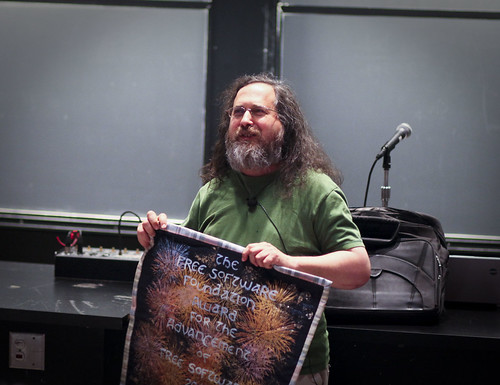
Richard Stallman. Photo by jeanbaptisteparis on Flickr. Some rights reserved

Google’s new cloud computing ChromeOS looks like a plan “to push people into careless computing” by forcing them to store their data in the cloud rather than on machines directly under their control, warns Richard Stallman, founder of the Free Software Foundation and creator of the operating system GNU.

Two years ago Stallman, a computing veteran who is a strong advocate of free software via his Free Software Foundation, warned that making extensive use of cloud computing was “worse than stupidity” because it meant a loss of control of data.

Now he says he is increasingly concerned about the release by Google of its ChromeOS operating system, which is based on GNU/Linux and designed to store the minimum possible data locally. Instead it relies on a data connection to link to Google’s “cloud” of servers, which are at unknown locations, to store documents and other information.

The risks include loss of legal rights to data if it is stored on a company’s machine’s rather than your own, Stallman points out: “In the US, you even lose legal rights if you store your data in a company’s machines instead of your own. The police need to present you with a search warrant to get your data from you; but if they are stored in a company’s server, the police can get it without showing you anything. They may not even have to give the company a search warrant.”

Google gave ChromeOS a “soft” launch last week, showing off aspects of the software and providing developers and some journalists with Cr-48 laptops set up to run it, while saying that it won’t be widely available until mid-2011.

Eric Schmidt, Google’s chief executive, praised it in a blogpost: “For me, these announcements were among the most important of my working life – demonstrating the real power of computer science to transform people’s lives. It’s extraordinary how very complex platforms can produce beautifully simple solutions like Chrome and Chrome OS, which anyone can use from the get-go – as long as you get it right,” he wrote. “As developers start playing with our beta Cr-48 Chrome OS computer, they’ll see that while it’s still early days it works unbelievably well. You can build everything that you used to mix and match with client software—taking full advantage of the capacity of the web.”

But Stallman is unimpressed. “I think that marketers like “cloud computing” because it is devoid of substantive meaning. The term’s meaning is not substance, it’s an attitude: ‘Let any Tom, Dick and Harry hold your data, let any Tom, Dick and Harry do your computing for you (and control it).’ Perhaps the term ‘careless computing’ would suit it better.”

He sees a creeping problem: “I suppose many people will continue moving towards careless computing, because there’s a sucker born every minute. The US government may try to encourage people to place their data where the US government can seize it without showing them a search warrant, rather than in their own property. However, as long as enough of us continue keeping our data under our own control, we can still do so. And we had better do so, or the option may disappear.”

The accountability of cloud computing providers has come under close focus in the past fortnight after Amazon removed Wikileaks content from its EC2 cloud computing service, saying that the leaks site had breached its terms and conditions, and without offering any mediation in the dispute.

Stallman only sees one aspect of ChromeOS to applaud: its GNU/Linux heritage. “In essence, Chrome OS is the GNU/Linux operating system. However, it is delivered without the usual applications, and rigged up to impede and discourage installing applications,” he told the Guardian. “I’d say the problem is in the nature of the job ChromeOS is designed to do. Namely, encourage you to keep your data elsewhere, and do your computing elsewhere, instead of doing it in your own computer.”

• Stallman warns would-be hackers not to download the LOIC software being pushed as a method of expressing anger with sites that have acted against Wikileaks – not because he thinks the protest is wrong, but because the tool’s code is not visible to the user. “It seems to me that running LOIC is the network equivalent of the protests against the tax-avoiders’ stores in London. We must not allow that to constrict the right to protest,” he notes. “[But] if users can’t recompile it, users should not trust it.”

(Note: deleted a duplicate paragraph at end of story.)

December 11, 2010

02 El Instituto Cervantes de Estocolmo homenajea a Vargas Llosa

Filed under: archivo personal — fores @ 8:09 pm

http://www.rtve.es/mediateca/videos/20101208/instituto-cervantes-estocolmo-homenajea-a-vargas-llosa/956031.shtml


Compartir

El Instituto Cervantes de Estocolmo homenajea a Vargas Llosa

08-12-2010

El escritor Mario Vargas Llosa ha recibido hoy el homenaje del Instituto Cervantes de Estocolmo, donde se ha inaugurado una exposición que incluye buena parte de los objetos que han acompañado al Premio Nobel de Literatura en su tarea rigurosa de escritor.

¡Joan Alvarez, Director del Instituto Cervantes en Estocolmo, enhorabuena!

http://www.cervantestv.es/informativos/2010/diciembre/informativo_497.htm?segundo=54.31&duracion=109&titulo=IC%20de%20Estocolmo:%20%C2%ABEspejos%20del%20Universo:%20Vargas%20Llosa%C2%BB

«Espacio Cervantes». Boletín informativo del Instituto Cervantes
IC de Estocolmo: «Espejos del Universo: Vargas Llosa»

Espacio Cervantes. Con la colaboración de Telefónica
Cartel de la película «Todas las canciones hablan de mí», de Jonás Trueba

N.º 497. 10 de diciembre de 2010

02 What Works in the Classroom? Ask the Students

Filed under: módulo básico — fores @ 11:04 am

What Works in the Classroom? Ask the Students

By SAM DILLON
Published: December 10, 2010

How useful are the views of public school students about their teachers?

Quite useful, according to preliminary results released on Friday from a $45 million research project that is intended to find new ways of distinguishing good teachers from bad.

Teachers whose students described them as skillful at maintaining classroom order, at focusing their instruction and at helping their charges learn from their mistakes are often the same teachers whose students learn the most in the course of a year, as measured by gains on standardized test scores, according to a progress report on the research.

Financed by the Bill and Melinda Gates Foundation, the two-year project involves scores of social scientists and some 3,000 teachers and their students in Charlotte, N.C.; Dallas; Denver; Hillsborough County, Fla., which includes Tampa; Memphis; New York; and Pittsburgh.

The research is part of the $335 million Gates Foundation effort to overhaul the personnel systems in those districts.

Statisticians began the effort last year by ranking all the teachers using a statistical method known as value-added modeling, which calculates how much each teacher has helped students learn based on changes in test scores from year to year.

Now researchers are looking for correlations between the value-added rankings and other measures of teacher effectiveness.

Research centering on surveys of students’ perceptions has produced some clear early results.

Thousands of students have filled out confidential questionnaires about the learning environment that their teachers create. After comparing the students’ ratings with teachers’ value-added scores, researchers have concluded that there is quite a bit of agreement.

Classrooms where a majority of students said they agreed with the statement, “Our class stays busy and doesn’t waste time,” tended to be led by teachers with high value-added scores, the report said.

The same was true for teachers whose students agreed with the statements, “In this class, we learn to correct our mistakes,” and, “My teacher has several good ways to explain each topic that we cover in this class.”

The questionnaires were developed by Ronald Ferguson, a Harvard researcher who has been refining student surveys for more than a decade.

Few of the nation’s 15,000 public school districts systematically question students about their classroom experiences, in contrast to American colleges, many of which collect annual student evaluations to improve instruction, Dr. Ferguson said.

“Kids know effective teaching when they experience it,” he said.

“As a nation, we’ve wasted what students know about their own classroom experiences instead of using that knowledge to inform school reform efforts.”

Until recently, teacher evaluations were little more than a formality in most school systems, with the vast majority of instructors getting top ratings, often based on a principal’s superficial impressions.

But now some 20 states are overhauling their evaluation systems, and many policymakers involved in those efforts have been asking the Gates Foundation for suggestions on what measures of teacher effectiveness to use, said Vicki L. Phillips, a director of education at the foundation.

One notable early finding, Ms. Phillips said, is that teachers who incessantly drill their students to prepare for standardized tests tend to have lower value-added learning gains than those who simply work their way methodically through the key concepts of literacy and mathematics.

Teachers whose students agreed with the statement, “We spend a lot of time in this class practicing for the state test,” tended to make smaller gains on those exams than other teachers.

“Teaching to the test makes your students do worse on the tests,” Ms. Phillips said. “It turns out all that ‘drill and kill’ isn’t helpful.”

« Previous Page — Next Page »

WPMU Theme pack by WPMU-DEV.