Forés @ UVPress


         Universitat de València PRESS -UVPress- weblog for research uses

February 23, 2010

01 El Supremo cree que Garzón no ha sufrido una “indefensión relevante”

El Supremo cree que Garzón no ha sufrido una “indefensión relevante”

JULIO M. LÁZARO – Madrid – 23/02/2010

Vota

Resultado Sin interésPoco interesanteDe interésMuy interesanteImprescindible 18 votos

La Sala de lo Penal del Tribunal Supremo ha rechazado el recurso del juez de la Audiencia Nacional Baltasar Garzón contra la admisión a trámite de la querella de dos abogados que le imputan sendos delitos de prevaricación y cohecho por haber archivado una querella contra el presidente del Santander, Emilio Botín, después de haber organizado en Nueva York unos cursos patrocinados por la entidad bancaria.

La noticia en otros webs

El recurso ha sido resuelto por los mismos magistrados que admitieron la querella contra el juez y que lógicamente no creen haberle causado una “indefensión relevante”. El abogado de Garzón, Gonzalo Martínez-Fresneda, se quejó de que se había admitido la querella contra su defendido “después de escuchar en seis ocasiones a los querellantes y ni una sola vez al juez querellado”.

La Sala contesta que el artículo 410 de la Ley de Enjuiciamiento Criminal no prevé “expresamente” y “con carácter general” la intervención del juez querellado. Aunque la Sala admite que “excepcionalmente” pudiera requerirse su participación, eso, en el caso de Garzón, “no ocurre”.

Volverá a declarar

El auto del Supremo, del que ha sido ponente el magistrado conservador Miguel Colmenero, rechaza las alegaciones del fiscal y del abogado de Garzón en el sentido de que los mismos hechos de Nueva York ya le fueron imputados en una causa especial que fue archivada por la propia Sala. Los magistrados replican que en esta querella se aporta un “hecho nuevo” consistente en la “petición de fondos por parte del querellado”. Así, el Supremo hace caso omiso a las informaciones de la Universidad de Nueva York según las cuales, Garzón “no recibió importe alguno, ni directa, ni indirectamente, ni en efectivo ni en especie, de los dos patrocinios recibidos del BSCH”.

A partir de ahora, la querella pasa a manos del juez instructor, el conservador Manuel Marchena. Los querellantes reclamarán que se tome declaración al juez imputado y previsiblemente también al presidente del Banco Santander, Emilio Botín.

Por otra parte, la Fiscalía Anticorrupción ha impugnado ante el Tribunal Superior de Madrid los recursos contra las escuchas acordadas por Garzón en el caso Gürtel. El fiscal considera esas escuchas “perfectamente compatibles” con la jurisprudencia constitucional y la del Tribunal Europeo de Derechos Humanos.

February 21, 2010

01 Britain, Greece, Spain and Norway tell markets: growth, not cuts

Filed under: política — fores @ 2:19 pm
Tags:

Britain, Greece, Spain and Norway tell markets: growth, not cuts

• Centre-left leaders defy mutinous global investors
• ‘We won’t fall into the trap’ says Spanish PM Zapatero

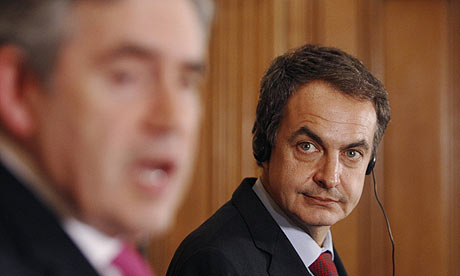
Gordon Brown and Spain's José Luis Rodríguez Zapatero

Gordon Brown and Spain’s José Luis Rodríguez Zapatero have said they will prioritise growth over deficit cuts. Photographer: Luke Macgregor/Reuters

The prime ministers of Britain, Greece, Spain and Norway have warned the financial community that they will prioritise growth over deficit cuts, and have asked speculators to change their short-term view for one that is more favourable to society as a whole.

The message from Gordon Brown, Spain’s José Luis Rodríguez Zapatero, George Papandreou of Greece and Norway’s Jens Stoltenberg is likely to infuriate some investors, who are pushing governments with high deficits to cut their ballooning debts on concerns about their ability to repay the money they owe.

“The agenda for the European Union this year should be growth and jobs,” Brown said during a conference organised by the Policy Network, a centre-left thinktank, in London.

“We won’t fall in the trap of those who provoked the credit crunch,” Zapatero said. “We will cut the deficit when economic recovery is active, but not at the expense of social cohesion.”

Over the past few weeks, the four left-wing leaders have suffered the attacks of speculators who do not believe politicians have their economies under control: in Britain and Spain, investors’ sales have pushed bond yields higher, making the countries’ borrowings more expensive – as well as the long-term interest rates that citizens pay in contracts such as mortgages. Speculators have also pushed up the price of protection against potential defaults on Greek, Portuguese and Spanish state debt, exacerbating negative sentiment towards the countries.

Papandreou reassured investors of his country’s ability to improve its ailing public finances – including a draconian budget deficit cut to 3% of gross domestic product by 2013, from 12% now. “Greece is our problem – we’re not looking for bailouts or money from other countries. We have a programme and the support for this programme and we’ll do what’s necessary to reach the targets. We want to borrow on the same terms as the others,” Papandreou said.

He was supported by European Union competition commissioner Joaquín Almunia, who defended the EU’s guarded approach towards the Greek crisis, saying that “you can’t promise a party everything they’re asking for”.

In an interview during the conference, Almunia said that the EU’s response to the Greek crisis, which has been much criticised by investors for its lack of detail, is “serious and responsible”.

However, with local strikes and popular opposition to the cuts, few investors believe the country will meet its targets. As he spoke, protection against a potential default of his country was trading at twice as much that of other European countries. “We have the power, if we have the will, to deal with some kinds of speculation,” Papandreou said. Financial instruments should be “tools” to help citizens lead a better life, whereas “they are God for the conservatives,” he said.

Greece may find help from Spain, as during his six-month EU presidency Zapatero will try to toughen regulation of credit default swaps – the instruments traded as sovereign credit protection, the Spanish prime minister told the Guardian on the sidelines of the conference.

“We have to tell the markets that they should have a more medium and long-term perspective,” the Spanish leader said during the summit. “They are also interested in an economic recovery that brings stability and tranquility for all.”

But investors claim there is still huge distance between the two sides – governments and markets – that are now battling to find the best way out of the worst recession in 60 years. While politicians “talk the talk” – instead of offering a more specific plan on how to help Greece – financial investors will keep looking only at the numbers, Evolution Securities analyst Gary Jenkins recently said.

“The market is now only interested in liquidity. We have to be focused on the short term: if you’re concerned about funding, you have to look short-term,” Jenkins said.

Brown called for more action and further global change on financial regulation over the next G20 meetings this year. A renewed global approach is needed as the “internationalism spirit of the G20 summit in London last year has somehow melted away,” Lord Mandelson, the business secretary, said at the conference.

“We can’t leave things as they were – we won’t withdraw from speculation beyond borders, from tax heavens,” Zapatero said.

“It’s a paradox that the markets that we saved are now demanding and putting difficulties, as those budget deficits are those that we incurred to save those who now demand budget cuts. What a paradox.”

01 Midsummer Night’s Dream

Filed under: recomendaciones — fores @ 2:10 pm
Tags: , ,

A Midsummer Night’s Dream:

Rose Theatre, Kingston/ Tobacco Factory, Bristol

midsummer

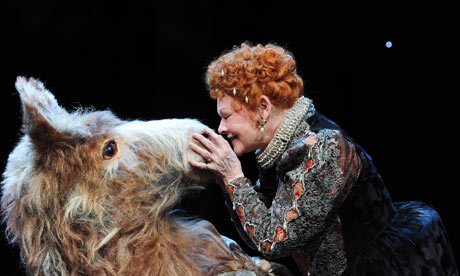
Judi Dench and Oliver Chris in A Midsummer Night’s Dream at the Rose Theatre, Kingston. Photograph: Tristram Kenton

It’s not so much a production as a coronation. Judi Dench appears in A Midsummer Night’s Dream, Shakespeare’s most immediate and engaging play, not only as Queen of the Faeries but also as the ruler of a mortal realm. Got up as Elizabeth I, in ginger crimp, neck-clenching ruff and a crinoline that looks like a wraparound stage, she glides silently on at the beginning of the play, waving off the proceedings with a regal palm. The drama that follows could be seen as her dream: the fantasy of an elderly monarch with her eye on younger men.

This Gloriana framework is director Peter Hall’s addition: a way of paying tribute to Dench’s royal career. She has, after all, worn these two crowns before: she was the Virgin Queen in Shakespeare in Love, and played Titania both in Hall’s 1962 RSC production and, six years later, in his film version, when she was decked out in little more than ivy leaves.

It’s a wheeze rather than a followed-through idea: after all, no one has yet suggested that Gloriana went in for beasts on the side. The Elizabeth I device – obtrusive in an otherwise solidly trad production – looks designed to soothe anyone who may be tormented by the notion that Charles Edwards’s nicely preening Oberon might not fancy an older fairy.

Actually, most people won’t much worry how Judi Dench flew in: the important thing is that she has landed. She is bringing in crowds to the Rose, whose future hasn’t always looked, well, rosy. She makes each line sound necessary, never ornamental. And, simply by being there, she tips the balance of the play in an interesting direction. Titania is usually more bewitched than bewitching: here she looks more like the pivot. Her speech towards the beginning of the play is one of those Shakespearean moments which, once highlighted, remake a play. Titania mourns the fact that everything is slipping around: there is frost on the rose and buds on the ice; there are crops rotting in the fields and massive floods. Nature is awry: “We see the seasons alter.” It’s as if a director has slipped in some text to bring the late 16th century up to date. But Shakespeare really did write about climate change. A comedy which, flickering between conscious and unconscious, has long seemed to be a pageant of the 20th-century imagination now appears wired directly into the crises of the 21st century. The playwright even fingered a bank as the cause of collapse and confusion. It’s that one “whereon the wild thyme blows”.

You couldn’t say that Hall makes this speech the motor of his production but Dench does make it count: it helps that her voice, with its rustles and shivers, sounds like shaken foliage. Still, the biggest surprise of the evening is that the romance between the donkey-endowed Bottom and the Faerie Queen looks no more of an aberration than the love affairs that make everyone else behave so nastily to each other. This is partly due to Dench’s alchemy: even encased in all her stiff Gloriana apparel, she seems about to melt. But it’s also a lot to do with the donkey. He’s adorable. The set and costume designer Elizabeth Bury has fashioned him a long, doleful head with silky ears and heavily fringed eyes. Oliver Chris makes him willowy and graceful, not only when he’s lolling in his lover’s arms but also when he clops off, festooned with fairies, into the depths of Bury’s (actually rather shallow-looking) cut-out wood, casting a long look over his shoulder, at once baleful and expectant.

Hall is often praised for the exact verse-speaking he elicits. Yet though Annabel Scholey scampers sweetly as Hermia, and Rachel Stirling brings a statuesque grief to Helena, some of the delivery is patchy: Susan Salmon’s Hippolyta in particular lets the lines cut across the sense.

She could learn from the mellowness that Amy Rockson gives the same part in Andrew Hilton’s inventive, coherent, crystally spoken production of the play at Bristol’s Tobacco Factory. It seems that Hilton has taken his cue for the evening from a line towards the end of the play when Hermia, waking from the shared nightmare that has blown across the stage, says it is as if she sees double. On a bare stage – the only addition to the structural pillars are ladders, from which the fairies hang to watch the action – the two kingdoms, mortal and fairy, day and night, mimic and shadow one another as if they were distorted variations of each other. It is not only that Theseus and Hippolyta are played by the same actors as Oberon and Titania. Apart from the pairs of young human lovers – who in any case have difficulty telling each other apart – everywhere you look there are doubles. Christopher Staines’s disobliging Puck, who glooms around like a surly teenager, is also a slightly sniffy Master of the Revels at the Duke of Athens’s court. The mechanicals – who are played carefully, without the condescension that can give the final scene so nasty a taste – double up as fairy followers, lumpily, lumberingly, sometimes touchingly. Jonathan Nibbs’s Cobweb knits in a wheelchair; Alan Coveney’s Moth is so drawn to the lantern he carries that he keeps banging his nose against it.

The result, utterly free from gauzy frolics, is as often disturbing as it is enticing. Still, throughout, the comedy is quick. Rebecca Pownall’s Helena is one long quiver of indignation – each tassel of her flapperish dress shakes in mortification. And the Pyramus and Thisbe scene sports a surprising hero. You couldn’t say that Wall steals the show, but it’s hard to imagine a funnier barricade than Felix Hayes, who staggers on heaving a block of concrete and sways there, eyes bulging, face flushed. Unable to move his hand to give the lovers a chink through which to whisper, he obliges them to smooch through his braced legs. His feat seems as marvellous as anything the fairies pull off.

February 20, 2010

01 F.B.I. Closes Anthrax Letters Case

Filed under: política — fores @ 11:28 am
Tags: , ,

F.B.I., Laying Out Evidence, Closes Anthrax Letters Case

By SCOTT SHANE
Published: February 19, 2010

WASHINGTON — More than eight years after anthrax-laced letters killed five people and terrorized the country, the F.B.I. on Friday closed its investigation, adding eerie new details to its case that the 2001 attacks were carried out by Bruce E. Ivins, an Army biodefense expert who killed himself in 2008.

U.S. Army

Bruce E. Ivins, a biochemist the F.B.I. says was responsible for five anthrax deaths.

Related

Times Topics: Bruce E. Ivins | Anthrax

A 92-page report, which concludes what by many measures is the largest investigation in F.B.I. history, laid out the evidence against Dr. Ivins, including his equivocal answers when asked by a friend in a recorded conversation about whether he was the anthrax mailer.

“If I found out I was involved in some way…” Dr. Ivins said, not finishing the sentence. “I do not have any recollection of ever doing anything like that,” he said, adding, “I can tell you, I am not a killer at heart.” But in a 2008 e-mail message to a former colleague, one of many that reflected distress, Dr. Ivins wrote, “I can hurt, kill, and terrorize.” He added: “Go down low, low, low as you can go, then dig forever, and you’ll find me, my psyche.”

The report disclosed for the first time the F.B.I.’s theory that Dr. Ivins embedded in the notes mailed with the anthrax a complex coded message, based on DNA biochemistry, alluding to two female former colleagues with whom he was obsessed.

The report described how an F.B.I. surveillance agent watched in 2007 as Dr. Ivins threw out a article and a book, Douglas Hofstadter’s “Godel, Escher, Bach: An Eternal Golden Braid,” that could betray his interest in codes, coming out of his house in Frederick, Md., at 1 a.m. in long underwear to make certain the garbage truck had taken his trash.

Whether the voluminous documentation will convince skeptics about Dr. Ivins’s guilt was uncertain on Friday. Representative Rush D. Holt, a New Jersey Democrat and a physicist who has sharply criticized the bureau’s work, said the case should not have been closed.

“Arbitrarily closing the case on a Friday afternoon should not mean the end of this investigation,” Mr. Holt said, noting that the National Academy of Sciences was still studying the F.B.I.’s scientific work. He said the F.B.I. report laid out “barely a circumstantial case” that “would not, I think, stand up in court.”

Dropped into a mailbox in downtown Princeton, N.J., the anthrax letters were addressed to news organizations and two United States senators and contained notes with radical Islamist rhetoric that appeared to link them to the Sept. 11 attacks, which occurred a week before the first of the two mailings.

In the jittery wake of 9/11, they set off a nationwide panic over random discoveries of white powder that people feared might be more anthrax. The real anthrax — a few teaspoons of very fine powder — infected at least 22 people, including several postal workers, and killed 5.

Congressional offices and the Supreme Court were evacuated as a result of anthrax contamination, and the Postal Service spent hundreds of millions of dollars to clean up mail-processing centers. The federal government increased spending on biodefense, with a total of nearly $60 billion since 2001, and rejuvenated the faltering military anthrax vaccine program on which Dr. Ivins had worked for many years.

The investigation included more than 10,000 interviews on six continents, the report said, and F.B.I. investigators conducted preliminary investigations of 1,024 people and “in-depth investigations” of more than 400 people, examining those with possible financial motives, links to the drug and pesticide industries or a history of corresponding with the lawmakers targeted by the mailings.

In response to requests under the Freedom of Information Act, the bureau also posted on the Web more than 2,700 pages of interview notes and investigative documents to bolster its case.

Dr. Ivins, a microbiologist who had worked with anthrax for decades as part of the vaccine program at the Army’s biodefense laboratory at Fort Detrick, Md., took a fatal overdose of Tylenol in July 2008 at the age of 62, after months of intense scrutiny by the F.B.I., which had placed a GPS device on his car, examined his trash and questioned his wife and two children.

They discovered his penchant for taking long drives at night, sometimes mailing letters and packages from distant spots under assumed names. They discovered his obsession with a sorority, Kappa Kappa Gamma, and with images of blindfolded women, hundreds of which were found on his computer, the report says.

Days after his suicide, Justice Department and F.B.I. officials said they believed that Dr. Ivins had carried out the anthrax attacks alone and they released search warrant affidavits that included some of the evidence against him.

The affidavits included e-mail messages in which he confessed to paranoia and delusion; time records showing he had worked alone in the laboratory late at night before the anthrax mailings in September and October 2001; and genetic analysis tracing the mailed anthrax powder to a flask overseen by Dr. Ivins and stored in his lab.

But some of Dr. Ivins’s colleagues at the United States Army Medical Research Institute of Infectious Diseases in Frederick, including several supervisors who knew him well, publicly rejected the F.B.I.’s conclusion. They said he was eccentric but incapable of such a diabolical act, and they questioned whether he could have produced the deadly powder with the equipment in his lab.

Skeptics also pointed to F.B.I. investigators’ long focus on another suspect, Dr. Steven J. Hatfill, another former Army scientist whom the F.B.I. pursued in 2002 and 2003, keeping him under constant surveillance. In 2008, the government exonerated Dr. Hatfill and agreed to a settlement worth $4.6 million to resolve a lawsuit alleging that his privacy rights had been violated.

Long before he became a serious suspect, Dr. Ivins, one of the government’s most experienced anthrax researchers, was a valued consultant to the F.B.I. investigators on the letters case. Only after path-breaking genetic analysis led to his lab did investigators consider that their genial scientific adviser might actually be their quarry.

As they focused on Dr. Ivins and read his e-mail messages, the report said, they began to be increasingly convinced that he was the mailer. And as he became aware that he was under scrutiny, he directed the F.B.I. repeatedly to other potential suspects. Once, in 2007, he wrote what the F.B.I. calls “an illogical 12-point memo” suggesting that the two female former colleagues with whom he was obsessed might have mailed the letters.

When one of the women, made aware of the memo, confronted Dr. Ivins about it in 2008, he wrote to her, blaming an alternate personality he called “ ‘Crazy Bruce,’ who surfaces periodically as paranoid, severely depressed and ridden with incredible anxiety.” He complained that “it seems as though I have been selected as the blood sacrifice for this whole thing.”

February 19, 2010

01 Contest for Oxford poetry professor begins again

Filed under: recomendaciones — fores @ 10:44 am
Tags: ,

Contest for Oxford poetry professor begins again

Geoffrey Hill and Anne Stevenson are among the names being suggested, as hunt for a successor to Ruth Padel begins

Oxford

Another contest in prospect … the skyline of Oxford. Photograph: Peter Macdiarmid/Reuters

The names of eminent poets including Geoffrey Hill and Anne Stevenson are being suggested as potential candidates for the Oxford professor of poetry post, as nominations open today to find a successor to last year’s controversial winner Ruth Padel.

Padel was elected in May by 297 votes to Indian poet and critic Arvind Mehrotra’s 129, but resigned less than two weeks later after admitting passing on material to journalists alerting them to claims of sexual harassment which had been made against her rival for the post, the Nobel laureate Derek Walcott. Walcott had earlier pulled out of the race.

The scandal prompted Oxford University to change the voting system for the election, which had previously only allowed Oxford graduates to vote in person at the university on a single day. Now, graduates will be able to vote online, as well as to cast their vote in person over a period of time.

The university opened nominations today to find a new candidate for the 300-year-old position, seen as the most prestigious in poetry behind that of the poet laureate. Aspiring professors of poetry must be nominated by at least 12 Oxford graduates by 5 May. If there is more than one contender, then graduates will be able to vote for their favourite.

Former poet laureate Andrew Motion, whose name was put forward as a possible candidate, ruled himself out of the running, as did poet, critic and author Blake Morrison. “Geoffrey Hill would get my vote, if he can be persuaded to run,” said Motion. Morrison agreed. “I’ve not written enough poetry in recent years to remotely consider it [but] Geoffrey Hill, Andrew Motion and Lachlan MacKinnon are all possible – and all would be good,” he said.

Stevenson – winner of the Lannan prize for a lifetime’s achievement in poetry – is also seen as a strong candidate, although the poet said she felt that “the whole notion of campaigning like a politician seems to me only to cheapen the post, as recent events have sadly shown”.

“I have always (probably naively) assumed that the professorship of poetry at Oxford was an honour that a poet was asked to accept,” said Stevenson. “If still so, having practised the craft of poetry for more than half a century, I would be pleased to be asked, and I would certainly accept the post, grateful for an opportunity to illustrate and affirm the literary values to which I have given my creative life. I don’t, though, cheer myself with great expectations.”

Other names being considered by the poetry establishment include the Scottish poet and critic Douglas Dunn, and the Pulitzer prize-winning American poet Jorie Graham. Broadcaster and writer Clive James said in Standpoint magazine last July that he “would rather throw himself off a cliff” than take the job, although he admitted later in the article that he did find the role “just about the most attractive cup of its kind in existence”. “The botched election might have made it a poisoned chalice, but what a chalice it is,” James wrote.

Mehrotra, who missed out to Padel in the last election, said late last year that he was unlikely to run for a second time. “Really, running for the professorship once seems like enough,” he told the Guardian at the time. “There was a point to be made – which is that occasionally, say once every five years, Oxford ought to look to points east and south for its poetry professor – and I think it has. There’s also the question of the Indian media. Alas, these things cannot be done quietly. The last time the media here got so excited about the whole affair – I mean, it’s Oxford, and then it’s the first Indian running for the job – that every journalist and her grandpa wanted a quote. In the end, the cacophony became too much. A lot of people I meet though think all the noise was about some big prize I’d won and even now congratulate me on it.”

Mehrotra is in the company of a host of distinguished unsuccessful candidates for the position, including CS Lewis, FR Leavis, Robert Lowell and Stephen Spender. The professorship, established in 1707 and coming with a stipend of £7,000, has been held in the past by poets including Matthew Arnold, WH Auden, Robert Graves, Paul Muldoon and Seamus Heaney. Literary critic Christopher Ricks held the post for five years, stepping down in 2009.

“We want someone who’s going to do what Christopher did – to enthuse everyone about poetry, not just literary students but the wider public,” said Dr Seamus Perry, deputy chair of Oxford’s English faculty board. Although there are no official nominations as yet, Perry said this could be a “very distinguished poet” such as Geoffrey Hill (“considered by many to be the greatest poet in England and also a very fine critic”), the current poet laureate Carol Ann Duffy (“there’s nothing to stop her running”), JH Prynne, John Fuller, Jorie Graham, Simon Armitage or Alice Oswald. But it could also be a critic, he said, or even a novelist such as AS Byatt, who “has written wonderfully about Browning”.

Perry hoped last year’s events wouldn’t put any candidates off from running. “It was all a bit of a kerfuffle and a regret, but I don’t think it actually reflects on the post at all,” he said. “I think it emerged pretty much unscathed, and in a funny kind of way it drew attention to its distinction.”

If more than one candidate comes forward for the position, the winner will be announced once voting is completed on 18 June, to be in post for the new academic year in autumn 2010.

« Previous Page — Next Page »

WPMU Theme pack by WPMU-DEV.