Forés @ UVPress


         Universitat de València PRESS -UVPress- weblog for research uses

November 4, 2011

04 Obama’s Sarkozy remark offends French

Filed under: future,George Lakoff,módulo básico,política — fores @ 5:21 pm

Obama’s Sarkozy remark offends French

By Dave Boyer

–

The Washington Times

Friday, November 4, 2011

President Obama taps his French counterpart Nicolas Sarkozy during an afternoon G20 summit session in Cannes on Nov. 3, 2011. (Associated Press)President Obama taps his French counterpart Nicolas Sarkozy during an afternoon G20 summit session in Cannes on Nov. 3, 2011. (Associated Press)

Text Size: +–

CANNES, France — President Obama came, he saw, he insulted.

“Obama insults Sarkozy,” blared the headline on one French website, taking umbrage at Mr. Obama’s wayward remark at the G-20 summit here about the physical appearance of French President Nicolas Sarkozy.

Mr. Obama thought he was making a gentle joke about Mr. Sarkozy, host of the summit, when he congratulated Mr. Sarkozy and wife Carla Bruni on the birth of their baby daughter on Oct. 19. Instead, Mr. Obama caused a minor international incident.

“I want to make mention that this is our first meeting since the arrival of the newest Sarkozy, and so I want to congratulate Nicolas and Carla on the birth of Giulia,” Mr. Obama told reporters shortly after his arrival at the G-20, with Mr. Sarkozy at his side. “And I informed Nicolas on the way in that I am confident that Giulia inherited her mother’s looks rather than her father’s, which I think is an excellent thing.”

He added, “And so now we share one of the greatest challenges and blessings of life, and that is being fathers to our daughters.”

Mr. Sarkozy, who is said to be very conscious about his looks, did not appear greatly amused by the comment, and some observers who attended the meeting said Mr. Obama’s remark fell flat.

The French president, who has three sons from two previous marriages, later told reporters, “You see the great influence of Barack Obama. It’s been four years now he tells me to be a father of girls is fantastic, he has two. So I listened and followed his example.”

But Mr. Obama’s remarks, intended as a compliment for the French president’s glamorous wife, ended up in the eyes of some Frenchmen as tagging their leader as an ugly man. France took notice.

“The U.S. President’s picnic on the ‘physical’ of his French counterpart is only the latest episode of reports [which are] rather cool at best, at worst frankly tense,” said L’Observateur newspaper, which called the two leaders “the best enemies.”

Another French publication said Mr. Obama had chosen to compliment Mr. Sarkozy “in a way unique to say the least, before the cameras around the world.”

The French celebrity website Staragora said Mr. Obama’s comment was “risky” and “not very cool, for the French president [was] humiliated in public.”

“Barack Obama has openly and publicly ridiculed the physical [appearance of] Nicolas Sarkozy,” Staragora said, adding that Mr. Obama’s comments were delivered “without pity.”

Mr. Sarkozy’s comeback, the publication said, achieved the “breaking [of] the most powerful man in the world.”

But others in France took Mr. Obama’s comment as a nice gesture intended simply to congratulate their country’s leader on the rare event of becoming a parent again while in office.

The French news site France Soir called it “a dash of humor that did not seem to offend the French president.”

The publication added that, given the summit’s focus on preventing various European nations from defaulting on their debts, no doubt the two leaders weren’t laughing later “in addressing economic issues.”

© Copyright 2011 The Washington Times, LLC. Click here for reprint permission.

November 3, 2011

04 Cain Says Perry Is Orchestrating a Smear Campaign

Filed under: economía,future,Karl Rove,módulo básico — fores @ 9:29 am
November 2, 2011

Cain Says Perry Is Orchestrating a Smear Campaign

By JEFF ZELENY, JIM RUTENBERG and MICHAEL D. SHEAR

WASHINGTON — A defiant Herman Cain accused Gov. Rick Perry of Texas, a Republican rival, of orchestrating a smear campaign to destroy his presidential candidacy, as additional accusations emerged Wednesday that Mr. Cain made unwanted sexual overtures to women while he led the National Restaurant Association more than a decade ago.

As he sought to contain the fallout that consumed his campaign for a third day, Mr. Cain shifted his blame from the news media to the Perry campaign. He accused a top political adviser to Mr. Perry of leaking details of one allegation, saying the adviser learned of it while working for Mr. Cain’s failed bid for the Senate in 2004.

A spokesman for Mr. Perry called the suggestion “reckless and false,” and denied that the campaign was the source of the disclosures that have roiled the race for the Republican presidential nomination. Mr. Cain took aim at his rival after The Associated Press reported that a third woman had come forward with an allegation of sexual harassment at the restaurant association in the 1990s.

“We now know and have been able to trace it back to the Perry campaign that stirred this up, in order to discredit me and slow us down,” Mr. Cain told supporters by phone Wednesday evening.

The events left the Republican presidential race mired in claims and counterclaims brought about by the sexual harassment allegations, with Mr. Cain blaming Mr. Perry, whose campaign in turn raised the possibility that Mitt Romney’s campaign could be behind the disclosure of the allegations. A spokeswoman for Mr. Romney replied simply, “Not true.”

While Mr. Cain’s accusations briefly turned the attention away from him, interviews with more than a dozen people over the last three days paint a picture of his 1996-99 tenure at the National Restaurant Association that is at odds with his insistence that he never harassed anyone. Several people who worked at the association said they knew of episodes that women said had made them uncomfortable dealing with Mr. Cain.

One of the two women whose accusations of sexual harassment led to a paid severance agreement has decided against speaking publicly about her side of the story, her lawyer said Wednesday. The lawyer, Joel P. Bennett, said he would instead ask the restaurant association on Thursday to allow him to release a statement on his client’s behalf that would make it clear, without violating a confidentiality agreement she signed, that her version of events is different from the account that Mr. Cain has offered.

Mr. Bennett said the statement would not go into minute details of her experience with Mr. Cain. “It’s unpleasant and it’s sensational and she does not want to do that,” he said in an interview. He added, “She has a life to live and a career, and she doesn’t want to become another Anita Hill.”

Chris Wilson, who worked as a pollster at the association, recalled in an interview that an incident involving a woman at a suburban Washington restaurant had made several observers uncomfortable. He would not say what Mr. Cain said to the woman or whether she responded at the time. He did not provide any other details.

“If she comes out and talks about it, like I said, it’ll probably be the end of his campaign,” Mr. Wilson said in an earlier radio interview on KTOK in Oklahoma, where he lives. “It was only a matter of time, because so many people were aware of what took place, so many people were aware of her situation — the fact she left. Everybody knew, with the campaign, that this would eventually come up.”

Mr. Wilson, who is a partner at a Republican polling firm, is supporting Mr. Perry and is working for Make Us Great Again, the “super PAC” run by one of Mr. Perry’s former top aides. In the 1990s, he worked for Tony Fabrizio, a leading Republican pollster who is a senior adviser to Mr. Perry’s campaign.

But in an interview with The New York Times, Mr. Wilson denied having provided any information to Politico.com, which first reported the harassment allegations on Sunday.

“I had nothing to do with leaking this in any way,” he said, “and I’ve never discussed or shared this story with any of my clients — period.”

The Associated Press reported Wednesday that the third woman had considered filing a workplace complaint against Mr. Cain over incidents that she said included an invitation to his apartment.

While Mr. Cain sought to project an air of normalcy around his campaign, he appeared far more agitated than earlier in the week. At one point, he screamed, “Excuse me! Excuse me! Excuse me!” as a scrum of photographers surrounded him.

The intensifying questions were putting Mr. Cain’s tenure at the National Restaurant Association under a microscope, and interviews with several former employees painted a picture of a chief executive who was always game to socialize with his staff. Living away from his family while working at the association headquarters in Washington, he was as ready to go out after work as were many of the younger, single employees, similarly free from family obligations, several former staff members said.

The gatherings had a mix of restaurant industry bravado, innuendo and joking, these people said, and Mr. Cain joined right in, setting the scene for at least one of the accusations of inappropriate conduct, people familiar with the incident said, but also for other interactions that left staff members wondering whether he had crossed a line.

Mr. Cain’s decision not to respond to the allegations in detail, and the addition of new descriptions of allegations, seemed likely to keep pressure on him and the association to provide more information about the accusations.

The unusually fierce exchanges between the rival Republican campaigns injected a new dynamic into the presidential nominating contest, which is set to begin with the Iowa caucuses on Jan. 3. In an interview with Forbes, Mr. Cain identified an operative working for the Perry campaign, Curt Anderson, as the source of the information being used against him, and Mr. Cain’s aides hit the Perry campaign even harder.

“The actions of the Perry campaign are despicable,” Mark Block, Mr. Cain’s chief of staff, said on Fox News’s “Special Report” program. “Rick Perry and his campaign owe Herman Cain and his family an apology.”

The episode provided an unusual window into the inner workings of political campaigns, where operatives often switch allegiances from election to election to work on different races. Mr. Cain has built his appeal as a political outsider who has never held elective office, but during his 2004 bid for a Senate seat in Georgia, he employed two advisers who joined Mr. Perry’s campaign two weeks ago.

One was Mr. Anderson, and the other was Mr. Fabrizio, who is well known in Republican circles and was Bob Dole’s pollster in the 1996 presidential race. In the interview with Forbes, Mr. Cain said he had told Mr. Anderson in 2003 about one sexual harassment case in preparation for the Senate race. It was another new explanation from Mr. Cain, who had previously described the matter as a “witch hunt.”

If Mr. Cain had previously outlined the allegations to his campaign consultants, it remains unclear why, in his account, he has struggled to remember the details now. Mr. Anderson said Wednesday evening that he had not been aware of the sexual harassment case involving Mr. Cain until he read about it this week. He said he liked and respected Mr. Cain, but added: “Herman needs to issue an apology to me. That’s what needs to happen.”

It remained an open question how the sexual harassment allegations — and the accusations against the Perry campaign — would play politically for Mr. Cain. While many conservative leaders have voiced their support for him, his abrupt shift from blaming the news media and the liberal left to suggesting that one of his rivals was plotting against him could cause a new divide in the Republican Party.

Mr. Fabrizio said he met Mr. Cain in 1993 and has had a cordial relationship with him ever since. He said he was “very fond” of Mr. Cain, but decided to work for Mr. Perry because he believed that the governor was the strongest Republican candidate.

“Do people on the right want to take him down? None that I’m aware of,” Mr. Fabrizio said. “There are people competing with him to be the nominee. By being the nominee, that means winning.”

Susan Saulny contributed reporting from Washington, and Mike McIntire from New York.

November 2, 2011

04 Euro CHAOS Marginalizes Obama’s Role in Cannes

Filed under: economía,future,George Lakoff,módulo básico — fores @ 9:04 pm
SPIEGEL ONLINE

SPIEGEL ONLINE


11/02/2011 06:17 PM

In the Shadow of the G-20 Stars

Euro Chaos Marginalizes Obama’s Role in Cannes

By Gregor Peter Schmitz in Washington, DC

A new experience awaits US President Obama at the G-20 summit in Cannes this week. Thanks to the euro crisis, he’s likely to remain only a peripheral figure in the meetings. Still, with the presidential campaign in full swing back home, he will be unable to deny himself the right to give at least a little bit of sage advice.

In his first trip abroad since spring, United States President Barack Obama will arrive in Cannes, France on Thursday morning for the G-20 summit. One thing is already clear: The most powerful man in the world will not be the center of attention here.

“The surprising announcement of the Greek referendum and the potential of Greek government collapse will completely overshadow the summit as the specter of default grows by the hour,” says Heather Conley, former deputy assistant secretary of state in the State Department’s Bureau for European and Eurasian Affairs, and now a senior fellow at the Center for Strategic and International Studies (CSIS) in Washington.

It’s not that Obama lacks any opinion on this crisis. Indeed, it could come to affect him directly, because a euro recession also has the potential to drag American banks down. Such a situation would likely have a negative impact on US unemployment rates and Obama’s chances of re-election next year as well.

The president regularly speaks with German Chancellor Angela Merkel. “If Europe does not deal with the problem of undercapitalized banks, it could easily blow up and turn into another worldwide conflagration,” Obama’s former chief economic advisor Austan Goolsbee said in a recent interview with SPIEGEL. “Europe as a whole has certainly been too hesitant. Germany is part of the leadership in the euro area — and it has not yet stepped up and done what has got to be done.”

Obama Wants to Intervene, But Quietly

When European Union leaders recently agreed on what was supposed to be a solution in Brussels, Obama quickly released this statement: “We welcome the important decisions made … by the European Union which lay a critical foundation for a comprehensive solution to the euro-zone crisis.”

But Obama also knows that he can’t intervene with too much gusto. As much as it might like to be right now, Washington isn’t the capital of Europe. Figuratively, at least, that would probably be Beijing right now. Europeans are hoping that Chinese President Hu Jintao will agree to invest billions in the European Financial Stability Facility (EFSF).

The US already suffered the painful experience of objections to its schoolmaster-like interventions after Treasury Secretary Timothy Geithner called for the Europeans to take stronger measures in combating their currency crisis, in addition to essentially inviting himself to a meeting of his EU counterparts in the Polish city of Wroclaw in September. He only wanted to share his experience in handling the last global finance crisis, he said at the time.

The response, however, bordered on the devastating. Austrian Finance Minister Maria Fekter said it was “odd” that the US would feel obliged to dispense advice to Europe, and Geithner was excluded from the more detailed consultations over the euro’s future.

Meanwhile the US, the motherland of the 2008 financial crisis, remains bogged down in another crisis of credibility that includes the president. “Obama’s position will be very weak,” says Jacob Kirkegaard, a research fellow at the Peter G. Peterson Institute for International Economics in Washington, DC. “He has very little to show to the other leaders when he makes the claim for coordinated stimulus in the G-20.” Obama hasn’t even succeeded in pushing his own proposals for stimulus and job creation or to reduce the national deficit through Congress.

Besides, it would seem odd for a country that just had its credit rating slashed to lecture the rest of the world on ways out of the financial crisis. Particularly when images of America’s social divisions highlighted by the Occupy Wall Street protests are making their way around the globe.

Criticizism of Europe Is Convenient

Nevertheless, it is natural for US experts to want to voice their opinions. Former Obama advisor Goolsbee, for example, told SPIEGEL: “I don’t think Europe will be able to get out of this without committing to the equivalent of a full stress test.” Such an action would require clarifying the financial situation of the banks and their recapitalization, he added. “There is a feeling among investors that continental European banks never did that in the earlier crisis,” he warned. But it remains unclear whether the latest EU summit results will meet these challenges.

Certainly there is no doubt that the political calendar will influence Obama’s rhetoric. The president is arriving in Europe as a candidate almost exactly one year ahead of election day in the US — and a bit of Europe bashing will score him points back home.

During appearances in recent months, the Democrat has not shied away from implying that without Europe, America would have made more progress in its economic recovery. The center of American criticism of Europe is often Germany, the most influential country in the euro zone. “If Europe’s leaders do not come up with a more robust plan, the judgment of global stock and credit markets is likely to be harsh and swift,” The New York Times commented harshly last month. “It is time for Mrs. Merkel to acknowledge that truth — and do what is best for Germany and all of Europe.”

Global Stimulus Unlikely

But Obama will have to reign in the Europe bashing in Cannes. Because of the euro crisis he’ll hardly have an opportunity to have other debates that are important to him, such as the fundamental question over whether the global economy should be stimulated with more government money to create more jobs, or if austerity is more important.

If Obama wants a decent chance of re-election, he will need to drive the US unemployment rate below 9 percent. A global economic stimulus program could certainly help him achieve that.

However, a similar suggestion by the Americans at the Toronto G-20 summit in 2010 fell flat. Experts hold out little hope that a similar proposal would have any success now. “There won’t be a big clash over stimulus vs. austerity because everyone has no interest in making the G-20 appear divided at this point in time,” says Kirkegaard. Not only would that undermine market confidence, he adds, but it would lead to more uncertainty. “They will agree that everyone should do what they can — according to national circumstances, which of course means potentially nothing.”

CSIS fellow Heather Conley offers a similar take. “The Obama administration would like to focus on a US-led global growth agenda,” she says. “Pressure will be applied to China and Germany to spur domestic demand to rebalance global growth, but I think Greece will overwhelm this story too.”

Related SPIEGEL ONLINE links:

© SPIEGEL ONLINE 2011
All Rights Reserved
Reproduction only allowed with the permission of SPIEGELnet GmbH

04 Las palabras cuentan

Filed under: economía,módulo básico,política,tecnología — fores @ 1:11 am

Las palabras cuentan

Un vistazo a los términos clave de los programas electorales del PP y del PSOE

Madrid 1 NOV 2011 – 15:39 CET9

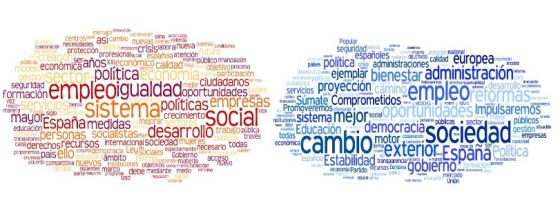
Las palabras más repetidas en los programa del PSOE (izquierda) y del PP

Si las palabras siempre cuentan, más lo hacen en campaña electoral. A tres días de su comienzo oficial, y con el documento programático del PP finalmente a mano, un rápido análisis léxico permite echar un vistazo al “peso” que cada palabra tiene en los programas de las dos principales fuerzas políticas. Empezando por las tres primeras, en orden de relevancia.

Las palabras más mencionadas en el documento del PSOE son social (repetida 232 veces) y empleo (206): la raíz del nombre y de la identidad de los socialistas prima en el texto, y acompaña a menudo otros términos cómo “economía”, “política” y “cohesión”. El empleo, el flanco débil de la última legislatura, se convierte en la primera preocupación del programa del PSOE. Por la misma razón, no sorprende que entre las tres primeras palabras más recurrentes en el programa del PP, también figure empleo, aunque en tercera posición. En el texto de los populares (222 páginas contra las 149 del PSOE) aparece 223 veces, detrás de sociedad (251) y cambio (261), palabra clave de toda la campaña de los de Rajoy.

Los otros términos relevantes que aparecen entre los primeros 10 en el programa del PP se prestan a varias interpretaciones: se repiten exterior, España y reformas, seguidas a poca distancia de oportunidades, administración, mejor y bienestar. Las primeras tres están en parte relacionadas, porque “exterior” se acompaña casi siempre a “proyección” y expresa la crítica del PP sobre la “pérdida” de peso internacional de España, que “ha pasado a ser un socio impredecible y poco fiable”. “Reformas” es también uno de los pilares del programa de los populares, en el que aunque falten los detalles de muchas propuestas, los propósitos reformistas abundan (otra palabra recurrente es impulsaremos).

En el programa del PSOE, en cambio, se insiste en vocablos que remiten a las políticas sociales y, por otro lado, a la economía. La tercera palabra más repetida es sistema, cuya relevancia depende más de los términos que la complementan: “sistema educativo”, “sistema universitario” y “sistema financiero”. A muy poca distancia está el vocablo igualdad, y también en este caso su importancia se comprende mejor si se considera la expresión en la que aparece: “igualdad de oportunidades”, la más repetida, e “igualdad de género”. Siguen las palabras economía, sector (en combinación con términos como “económico”, “energético”, “público” y “privado”, que remiten siempre al universo semántico de la economía), desarrollo, empresa y España.

Además, si se mira a la nube de términos que representa gráficamente el peso de cada palabra en los dos textos, entre los términos comunes más utilizados está gobierno. Pero en el programa del PP está mucho más presente.


November 1, 2011

04 Más que convencer, seducen

Filed under: economía,future,módulo básico — fores @ 10:37 am

Más que convencer, seducen

Las campañas son cada vez más personalistas, recalcan los expertos

Y la capacidad de sintetizar ideas complejas en un titular es imprescindible

31 OCT 2011 – 19:18 CET3

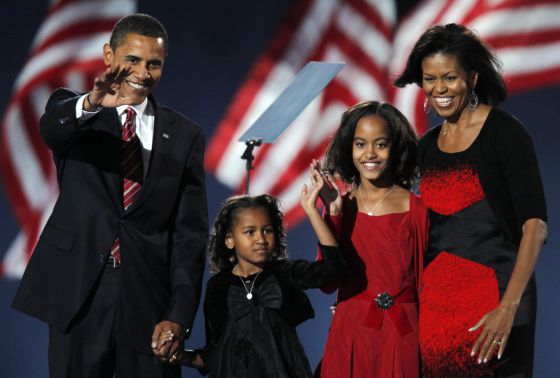
“Cuatro personas, tres colores”. El experto Jorge Santiago Barnés destaca el primer discurso de Barack Obama tras ganar las elecciones, en un parque de Chicago en 2008, como una puesta en escena diseñada para evitar distracciones y que destaque el mensaje. / GARY HERSHOM (REUTERS)

Londres, 1979. Dos asesores se sientan frente a la dama. “Ese sombrero tiene que desaparecer… Y las perlas”, advierte el de la izquierda. “Pero lo fundamental es su voz. Demasiado aguda, no denota autoridad”, añade. A lo que ella responde: “Quizá logran convencerme de que abandone el sombrero… Pero las perlas… ¡son absolutamente no negociables!”, esta Margaret Thatcher. Los líderes quizá nacen, pero, como muestra el tráiler de la película La dama de Hierro (aún sin estrenar), los candidatos se hacen. Más aún ahora, cuando las campañas son cada vez más personalistas, como explica Jorge Santiago Barnés, doctor en Comunicación Política. ¿En qué se centran más quienes diseñan las campañas de Mariano Rajoy o Alfredo Pérez Rubalcaba? ¿En la imagen o en el mensaje?

La competición es “más entre Rajoy y Rubalcaba que entre el PSOE y el PP o entre la izquierda y la derecha”, asegura Barnés, director del máster de Asesoramiento de Imagen y Consultoría Política de la Universidad Pontificia de Salamanca. Y lo que más importa en esa batalla no es que “Rajoy se haya quitado la corbata o Rubalcaba se haya puesto jeans”, dice, sino “su imagen psicológica, lo que transmiten sus palabras”. “La fortaleza de Rubalcaba es cómo transmite su mensaje, el sosiego”, explica este experto, que pone el ejemplo de su abuela: “Ella decía ‘¡Qué bien habla este hombre!’. Y eso que ella era de los otros, pero Rubalcaba le transmitía algo”. Es una capacidad tan difícil de describir como fácil de percibir. “Hay personas que en cinco minutos saben cautivarte. Rajoy creo que no es de esos, es de los que te cautiva en 20 minutos. Baja el tono, hace pausas, no parece que estés en un mitin”, sostiene Barnés. “Las campañas no están tan basadas en argumentos, sino en emociones y sentimientos”, afirma la periodista política Iolanda Mármol, que analizó la de las elecciones generales de 2008 y después publicó Secretos de campaña.

Los expertos creen que ahora hay poco margen de maniobra porque la campaña está monopolizada por la crisis y el desempleo, y los sondeos pronostican una holgada mayoría popular.

ampliar foto

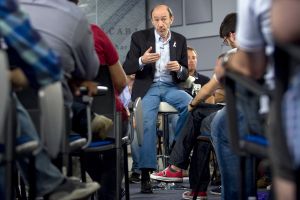
La periodista política y autora de ‘Secretos de campaña’, Iolanda Mármol, explica que en los mítines íntimos con simpatizantes Alfredo Pérez Rubalcaba se sienta en un taburete, lo que “le rejuvenece”. / SANTI BURGOS

Los dos grandes partidos afrontan la batalla con estrategias diferentes. “Al PSOE la marca le está lastrando. Por eso vamos a ver más personalización en Rubalcaba. En el PP también la hay [con Rajoy], pero el PP siempre ha tenido una marca como gestor de crisis”, añade Mármol. Ello estaría llevando al PSOE a poner el foco en su candidato y minimizar la presencia del partido. El director de comunicación del PSOE, Carlos Hernández, discrepa de este análisis: “El logo del PSOE está por todas partes. Para nada se está ocultando”.

Se trata de potenciar las virtudes y disimular los defectos, insisten los expertos. Es imprescindible mostrarse cercano y, por eso, explica Mármol, el PP está embarcado en presentar a Rajoy “como ser humano más que como alguien portador de ideas. Aún no conocemos muchas de sus propuestas, pero ya sabemos que monta en bici, que ha logrado adelgazar…”.

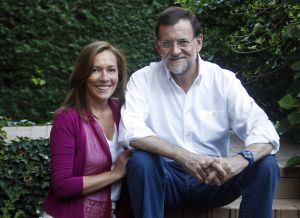
Hernández, del PSOE, asegura que han optado por “una campaña explicativa”, que “lo prioritario es el mensaje y la imagen pasa a segundo o tercer plano”. Sin embargo, no renuncia a algunos detalles. Mármol recuerda que en los mítines íntimos con simpatizantes Rubalcaba se sienta en un taburete, lo que “le rejuvenece”, y menciona aquella ocasión (la única, confirman en el PSOE) en la que llegó a un acto público conduciendo su coche, un utilitario. Y solo ahora que es el número uno ha acudido a actos públicos, a dos, con su esposa, Pilar Goya. Ambos candidatos aceptaron la petición de este diario de posar con sus respectivas esposas, aunque ellas no hicieran declaraciones.

Recalcan los asesores en Comunicación Política que en este mundo tan mediatizado es imprescindible también saber sintetizar ideas complejas en un titular. “La televisión es indiscutiblemente el medio por excelencia. Esos 15 segundos [lo que el candidato habla en pantalla] son la esencia de la campaña. Es evidente que la política debe ser simplificada al mínimo común denominador”, subraya Luis Arroyo, presidente de la Asociación de Comunicación Política. Es un fenómeno que a Mármol le preocupa mucho por sus implicaciones: “La política se está descafeinando, se diluye, se banaliza, se trivializa tanto que yo diría que estamos cayendo en el neopopulismo”. Arroyo considera “prepotente” pensar que los electores “ven tres informativos, leen cuatro periódicos y los programas electorales” para decidir su voto. El secreto de una buena campaña es, según este experto que ha trabajado en algunas de los socialistas, “un contexto adecuado y una narrativa poderosa, sugerente y creíble”. En el PP confirman que Rajoy suele decir “que la dictadura del titular y el total de televisión no le hace justicia” a su capacidad “de generar empatía en el trato directo”.

ampliar foto

Es habitual que los candidatos acepten posar con sus esposas, porque les humaniza, incluso si ellas prefieren, como Elvira Fernández, mantener un perfil bajo. / BERNARDO PÉREZ

¿Hacen caso los candidatos a las peticiones de los asesores, externos o del partido? “Rubalcaba es muy intuitivo, dicen que no hace caso… Y Rajoy me consta que lleva mucho preparándose”, responde Arroyo. El portavoz del PSOE asegura que el cabeza de lista “acepta todo tipo de sugerencias sobre el contenido, pero es menos receptivo con lo relativo a su imagen”. Añade Hernández que Rubalcaba ya tenía “una imagen muy sólida”, “no hay tiempo, ni creemos necesario cambiarla”. En 2008, al PP le salió el tiro por la culata, dice la autora de Secretos de campaña, que revela: “Uno de los asesores que contrató el PP me dijo: ‘Mira, a Mariano Rajoy le dieron tantos consejos, qué vestir, qué hacer, que lo convirtieron en un personaje impostado”. De ahí al fiasco de “la niña de Rajoy”.

Fuentes del PP aseguran que ahora “no tiene” consultores externos, sino “los asesores de siempre del partido”. Y añaden que Rajoy hace “bastante” caso porque, recuerdan, “fue director de las campañas con mejores resultados del PP” y “entiende mucho del asunto”.

ampliar foto

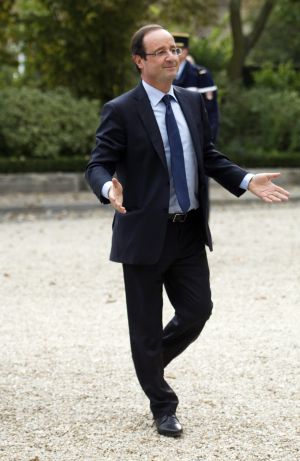
El aspirante socialista francés a la presidencia, François Hollande, se puso a dieta cuando decidió presentarse a las primarias, que acaba de ganar. Perdió 11 kilos. / fred dufour (afp)

“Lo importante es que el mensaje llegue y que llegue como nosotros queremos, sin distracciones”, explica Barnés, al que le viene a la mente el discurso de la victoria de Obama, diseñado para que solo destacara el mensaje. Imagen y mensaje son, según Arroyo, inseparables. El peso de cada uno depende de las circunstancias. Gloria Ostos, de Ostos y Sola, que trabajó para el PP en 2008, recalca que “la imagen ya no es corbata azul o verde. Es potenciar la imagen del candidato y que sea coherente con su mensaje. Porque el ciudadano vota con mucho sentido común”. Y todo con un fin: “Potenciar el voto duro, activar al desmotivado y desactivar al que está en contra para que no vote o vote otra cosa [que considera menos dañina]”.

Cuenta Barnés, director del máster de Asesoramiento de Imagen y Consultoría Política, que a veces un candidato recibe un empujón inesperado y eficaz. Por ejemplo, cuando el presidente francés, Nicolas Sarkozy, alabó los méritos de Rajoy como jefe de la oposición, junto a los del presidente Zapatero, para sacar a España de la primera fila de la crisis. “Esas palabras tienen más efectos positivos [en la campaña del PP] que cualquier declaración de Rajoy”. Las declaraciones dañinas tampoco son infrecuentes, añade. Véase al portavoz del PP, Esteban González Pons, diciendo la semana pasada: “No hay ningún español tan idiota que quiera la continuidad que el PSOE ha dado estos años”. Luego pidió disculpas vía Twitter. Precisa que el elector acepta, obviamente, a quien disiente, pero no tolera los ataques, “porque son personales”.

Los expertos en comunicación política españoles trabajan mucho en Latinoamérica, donde los partidos, como en EE UU, están menos estructurados y, en consecuencia, tienen más poder para moldear al candidato. Todos los consultados opinan que la estrategia Cristina Kirchner, que acaba de arrollar en Argentina sin aceptar una entrevista, un debate en televisión o un reportaje, jamás prosperaría en España. Rajoy acudirá a un debate pero no ha previsto un solo contacto con los periodistas que cubren su campaña.

Thatcher fue fiel a su palabra. Y a sus perlas.


« Previous Page — Next Page »

WPMU Theme pack by WPMU-DEV.