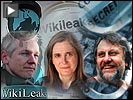
AMY GOODMAN: Democracy Now! was in London this weekend for and unusual gathering. 18 hundred people gathered in an old theater in the East End of London, called the Troxy, to watch a conversation between WikiLeaks editor in chief, Julian Assange and renowned Slovenian philosopher Slavoj Žižek. I moderated the event.
Our discussion centered on the impact of WikiLeaks on world politics, the Iraq and Afghanistan War Logs, and Cablegate, the largest release of U.S. State Department cables in history. Julian Assange is currently under house arrest in Norfolk, outside London, pending his trial, pending his going to court next week. He is appealing extradition to Sweden for questioning in a sexual misconduct case. Assange has now spent six months under house arrest despite not being charged with a crime in any country. On Friday, WikiLeaks announced it intends to sue Visa and MasterCard for blocking donations to the service an action it described as, “an unlawful U.S. influenced financial blockade.”
Saturday’s event was sponsored by the Front Line Club, which was founded in part to honor journalists who fall in the front lines of war. Its founder, Vaughn Smith, has given refuge to Julian Assange at his estate in Norfolk. Assange was wearing an ankle monitor under his boot and the event at the Troxy was concluded shortly after 6 p.m. so that Assange could return to his bail address by his curfew.
Today we play the first part of the conversation.
AMY GOODMAN: It is a great honor to be with you this afternoon and a shout out to all of the people who are watching this broadcast all over the world. We are live streaming this at democracynow.org. By the way, how many of you watch, or listen to, or read Democracy Now!?
[loud applause]
AMY GOODMAN: We’ve given out about a thousand fliers of where we broadcast in Britain and also where you can watch, read and listen to the broadcast. We’re also live streaming, we’ve offered the embed for anyone to take to put on their website. The Nation is live streaming us, michaelmoore.com is live streaming us, Free Speech TV is broadcasting Democracy Now! across the United States and there are many others. I hope people Tweet in and Facebook and let us know what you are doing with this broadcast. It’s extremely important because information is power. Information is a matter of life and death. We’ve learned that through these remarkable trove of documents that have been released in the last year. The Iraq War Logs, the Afghanistan War Logs, and what’s been called Cablegate, the U.S. state department documents that are continuing to be released.
Why does it matter so much? Well, we’ll talk about that this afternoon, but let’s just take one example, that came out in the Iraq War Logs, February of 2007. The war logs show that two men were standing under an Apache helicopter, the men have their hands up, they clearly are attempting to surrender, the Apache helicopter can see this. So, they are not rogue. The soldiers call back to the base and they say what should we do? These men have their hands up. The lawyer on the base says you cannot surrender to a helicopter and they blow the men, attempting to surrender, away—that was February 2007.
Now, we will fast forward to July 12, 2007, a video that has been released by WikiLeaks. This devastating video of an area of Baghdad called “New Baghdad”, where a group of men were showing around two Reuters journalists. Well, one was a videographer, a young up-and-coming videographer named Namir Noor-Eldeen and one was his driver, Saeed Chmagh; he was 40 years old, he was the father of 4 and they were showing them around the area. The same Apache helicopter unit is hovering above. They open fire.
The video is chilling. I am sure many of you have seen it. If you watch or listen to Democracy Now! we played it repeatedly discussing it with various people from Julian Assange to soldiers who were there on the ground, over time we dissected this.
The soldiers opened fire, you have the video of the target and you have the audio of the sounds of the soldiers cursing laughing, but not rogue, always going up the chain of command asking for permission to open fire. In the first explosion Namir Noor-Eldeen and the other men on the ground are killed. Saeed Chmagh, you can see him attempting to crawl away. And then a van pulls up from the neighborhood and they are attempting to pick up the wounded, there are children in the van and the Apache helicopter opens fire again and Saeed Chmagh, others in the van are killed. Two little children are critically injured inside.
US SOLDIER 1: Where’s that van at?
US SOLDIER 2: Right down there by the bodies.
US SOLDIER 1: OK, yeah.
US SOLDIER 2: Bushmaster, Crazy Horse. We have individuals going to the scene, looks like possibly picking up bodies and weapons.
US SOLDIER 1: Let me engage. Can I shoot?
US SOLDIER 2: Roger. Break. Crazy Horse one-eight, request permission to engage.
US SOLDIER 3: Picking up the wounded?
US SOLDIER 1: Yeah, we’re trying to get permission to engage. Come on, let us shoot!
US SOLDIER 2: Bushmaster, Crazy Horse one-eight.
US SOLDIER 1: They’re taking him.
US SOLDIER 2: Bushmaster, Crazy Horse one-eight.
US SOLDIER 4: This is Bushmaster seven, go ahead.
US SOLDIER 2: Roger. We have a black SUV —- or Bongo truck picking up the bodies. Request permission to engage.
US SOLDIER 4: Bushmaster seven, roger. This is Bushmaster seven, roger. Engage.
US SOLDIER 2: One-eight, engage. Clear.
US SOLDIER 1: Come on!
US SOLDIER 2: Clear. Clear.
US SOLDIER 1: We’re engaging.
US SOLDIER 2: Coming around. Clear.
US SOLDIER 1: Roger. Trying to -—
US SOLDIER 2: Clear.
US SOLDIER 1: I hear ’em — I lost ’em in the dust.
US SOLDIER 3: I got ’em.
US SOLDIER 2: Should have a van in the middle of the road with about twelve to fifteen bodies.
US SOLDIER 1: Oh yeah, look at that. Right through the windshield! Ha ha!
AMY GOODMAN: Now, I dare say that if we had seen what came out in the Iraq War Logs in February of 2007, if we had learned the story at the time after it happened, of the men with their hands up trying to surrender, there would have been an outcry. People are good, people care, people are compassionate, they would have called for an investigation. Perhaps one would have begun, but it might well have saved the lives of so many. Certainly, months later, perhaps that same Apache helicopter unit under investigation would not have done what it did. And maybe Namir Noor-Eldeen, the young Reuters videographer and his driver Saeed Chmagh, not to mention the other men who were killed and the kids critically injured, none of that would have happened to them. That’s why information matters. It is important we know what is done in our name. And today we are going to talk about this new age of information.
We’re joined by two people, many of you know well. Earlier I asked a young man, who would come to the gathering, why he traveled so far. He said, “are you kidding, to be with two of the most dangerous people?” The National Review calls Slovenian philosopher Slavoj Žižek, the most dangerous political philosopher in the West and The New York Times says he’s the Elvis of cultural theory. Slavoj Žižek has written over 50 books on philosophy, psychoanalysis, theology, history and political theory. His latest book Living in the End Times—and we’ll talk about what he thinks and talks about around the world.
Now, we’re joined by another man who has published perhaps more than any one in the world. In fact he wrote a book on the underground computer information age called, The International Computer Underground. (Correction: The title of Julian Assange’s book is Underground: Tales of hacking, madness and obsession on the electronic frontier.) But with the Iraq War Logs, the Afghanistan War Logs, and now the U.S. government cables that have yet to be fully released, I would say that perhaps Julian Assange is the most widely published person on earth.
Today we’re going to have a conversation about information and I’d like to ask Julian to begin by going back to that moment in 2007, as we talk about the Iraq War Logs. And talk about the significance of them for you and why you’ve chosen to release this information.
JULIAN ASSANGE: Amy, I suspect under that criteria perhaps Rupert Murdoch is the most widely published person on earth. Something people say Australia has given to the world Rupert Murdoch and me, big in publishing. Well, in some ways things are very easy for us and very easy for me in that we make a promise to sources that if they give us material that is of a certain type, that is a significant—of diplomatic, “cryptical”, ethical, or historical significance, not published and under some sort of threat, we will publish it. And that actually is enough.
Of course, we have a goal with publishing in general. It has been my long term belief that what advances us as a civilization is the entirety of our international record, the entirety of our understanding about what we are going through, what human institutions are actually like and how they behave. And if we are to make rational policy decisions in so far as any decision can be rational then we have to have information that is drawn from the real world, and a description of the real world.
At the moment we are severely lacking in the information from the interior of big secretive organizations that have such a role in shaping how civilization evolves and how we all live.
AMY GOODMAN: As we continue with this unusual rare gathering in the East End of London on Saturday of July 4th weekend. A discussion between Slovenian philosopher Slavoj Žižek and WikiLeaks editor in chief Julian Assange.
JULIAN ASSANGE: Getting down in to Iraq, so that was 400 thousand documents. Each one written in military speak, on the other hand, each one having a geographic coordinate down often to 10 meters, a death count of civilians, U.S. military troops, Iraqi troops and suspected insurgents.
So, it was the first, rather the largest, because we also did the Afghan War Logs, the largest history of a war, the most detailed significant history of a war to have ever been published, probably at all, but definitely during the course of a war. And so it provided a picture of the every day squalor of war. From children being killed at road side blocks to over a thousand people being handed over to the Iraqi police for torture, to the reality of close air support and how modern military combat is done—linking up with other information such as this video that we discovered—men surrendering, being attacked.
So, as an archive of human history this is a beautiful and horrifying thing—both at the same time. It is the history of the nation of Iraq and most significant recording during its most significant development in the past 20 years. And while we always see newspaper stories reporting and revealing some individual, if we’re lucky, some individual event or some individual family dying. This provides the broad scope of the entire war and all the individual events. So, the details of over 104 thousand deaths.
And we worked together to statistically analyze this with various groups, around the world, such as Iraq Body Count, who became the specialists in these areas and lawyers here in the U.K. who represented Iraqi refugees—to pull out the stories of 15 thousand Iraqi civilians, labeled as civilians by the U.S. military, who were killed and were never before reported in the Iraqi press, never before reported in the U.S. press, world press even in aggregate—even saying today 1,000 people died. Not reported in any manner whatsoever. And, yeah just think about that—15 thousand people whose deaths were recorded by the U.S. military, but were completely unknown to the rest of the world—that’s a very significant thing.
I mean, compare that to 3,000 deaths on 9/11. Imagine the significance for Iraqis. That is something that we specialize in and that I like to do and that I always do is go from the small to the large, not just by abstraction or analogy, but actually by encompassing all of it together. And then trying to look at it and abstract, through mathematics or statistics. And so to try and sort of push both of these things at the same time, the individual relationship, plus the state relationship, plus the relationship that has to do with civilization as a whole.
AMY GOODMAN: Slavoj Žižek, the importance of WikiLeaks today in the world?
SLAVOJ ŽIŽEK: Wait a minute, to understand properly this question, this question is just, you can withdraw and just give me two hours. No, but we’ll try to condense it. First, let me say also how proud I am to be here and mention something, which maybe most of you don’t know—that, how difficult it was even to organize this event. Like, it had to be moved two times—out and more out from Central London and so on.
And so, what again, what I want to say is let me begin with the, uh, the significance of what you—Amy started with, this shots, I mean not shooting, but video shots of those Apache helicopters shooting on…You know why this is important? Because the way ideology functions today it’s not so much that—let’s not be naive, that people didn’t know about it. But I think the way those in power manipulate it. Yes, we all know dirty things are being done, but you are being informed about this obliquely in such a way that basically you are able to ignore it.
Can I make a terrible, maybe sexually offensive, but not that dirty don’t be afraid, remark? You know, like a husband, sorry for making male chauvinist, uh twist—a husband may know abstractly my wife is cheating on me and you can say, okay I’m modern, tolerant husband, but you know when you get the thought of your wife doing things it’s quite a different thing. And I would say with all respect, something similar, it’s very important because it, just say no, I’m not dreaming here.
The same thing happened about two years ago in Serbia. You know, people rationally accept that we did horrible things in Srebrenica and so on, but you know it was just abstract knowledge. Then by chance all the honor who served media, to publish this, they got hold of a video effectively showing a group of Serbs pushing to an X and shooting a couple of Bosnian prisoners. And the effect was a total shock, national shock, although again, strictly saying nobody learned anything new.
So here, so that I don’t get lost, if you allow me just a little bit more, here we should see the significance of WikiLeaks. Many of my friends who are skeptical about it are telling me. So, what did we really learn? Isn’t it clear that every power in order to function you have collateral damage—you have to have a certain discretion? What you say, what you don’t say, but to conclude I mean to propose a formula, what WikiLeaks is doing and it’s extremely important. Of course, I’m not a Utopian. Neither me nor Julian believes in this kind of pseudo-radical openness—everything should be clear and so on. But what are we dealing with here?
Another example from cinema, very short, Ernst Lubitsch’s Ninotchka. You find there a wonderful joke where, I think towards the beginning of the film, the hero enters a cafeteria and says, “can I get some coffee with cream please?” And the waiter answers him, “sorry we run out of cream we only have milk. So, can I serve you coffee without milk?” That’s the trick here. When we learn something from the media, like, if I may repeat the metaphor, they behave as if they are serving coffee with cream. That is to say of course we all know they are not telling the entire truth, but you know, that is the trick of ideology, even if they don’t lie directly the implication is the unsaid is a lie. And you bring this out. You are not so much putting them, catching them, as they put it, with their pants down and lying on behalf of what they explicitly say, but precisely on behalf of what they are implying. And I think this is an absolutely crucial mechanism in ideology. It doesn’t only matter what you say it matters what you implied to say.
So, just to make the last point, I think that—are we aware that what an important moment we are living today? On the one hand, as you said information is crucial and so on. We all know that it’s crucial economically. I claim that one of the main reasons capitalism will get in to crisis is intellectual property. In the long term it simply cannot deal with it. But what I’m saying is just take the phenomenon that media are trying to get us enthusiastic for clouds. Like you know, computers getting smaller and smaller and all is done for you up there in a cloud.
Okay, but the problems is that clouds are not up there in clouds—they are controlled and so on. For example, you rely on, maybe you have an iPhone, but you mentioned Murdoch. [His] name was mentioned here. Do you know, it’s good to know if you rely on your news through iPhone or whatever, that Apple signed an exclusive agreement with Murdoch. Murdoch’s corporation is again the exclusive provider of entire news and so on and so on. This is the danger today. It’s no longer this clear distinction, private space-public space. The public space itself gets, as it were, privatized in a whole series of invisible ways—like the model of it being clouds; which is why and again this involves new modes of censorship, repeat this.
That’s why you say, but what really did we learn new? Maybe we learned nothing new, but you know it’s the same as in that beautiful old innocent fairytale, the Emperor is Naked. The Emperor is Naked. We may all know that the emperor is naked, but the moment somebody publicly says, “the emperor is naked,” everything changes, but the moment somebody publicly says the emperor is naked everything changes. This is why even if we learned nothing new – but we did learn many new things – but even if nothing learned, the forum matters. So, don’t confuse Julian and his gang – in a good sense not the way they accuse – don’t confuse them with this usual bourgeois heroism, fight for investigative journalism, free flow and so on. You are doing something much more radical. That’s why it aroused such an explosion of resentment. You are not only violating the rules, disclosing secrets and so on. Let me call it in the old Marxist way the bourgeois press today has its own way to be transgressive. Its ideology controls not only what you can say but also how you can violate what you are allowed to say. You are not only violating the rules, you are changing the very rules how we were allowed to violate the rules. This is maybe the most important thing you can do.
AMY: And, yet, Julian even as you were releasing information in all different ways, you then turn to the very gatekeepers who in some cases had kept back this information and you worked with the mainstream media throughout the world in releasing various documents. Talk about that experience and that level of cooperation and what has happened after that.
ASSANGE: If you want to have an impact and you promise an impact and you’re an organization which is very small where actually you have to co-opt or leverage the rest of the mainstream press. So, under our model of how you make and impact and get people to do things that you wouldn’t have been otherwise be able to do, unless you have an army that can physically go someplace and divisions that can roll over.
The only way you can easily make an impact is push information about the world to many, many people. So, the mainstream press has developed expertise for how to do that. And it’s competition also for people’s attention. So, if we had several billion dollars to spend on advertizing across the world, if we could get our ads placed, we wouldn’t easily be able to make the same impact as we did. And we don’t have that kind of money. So, instead we entered into
partnership with over 80 media organizations all over the world, including many good ones that I wouldn’t want to disparage. To increase the impact and push our material into over 50 different countries endemically. That has been, yes, subverting the filters of the mainstream press.
But an interesting phenomena has developed amongst the journalists who work in these very large organization that are close to power and negotiate with power at the highest levels, which is the journalists having read our material and having been forced to go through it to pull out stories have themselves become educated and radicalize. And that is an ideological penetration of the truth into all these mainstream media organizations. And, that to some degree, may be one of the lasting legacies over the past year. Even Fox News, which is much disparaged, is an organization that wants viewers. It cannot do anything else without viewers. So, it will try and push news content.
So, for example, with collateral murder, CNN showed only the first few minutes and blanked out all the bullets going to the street, completely blanked it out – and said they did it out of respect for the families of the people who were killed, well there was no blood, there was no gore. And then they cut out all the most politically salient points. And the families had come forward and said that it was very important for us to have seen it. Fox actually displayed the first killing scene in full. Quite interesting. So, Fox not perceiving itself to be amenable to the threat of it not acting in a moral way actually gave people more of the truth than CNN did. So,
Fox also motivated to grab in a hungry way this greater audience share as possible took this content and gave it to more people. Afterwards, of course, they put in their commentators to talk against it but I think that the truth that we got out of Fox was often stronger than the truth we got out of CNN and similarly for many institution in the media that we think of as liberal.
AMY GOODMAN: Speaking of other legal cases I just wanted to ask you about what you face next week, the extradition case on July 12th. The Nation magazine has done two pieces—one is forthcoming. And they quote your new lawyer, Gareth Peirce who is very well known for representing prisoners at Guantanamo, a renowned human rights attorney. And Tom Hayden, who writes the piece, interviewed many people in Sweden and the United States and sort of talks about a feeling in Sweden of an attack very much represented by your past lawyers on the Swedish justice system, and on the integrity of the women in Sweden. And he quotes Gareth Peirce saying…
JULIAN ASSANGE: Our lawyers never attacked any integrity of women.
AMY GOODMAN: Well, he quotes Gareth Peirce saying, “the history of this case is as unfortunate as it is possible to imagine. Each of the human beings involves deserves respect and consideration.” And I just wanted to ask if you are seeing this as a change of approach with your legal team in dealing with your possible extradition to Sweden?
JULIAN ASSANGE: Possibly, I mean the situation….What has happened to Europe and what has happened to Sweden is fascinating. It is something I have come to learn because I’ve been embroiled in it. But it is intellectually extraordinary—so we see for example, that the European Union introduced an Arrest Warrant system. And that Arrest Warrant system to extradite from one state of the EU to another state of the EU was put in place in response to 9/11 to extradite terrorists—to have fast extradition of terrorists. And it introduced this concept, or rather recycled a European Union concept of mutual recognition. This is sort of a very feel good phrase, that one state in the EU mutually recognizes another state in the EU, and that shrunk down into mutual recognition between one court in the EU to another court in the EU. But actually what it seems to be talking about, if you think about it, given the reality that three people a day are extradited from this country to the rest of Europe, is a mutual recognition of the elite in each country in the EU. It is a method of, um, of being at peace.
So, the elite in each country in the EU, has, if you like, made literally a treaty with each other, to recognize each other and to not complain about the behavior. Now you might say that, well okay, we have justice systems in the EU and various countries. Some are better some are worse depending on your values system, but we have sunk so low that it’s not even like that anymore. The European Arrest Warrant talks about the mutual recognition of judicial authority—so courts. But it has permitted each country to define what they call a judicial authority, and Sweden has chosen to call policeman and prosecutors judicial authorities. And the whole basis of this term being used in the original introduction of the European Arrest Warrant was that you would keep the executive separated from the judicial system, that it was meant to be a natural and neutral party who would request extradition and it’s not.
So there are many things like this that are going on in that case. I haven’t been charged. Is it right to extradite to a state where they do not speak the language? Where they do not have family, they do not know the lawyers, they do not know the legal system. If you don’t even have enough evidence to charge them, you won’t even come over as we have offered many times to speak to the people concerned. So previous complaints about these sort of problems have lead to some inquires in Sweden. For instance, the biggest Swedish law magazine that goes out to all the lawyers had a survey on this and one third of the lawyers responding said that yes, these complaints about the Swedish judiciary system, they truly are a problem. On the other hand, it has entered a situation where the Swedish Prime Minister and the Swedish Justice Minister have personally attacked me. Um, and said, the Swedish Prime Minister said that I had been charged to the Swedish public, when I hadn’t been.
So it is a delicate situation, Sweden, the Sweden we have now is not the Sweden of Olof Palme in the 1970s. Sweden recently sent troops, recently passed a bill to send marines in Libya. It was the fifth country out to send fighter jets into Libya. This is a different dynamic, we have to be careful at dealing with it. It’s one thing to sort of be considerate of differences in the way various justice systems are administered, but it’s another to tolerate any difference. And I don’t think any difference should be tolerated in the EU.
You know, what it is that prevents the justice systems of EU states from fundamentally collapsing and decaying? You say there is mutual recognition. There’s mutual recognition between the UK and Romania, and what if the Romanian justice system collapses more and more and more? Who’s going to account for that? Who’s going to scrutinize it? Is it going to be some bureaucrats in the EC that are going to scrutinize the Romanian justice system? No. The only sustainable approach to scrutinizing the justice systems of the EU is the extradition process.
So it is extradition lawyers and defendants who have the highest motivation to scrutinize the quality of justice in the state that they are being extradited to. And that’s a healthy system that permits outside scrutiny—and so it can stop European states from decaying. But the European Arrest Warrant system removes that possibility; it’s not open to us to look at any of the facts in the case in the extradition at all, that is completely removed. All we’re arguing about is whether the two page request that was filled out, which literally has a box ticked rape, is a valid document.
AMY GOODMAN: I wanted to ask you, Julian, about Bradley Manning. Mike Huckabee, who also was a presidential candidate, the governor of Arkansas, said that the person who leaked the information to Julian Assange should be tried for treason and executed. He said whoever in our government leaked that information is guilty of treason and I think anything less than execution is too kind a penalty. Bradley Manning is a young U.S. soldier who was in Iraq, um, has been held for more than a year, much of that time in solitary confinement in Quantico in Virginia. Um it was exposed that his treatment was tantamount to torture. P.J. Crowley, the White House State Department spokesperson, spoke to a group of bloggers at MIT and said his treatment is stupid. For that he was forced out of the State Department. Bradley Manning was then moved to Fort Leavenworth because of the outcry, but he remains, uh, in prison. He remains, um, not tried. What are your comments on him?
JULIAN ASSANGE: First of all, Amy, thanks for answering this question‚ asking this question, but it is difficult for me to speak in detail about that case, and but i can speak about why it is difficult for me to speak about it. So Bradley Manning is an alleged source of WikiLeaks who was detained in Baghdad, and then although there was very little ‚no mainstream press at the time, shipped off to Kuwait, where he was, if you like, held in an extrajudicial circumstance in Kuwait in a similar manner to which detainees are held in Guantanamo Bay. Eventually, through some legal, creative legal methods, he was brought back to the United States, and he’s been imprisoned now for over year. He was being kept in Quantico for eight months under extremely adverse conditions. Quantico is not meant for long-term prisoners. Other prisoners, the maximum duration over the past year has been three months, and people that have been visiting Bradley Manning say, and we have other sources who say, that they were applying those conditions to him because they wanted him to confess that he was involved in a conspiracy to commit espionage against the United States with me. That pressure on Manning appears to have backfired. So by all reports, this is a young man of high moral character and when people of high moral character are pressured in a way that is illegitimate, they become stronger and not weaker. And that seems to have been the case with Bradley Manning and he has told U.S. authorities, as far as we know, nothing about his involvement.
Now there has concurrently been a secret grand jury taking place six kilometers from the center of Washington. That grand jury involves nineteen to twenty-three people selected from that area. Now why was it in Alexandria, Virginia six kilometers [from] the center of Washington, that that grand jury was placed? And those people drawn? Well, it has the highest density of government employees anywhere in the United States. The U.S. government was free to select the place, and they selected this place in order to bias the jury from the very beginning. This, is in fact, wrong to call a jury. This is a type of medieval star chamber. There are these nineteen to twenty-three individuals from the population that are sworn to secrecy. They cannot consult with anyone else. There is no judge, there is no defense council, and there are four prosecutors. So that is why people that are familiar with the grand jury the United States say that a grand jury would not only indict a ham sandwich; it would indict the ham and the sandwich. And that’s a real threat to us.
A grand jury, which was removed from U.K. jurisprudence because of abuses, combines the executive and the judiciary. So this old common lore notion of the separation of these branches of power is removed in a grand jury. U.S. government argues that these captive nineteen to twenty-three individuals are the branch of the judiciary, if they perform a judicial function, where of course, actually, they’re just captive patsies for the Department of Justice, United States and the FBI. So they have been going out and they have coercive powers. They can force people to testify, and they have been pulling in all sorts of people that are connected to WikiLeaks and people that are not. They have recently a number of individuals that have been pulled to the grand jury understand what is going on and they have refused to testify and have pleaded the First Amendment, Third Amendment‚ Fifth Amendment protection against self-incrimination to‚ well I’m not sure the purpose, I don’t have direct communication, but from the outside it appears to nullify that political witch hunt in the United States against us.
Now, in response, the grand jury has been instructed to send out immunity certificates. So these are certificates that go to subpoenaed individuals that say that if you come to the grand jury to testify, your testimony cannot be used against you and therefore you have no right to plead the Fifth. What this means in practice is coerced, compulsive interrogation in secret with no defense council. There’s not‚ not even lawyers for, for the subpoenaed witnesses are permitted into the grand jury. It is just the prosecutors and these people from six kilometers away from the center of Washington. That’s something that should be opposed. There is another grand jury that has sprung up here in the United States and is investigating anti-war activists, engaged in the same sort of witch-hunt. So these are a really a classical device that was looked at very critically in the UK four hundred years ago, and the result in the UK’s concept of, the, if justice is to be done, it must be done publicly. And, that is being a concept that is way late. It’s interesting why or how it has been way late. So on the surface this device of, well you want the police to have an investigation, an executive says it wants to conduct and investigation into some group of people. Well, we get people from the community, nineteen to twenty-three people from the community, and they monitor the investigation. They make sure it’s not overstepping and so on. But actually this has been turned on its head and used as a way to completely subvert the judicial system in the United States.
AMY GOODMAN: WikiLeaks editor Julian Assange and Slovenian philosopher Slavoj Žižek speaking on Saturday before about 1,800 people in the East End of London. We had to end the event in order for Julian Assange to return to his bail address in order for him to meet his curfew. The event was sponsored by the Frontline Club. Part two of our conversation tomorrow, when among other things Julian Assange will talk about WikiLeaks’ case against MasterCard and Visa.
That does it for the show. If you’d like a copy go to our website for a copy, DemocracyNow.org. Special thanks to Julie Crosby, Dennis Moynihan, Rebecca Wallack, the Frontline Club.
Democracy Now is produced by Mike Burke, Renee Feltz, Aaron Mate, Nermeen Shaikh, Steve Martinez, Sam Alcoff, Hany Massoud. I’m Amy Goodman. Thanks so much for joining us.