Forés @ UVPress


         Universitat de València PRESS -UVPress- weblog for research uses

May 23, 2009

00 The Daily Show With Jon Stewart American Idealogues

Filed under: módulo básico — fores @ 10:11 am
The Daily Show With Jon Stewart M – Th 11p / 10c
American Idealogues
thedailyshow.com
Daily Show
Full Episodes
Economic Crisis Political Humor

May 20, 2009

00 Tomgram: Noam Chomsky, Unexceptional Americans

Filed under: módulo básico — fores @ 9:24 am

posted May 19, 2009 09:36 am

Tomgram: Noam Chomsky, Unexceptional Americans

Murder, torture, abuse… and photos of the same. We’ve seen some of them, of course. Now, evidently under pressure from his top generals, President Obama has decided to fight the release of other grim photos from the dark side of the Bush years of offshore injustice — on the grounds that their publication might inflame opinion in the Middle East and our various war zones (as if fighting to suppress their publication won’t). In this way, just as the president is in the process of making Bush’s wars his own, so he seems to be making much of the nightmare legacy of those years of crime, torture, and cover-up his, too.

The photos his Justice Department will fight to suppress (for how long or how successfully we don’t yet know) are now officially “his”; next, assumedly, come those military commissions, suspended as Obama took office, which are evidently about to be reborn as Obama era tools of injustice. (This brings to mind, in grimmer form, the old saw about how military justice is to justice as military music is to music.) And with those commissions comes that wonderfully un-Constitutional idea of detaining chosen prisoners indefinitely either entirely without trial or with trials that will be mockeries. And with that, evidently, goes the idea of possibly setting up some sort of new “national security court” to try some detainees. (Keep in mind that the Obama administration is already hanging on tightly to Dick Cheney’s “state secrets” privilege to block various lawsuits by those wronged in all sorts of ways in the Bush years.)

In other words, if you can’t go to court and get the punishments you want, the solution is simply to create courts jiggered in such a way (and surrounded by enough secrecy) that you’ll get the decisions you desire. If that isn’t a striking definition of American justice, I don’t know what is.

Obama’s national security world is now coming into view — and it’s not a pretty picture, but then, as Noam Chomsky points out, in a tour de force piece below, it hasn’t been a pretty picture for a long, long time. Tom

Why We Can’t See the Trees or the Forest

The Torture Memos and Historical Amnesia
By Noam Chomsky

The torture memos released by the White House elicited shock, indignation, and surprise. The shock and indignation are understandable. The surprise, less so.

For one thing, even without inquiry, it was reasonable to suppose that Guantanamo was a torture chamber. Why else send prisoners where they would be beyond the reach of the law — a place, incidentally, that Washington is using in violation of a treaty forced on Cuba at the point of a gun? Security reasons were, of course, alleged, but they remain hard to take seriously. The same expectations held for the Bush administration’s “black sites,” or secret prisons, and for extraordinary rendition, and they were fulfilled.

Read More >>

May 18, 2009

00 Echoes of the Bible: Obama’s Notre Dame Address

Filed under: módulo básico — fores @ 11:23 pm
Aaron Zelinsky

Aaron Zelinsky

Posted: May 18, 2009 01:29 AM

Echoes of the Bible: Obama’s Notre Dame Address

digg Share this on Facebook Huffpost – stumble reddit del.ico.us huffington_post:http://www.huffingtonpost.com/aaron-zelinsky/echoes-of-the-bible-obama_b_204484.html ShareThis RSS

President Obama made an admirable call for a civil discourse on abortion at Notre Dame’s commencement. While there was much controversy leading up to Obama’s address, his speech was generally well received by the Fighting Irish, and not just because of the sports references.

Obama successfully couched his underlying message of the abortion debate’s legitimacy in the familiar language of the Bible. In rhetoric, it’s important to remember your audience, and Obama clearly remembered in South Bend. Here are eight key lines from Obama’s address and the biblical passages they reference:

“Some were here during years that simply rolled into the next without much notice or fanfare – periods of relative peace and prosperity that required little by way of sacrifice or struggle.”

This line echoes Jeremiah 29:1, “Also, seek the peace and prosperity of the city to which I have carried you into exile. Pray to the Lord for it, because if it prospers, you too will prosper.” Jeremiah’s letter is a fitting reference for times of turmoil, as he instructs the Israelites to hope for prosperity in their new and challenging environment.

“Part of the problem, of course, lies in the imperfections of man – our selfishness, our pride, our stubbornness, our acquisitiveness, our insecurities, our egos; all the cruelties large and small that those of us in the Christian tradition understand to be rooted in original sin.”

First, Obama references seven sins (counting “cruelties large and small” as number seven). Many of the “original” seven deadly sins, enumerated by Pope Gregory, are referenced: selfishness, pride, and acquisitiveness. Interestingly, Obama leaves out envy, wrath, discouragement, and extravagance. Obama also references original sin, a concept largely crystallized by Augustine in the Sixth Century and a central tenet of Roman Catholics. While neither of these references is strictly biblical, they have deep religious resonance and tie the 21st Century’s problems to the age-old failings of man.

“The strong too often dominate the weak, and too many of those with wealth and with power find all manner of justification for their own privilege in the face of poverty and injustice.”

Here, Obama turns the traditional religious exhortation on its head, as the strong “dominate the weak” instead of protecting them. This line also references the Book of Joel, which looks to a time when such distinctions no longer matter: “Beat your plowshares into swords and your pruning hooks into spears: let the weak say, I am strong.”

“The question, then, is how do we work through these conflicts? Is it possible for us to join hands in common effort?”

This line alludes to Exodus 23:1: “Do not join hands with the wicked[.]” Again, Obama uses this phrase to signify its negation: Americans can join hands to debate each other as reasonable people, but only if they stop “demonizing those with just as strongly held convictions on the other side.” Each side must stop seeing the other as “wicked” so that they may “join hands in common effort.”

“And I said a prayer that night that I might extend the same presumption of good faith to others that the doctor had extended to me.”

Obama references the famous lines of Luke 6:31: “Do to others as you would have them do to you.” This is the speech’s central theme.

“But remember too that the ultimate irony of faith is that it necessarily admits doubt. It is the belief in things not seen. “

Obama quotes Hebrews 11:1 “Now faith is the substance of things hoped for, the evidence of things not seen.”

“Remember that each of us, endowed with the dignity possessed by all children of God, has the grace to recognize ourselves in one another; to understand that we all seek the same love of family and the same fulfillment of a life well-lived.”

The King James Version, in Galatians 3:26, is less inclusive: “For ye are all the children of God by faith in Christ Jesus.”

“If nothing else, that knowledge should give us faith that through our collective labor, and God’s providence, and our willingness to shoulder each other’s burdens, America will continue on its precious journey towards that more perfect union.”

Obama’s final line references Psalm 81:6, “I removed his shoulder from the burden,” and closes with an allusion to the opening line of the Preamble to the Constitution, moving from the founding texts of monotheism to our shared government’s founding charter: “We the people of the United States, in order to form a more perfect union, establish justice, insure domestic tranquility, provide for the common defense, promote the general welfare, and secure the blessings of liberty to ourselves and our posterity, do ordain and establish this Constitution for the United States of America.”

Related Blogs On Huffington Post:

Bill Press Bill Press: Obama Wins One For the Gipper

Obama changed what protesters tried to make an ugly scene about abortion into a triumphant message about faith-based politics.
Martha Burk Martha Burk: Weak on Women’s Rights at Notre Dame

I need to know Obama is not afraid to say unequivocally that he supports the fundamental rights of his daughters and my granddaughters as strongly as he supports so-called open dialogue and debate.
Paul Raushenbush Paul Raushenbush: Barack Obama’s (and America’s) Victory at Notre Dame

Ultimately, the biggest winner Sunday was Notre Dame. As President Obama said in his speech, the pro-life movement is no longer filled with caricatures.

May 17, 2009

00 El Plan Zapatero

Filed under: módulo básico — fores @ 7:26 pm

El Plan Zapatero

¿Será algo como esto, Sr. Presidente? Se pregunta Jordi Adell en http://elbonia.cent.uji.es/jordi/

con link al video publicado por vimeo.com en http://vimeo.com/2465202

y que describe la implementación en Uruguay del sistema CEIBAL y que como dice su presidente consiste en proporcionar a cada estudiante con un ordenador, aplicando la propuesta del MIT y Negroponte de fabricar ordenadores accesibles menos de 100 dolares unidad

Y un día antes ya hablaba de:

Nuevo artículo en El País, sin desperdicio, sobre los planes de Gobierno para “digitalizar” la escuela. Basta el último párrafo para comprender la auténtica naturaleza del plan (perpetuar un modelo de negocio basado en el papel y la imprenta, prescindiendo de cualquier otra consideración) y su potencial para hacer avanzar nuestro país hacia la sociedad de la información (ninguno). No me resisto a copiarlo (ni yo a copiarlo de Adell):

Las editoriales trabajan en el desarrollo de paquetes de materiales digitalizados, cuya novedad sería que los libros electrónicos llevan implantados un gestor (un hardware) que contiene una licencia personal para cada usuario. El niño al entrar en el ordenador introduce la contraseña que va en su licencia y empieza a trabajar en su libro digital. El gestor sirve también para que el profesor controle lo que hace cada niño en su ordenador. El ministerio está en contacto con las editoriales para ayudarlas a impulsar la renovación de su sector. El paquete contempla complementos, como diccionarios, recursos didácticos de ampliación y refuerzo y un abanico de actividades que dependen de la habilidad de cada niño. Lo que aún falta por definir es cuál es el precio de mercado de la licencia del libro digital.

Sin desperdicio alguno.

00 Tim Berners-Lee: ‘La Web 3.0 es la Web 2.0 sin barreras’

Filed under: módulo básico — fores @ 6:28 pm

INTERNET | 18ª Conferencia Mundial de la WWW

Tim Berners-Lee: ‘La Web 3.0 es la Web 2.0 sin barreras’

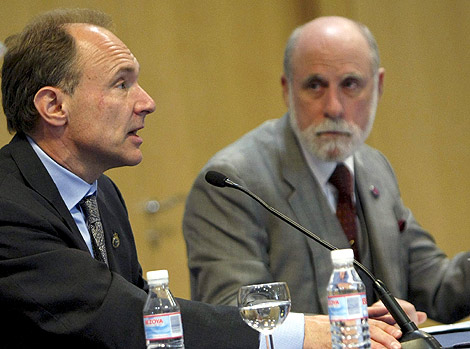
Tim Berner-Lee, y Vinton Cerf, padres de Internet | EfeTim Berner-Lee, y Vinton Cerf, padres de Internet | Efe
  • Una de las apuestas de Berners-Lee es que Internet sea ‘modulable’

A Tim Berners-Lee, uno de los padres de Internet, no le gusta mirar al futuro ni pensar en el pasado. Prefiere analizar el presente. Y en su charla de apertura de la 18ª Conferencia Mundial de la WWW ha apostado por acabar con las TRABAS que actualmente hacen de muchos sitios ‘jardines cerrados’ a sus propietarios: “La Web 3.0 es la Web 2.0 sin barreras”.

Tras saludar a “todos los geeks” del auditorio y a otros asistentes, Berners-Lee comenzó su charla con un objetivo claro -el de este evento-: dejar claro que una ‘Ciencia de la web’ es posible. Pero también lanzó algunas advertencias: “Los sitios vallados (‘walled gardens’) son una gran tentación, pero también pueden suponer una enorme frustración para el usuario“.

La intervención del ‘padre’ de Internet estuvo precedida por la inauguración oficial del evento, que estuvo presidida por los Príncipes de Asturias, el rector de la Universidad Politécnica de Madrid, Javier Uceda, y el secretario de Estado de Telecomunicaciones, Francisco Ros.

El inventor del hipertexto -tras dejar muy claro que en el futuro ve píxeles y pantallas por todas partes- desveló su apuesta por redes sociales abiertas que mejoren las posibilidades de interactuar a los usuarios. No respecto a cómo deben funcionar, sino en lo relativo al tratamiento de los datos que albergan. Motivo por el que apuesta por estándares: es mejor dejar tus datos disponibles que cerrarlos, incluso desde una perspectiva empresarial, ha explicado.

Una mejor experiencia móvil

Poco más de un 20% de la población mundial está conectada a la Red. Y en muchos casos, al menos en el tercer mundo, su primer contacto con Internet se produce a través de dispositivos móviles. Por eso es imprescindible “hacer la web accesible para estos dispositivos”. Y, por supuesto, que el acceso a la Red no dependa de acuerdos comerciales, sino que sea libre y abierto.

Otra de las propuestas de Berners-Lee es que Internet sea modulable, lo que mejorará sus posibilidades de crecimiento. “Hay que diseñar los sitios como si fuesen parte de algo más grande“, ha dicho antes de destacar los problemas que afronta un sistema de este tipo: la existencia de muchos lenguajes de programación que tendrán que ‘hablar’ entre sí. El javascript, ha asegurado, es una solución, pero no siempre funcionará.

“Necesitamos que Internet sea más colaboradora y menos estática”, ha afirmado sin temor a la interacción con los usuarios, pero también cree que es muy necesaria más “limpieza” en el tratamiento de los datos personales.

La Red que le gustaría tener a Berners-Lee es una con “datos bien integrados con los lenguajes de programación, de modo que sea muy sencillo operar”, pero también tiene claro que, cuando esto ocurra, será necesario “un modelo muy eficaz para garantizar la seguridad”.

¿Cómo se caracteriza y diferencia la Web 3.0 de la Web 1.0 y de la Web 2.0?

El desarrollador uruguayo,
Andrés Richero
, presenta el siguiente esquema:

  • Web 1.0 – Personas conectándose a la Web
  • Web 2.0 – Personas conectándose a personas – redes sociales, wikis, colaboración, posibilidad de compartir.
  • Web 3.0 – Aplicaciones web conectándose a aplicaciones web, a fin de enriquecer la experiencia de las personas, a esto agrega: estado de conciencia del contexto en la Web Geoespacial, autonomía respecto del navegador y construcción de la Web Semántica.

Sobre este último punto, cabe acotar que si bien diferentes factores se conjugan en la Web 3.0 a favor de la semantización de la web, en tanto esto es un proceso, no es privativo de ella. Por tal motivo, quizás sea más apropiado concebir la construcción de la Web Semántica, por fuera y por encima de estos estadíos o instancias.

« Previous Page — Next Page »

WPMU Theme pack by WPMU-DEV.