Forés @ UVPress


         Universitat de València PRESS -UVPress- weblog for research uses

May 7, 2011

03 Arctic ice melting faster, sea level to rise more, report says

Filed under: archivo personal,future,Holístico,interesting news,política — fores @ 11:00 am

Greenspace

Arctic ice study

Environmental news from California and beyond

« Previous | Greenspace Home | Next »

Climate change: Arctic ice melting faster, sea level to rise more, report says

(325)
(89)
May 4, 2011 | 12:31 pm

Icebergmelt

Sea levels will rise more dramatically than was predicted nearly four years ago by the Intergovernmental Panel on Climate Change, a new study of arctic conditions concludes.

The Arctic ice study by the International Arctic Monitoring and Assessment Program, titled Snow, Water, Ice and Permafrost in the Arctic (SWIPA), says that the feedback loops scientists have been warning about already are accelerating glacial melting in the Arctic, which accounted for 40% of sea-level rise chronicled annually from 2003 through 2008.

The executive summary of the report says:

The greatest increase in surface air temperature has happened in autumn, in regions where sea ice has disappeared by the end of summer. This
suggests that the sea is absorbing more of the sun’s energy during the summer because of the loss of ice cover. The extra energy is being released as heat
in autumn, further warming the Arctic lower atmosphere. Over land, the number of days with snow cover has changed mostly in spring. Early snow
melt is accelerated by earlier and stronger warming of land surfaces that are no longer snow-covered.

These processes are termed “feedbacks.” Snow feedbacks are well known. The sea-ice feedback has been anticipated by climate scientists, but clear evidence for it has only been observed in the Arctic in the past five years. Sea levels are expected to rise by 35 to 63 inches by 2100, far more than the 2007 projection of 7 to 23 inches made by the IPCC, the report says. Temperatures from 2005 through 2010 have been the highest since records began in 1880, the study shows.

The melting will not only affect sea levels; it has the potential to alter sea currents that regulate climate, the report warns:

All the main sources of freshwater entering the Arctic Ocean are increasing — river discharge, rain/snow, and melting glaciers, ice caps, and
the Greenland Ice Sheet. Recent calculations estimate that an extra 7700 km3 of freshwater -– equivalent to one meter of water over the entire land
surface of Australia -– has been added to the Arctic Ocean in recent years. There is a risk that this could alter large-scale ocean currents that affect
climate on a continental scale.

The report will be presented to the foreign ministers of Arctic nations next week, and is likely to stir more controversy over stalled efforts to curb planet-warming greenhouse gases.

“It is deeply concerning that these latest scientific findings blow previous estimates out of the water,” Lou Leonard, managing director of the World Wildlife Fund’s Climate Change Program, said in a statement Wednesday. “I’m not sure what is more alarming, the glacial pace of Congress to reduce carbon pollution or the astounding rate of melting Arctic ice.”

RELATED:

Bubbles of warming, beneath the ice

The melting Arctic: a bigger-than-estimated impact on climate

Arctic sea ice reaches historic summer low

— Geoff Mohan

Photo: An iceberg melts off Greenland in 2005. Credit: John McConnico / Associated Press

May 3, 2011

03 Turning to Social Networks for News

Filed under: archivo personal,future,política,tecnología — fores @ 9:41 am
May 2, 2011

Turning to Social Networks for News

By and

When the White House abruptly announced an address to the nation by President Obama on Sunday night, CNN anchors spent the better part of an hour previewing the address without actually saying what it was about.

“I have my own gut instincts on what it might be,” the CNN anchor Wolf Blitzer said a couple of times, adding that a senior White House official had thanked him for showing “restraint” and not speculating.

Thanks to Twitter and Facebook, some CNN watchers had already heard the news. Unconfirmed reports — that turned out to be true — of Osama bin Laden’s demise circulated widely on social media for about 20 minutes before the anchors of the major broadcast and cable networks reported news of the raid at 10:45 p.m., about an hour before Mr. Obama’s address from the White House.

It was another example of how social media and traditional media deal with the same news in different ways and at different speeds. Just as CNN once challenged newspapers and evening newscasts with a constant stream of images from the Persian Gulf war, Twitter and Facebook have become early warning systems for breaking news — albeit not always reliable ones.

Twitter saw the highest sustained rate of posts ever, with an average of 3,440 per second from 10:45 p.m. to 12:30 a.m. Eastern time. There were more than five million mentions of Bin Laden on Facebook in the United States alone, as news of the raid at his hideout spread starting around 10:30 p.m. A new Facebook page titled “Osama bin Laden Is Dead” popped up for people to begin sharing their thoughts. It had more than 400,000 fans on Monday. (A second page, “Osama bin Laden Is Not Dead,” soon followed.)

Text messages and social networks did not only help people get and spread the news about Bin Laden’s death, but they also helped people absorb it, spurring impromptu gatherings at ground zero and outside the White House.

It left some reporters and observers trying to place the shared experience of the Bin Laden news in context. “Kennedy moment for a new generation,” wrote Alan Fisher, a correspondent for Al Jazeera English, on Twitter. “For my generation, they’ll remember 9/11 and Diana’s death. For those younger, Osama’s death will be on that scale for its global impact.”

Sam Dulik, 20, a sophomore majoring in Latin American studies at Georgetown University, was writing a paper in his dorm room when he looked at his Facebook page and saw an update from a friend, making reference to a coming announcement by Mr. Obama and speculation about Bin Laden’s death.

“It just ripped across Facebook,” said Mr. Dulik, who watched in real time as bits and pieces of the story exploded in his Facebook news feed. Then he saw calls urging students to gather at the university’s gates and head to the White House.

“For the first time ever, rather than just informing me, it spurred me into action,” said Mr. Dulik, who grabbed an American flag off his wall and headed out.

Once the president made his announcement, users of Instagram, a photo-sharing application for the iPhone, flooded the service with photos of Mr. Obama speaking, snapped from televisions and laptop screens. Soon there were photos of American flags and then photos from the crowds gathered in New York and Washington.

Around 11 p.m., during the eighth inning of a tied Mets-Phillies game at Citizens Bank Park in Philadelphia, chants of “U-S-A! U-S-A!” started in a section near the third base line. Billy Wichterman, 30, a season ticket holder, pulled out his iPhone, searched Twitter and found out why the chants were filling the stadium.

Some people in the crowd remained cautious.

“At first, I was slightly skeptical because I know that there were reports in the past where airstrikes were not successful,” said Julia Hays, 24, of Pitman, N.J., who was at the game. “Then I saw a lot of friends tweeting about it — that Obama was about to come on the news. Then I heard the chants and saw people pulling out their phones checking.”

What was missing on these services, for the most part, was original reporting. That was left up to the news media, particularly the few that had reporters in Pakistan and Afghanistan.

“Our Kabul reporters spoke to Afghan security chiefs who said it comes too late — there is now a Bin Laden on every street,” Peter Horrocks, the director of BBC Global News, said in an e-mail.

Dan Gillmor, the author of “We the Media: Grassroots Journalism by the People, for the People” and a journalism instructor at Arizona State University, said it was important to remain cautious about the impact of how people are consuming real-time news, particularly given the erroneous reports that Representative Gabrielle Giffords had died in the shooting in Tucson in January.

“I think that we should be cautious about the value of these networks,” Mr. Gillmor said. “The value of these networks is huge for everyone involved, including the users. I think that we should be cautious about turning over all of our conversations to privately held companies that are in business for their shareholders in terms of things we control ourselves.”

Jenna Wortham contributed reporting.

April 28, 2011

03 Feds use Facebook to collect crime evidence

Filed under: archivo personal,future,interesting news,política,tecnología — fores @ 12:34 pm

Feds use Facebook to collect crime evidence

Details found in murder, drug case

** FILE ** Federal agents have accessed Facebook records to search for evidence in a potential death-penalty trial.

By Jim McElhatton

–

The Washington Times

8:38 p.m., Wednesday, April 27, 2011

Along with wiretaps, undercover drug buys, cooperating witnesses and other evidence typically seen in major conspiracy cases, federal prosecutors are scouring the Facebook pages of defendants for proof in a potential death penalty trial.

In an example of how monitoring social media pages has become part of the law enforcement toolbox, the FBI recently filed a search warrant affidavit to examine the private details from Facebook pages of three men facing trial in U.S. District Court in Washington in a murder and drug case.

According to the affidavit, one of the defendants may have even been updating his Facebook status from inside the D.C. Jail with a contraband cellphone, posting messages such as “Life sucks right now.”

William Miller, a spokesman for the. U.S. attorney’s office, declined to comment on the affidavit because the case is active, adding that “we typically do not discuss investigative techniques.”

Attorneys for the three defendants whose Facebook accounts were the subject of the affidavit – Timothy Moon, Randolph Danson and Mark Pray – said they had not seen the document and declined to discuss any details in the filing, which was obtained by The Washington Times through federal court records.

But, in general, it’s become “extremely common” for law enforcement to view social media sites such as Facebook and MySpace as evidence in conspiracy cases, said Mr. Pray’s attorney, James G. Connell III. “We see social media evidence in conspiracy cases all the time now,” he said.

Mr. Pray is the only one of the three defendants named in the affidavit who could face the death penalty. The Justice Department is weighing whether to seek capital punishment against him and two other defendants in the case, neither of whom is named in the affidavit.

Mr. Pray, who has pleaded not guilty, is accused of running a violent drug gang based in the Barry Farm neighborhood of Southeast Washington. Among the crimes he is accused of is the 2009 killing of Crystal Washington. Prosecutors say she was shot to keep her from testifying in a D.C. drug case.

In the affidavit, the FBI says it began the investigation into what authorities dubbed the “Pray Organization” about four months after the Washington slaying. Listening in on Mr. Pray’s cellphone conversations after getting court approval, authorities said Mr. Pray got a call from a woman in March 2010 who told him she could see everything he was writing on Facebook.

In another conversation, the woman asked what Mr. Pray changed his name to on Facebook. After initially denying he had an account, he later said, “I changed my name to Kaiser Sorsay,” the affidavit stated.

“Kaiser Sorsay” was listed as “friends” on Facebook with accounts linked to two other defendants in the case, Mr. Moon and Mr. Danson, authorities say.

The FBI document said, based on the public information posted on the Facebook pages, “there is probable cause to believe that this Facebook account was used for communication in furtherance of the charged conspiracies.”

One post has mention of how somebody named “Spitz” was “watering down the pack.” The FBI said that referred to a method of adding agents to PCP get more but less-potent narcotics.

The FBI affidavit also said Mr. Danson’s Facebook page is associated with the user name “Randy Ladiescallmesmooth Danson” and included eight status updates after Mr. Danson’s March 11, 2010, arrest and incarceration by the D.C. Department of Corrections.

“Life sucks right how …” was one of the posts from October, according to the affidavit.

“It is presently unclear where these Facebook status updates originated, however, the Facebook website states that several of the updates were sent ‘via Mobile Web’ which indicates that the originated from a cellular device (which Danson may have unlawful access to inside the D.C. Jail),” the affidavit said.

Three days before their arrests, a response to a status update on Mr. Danson’s Facebook page from user “Kaiser Sorsay” also stated, “I told fb this morning that the streets don’t love me. Jumpers came like I had a bomb strapped to me yesterday.”

Jumpers is a reference to “jump out” or vice police officers patrolling around the Barry Farm neighborhood, the FBI said in the affidavit.

According to court records, U.S. Magistrate Judge John M. Facciloa approved the FBI search warrant on March 30. The same day, the FBI emailed the warrant to Facebook. The company responded by emailing three files on April 18.

While it’s unclear what information Facebook provided in the case, court records show authorities were searching for, among other things, all postings, videos, contact information, photos, private messages, “friend” requests and “information about the user’s access and use of Facebook applications.”

Email inquiries to Facebook about the case were not returned by deadline Wednesday, but the nonprofit Electronic Frontier Foundation and the Samuelson Clinic at the University of California at Berkeley recently obtained through open records requests a company document describing how Facebook handles inquiries from law enforcement. The groups also obtained other social media companies’ law enforcement policies.

“For requests pursuant to formal compulsory legal process issued under U.S. law, we will provide records as required by the law,” the Facebook guidelines state.

In addition, the company also considers “emergency requests” that “will only receive a response if we believe in good faith that serious bodily harm or death of a person may occur if we do not respond quickly,” according to the document.

© Copyright 2011 The Washington Times, LLC. Click here for reprint permission.

About the Author

Jim McElhatton

Jim McElhatton is an investigative reporter for The Washington Times. He can be reached at jmcelhatton@washingtontimes.com.

April 9, 2011

03 Roundtable on Journalism, Broadband and Broadcast

Filed under: archivo personal,future,política,tecnología — fores @ 9:36 am

April 08, 2011

At National Conference for Media Reform, a Roundtable on Journalism, Broadband and Broadcast Amidst Cutbacks and Consolidation

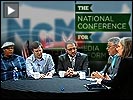
Playroundtable

Democracy Now! broadcasts from the National Conference for Media Reform in Boston, where more than 2,000 media activists, journalists, academics and lawmakers have gathered during a time of massive cutbacks in the news industry and increasing concentration of media ownership. Comcast merged with NBC in January, and last month AT&T announced plans to purchase T-Mobile, a deal that could leave the country with just three wireless carriers. Meanwhile, the Federal Communications Commission faces increasing criticism for its lack of progress on expanding the nation’s broadband system. We host a media roundtable with Craig Aaron, incoming president of media advocacy group Free Press; Sascha Meinrath, director of the New America Foundation’s Open Technology Initiative; and Malkia Cyril, the executive director and founder of the Center for Media Justice. [includes rush transcript]

Guests:

Craig Aaron, incoming president of Free Press.
Sascha Meinrath, director of the New America Foundation’s Open Technology Initiative.
Malkia Cyril, executive director of the Center for Media Justice.

Rush Transcript

This transcript is available free of charge. However, donations help us provide closed captioning for the deaf and hard of hearing on our TV broadcast. Thank you for your generous contribution.
Donate – $25, $50, $100, More…


Related Links

AMY GOODMAN: We are broadcasting from the National Conference on Media Reform here in Boston, Massachusetts, at the Seaport. There are hundreds of people in the audience for this global broadcast. And it’s great to be with Juan, who yesterday in New York won, for the second time, the George Polk Award for his remarkable reporting about corruption in New York City. Hi, Juan.

JUAN GONZALEZ: Hi, and welcome to all of our listeners and viewers around the country and around the world and to all of you here in the audience watching this broadcast from the National Conference on Media Reform.

Over 2,000 media activists, journalists and academics and lawmakers are gathering here for the next three days to discuss ways to improve our nation’s media system. The conference comes at a time of massive cutbacks in the news industry and increasing concentration of media ownership.

Just last month, AT&T announced plans to purchase T-Mobile for $39 billion. If the deal is approved, it would leave the country with just three wireless carriers. Republican lawmakers are threatening to cut off federal funding for the Corporation for Public Broadcasting, which helps fund NPR, PBS and many community media outlets.

In the newspaper industry, the New York Times has just introduced a new internet paywall in an attempt to generate more revenue from online readers.

Meanwhile, the Federal Communications Commission is coming under increasing criticism for moving slowly on a number of key initiatives, including expanding the nation’s broadband system.

AMY GOODMAN: To talk about these and other issues, we’re joined by three guests here in Boston at the National Conference on Media Reform.

Craig Aaron is the incoming president of the media advocacy group Free Press, the organizers of the National Conference on Media Reform, or NCMR. He’s currently serving as managing director of the organization.

Sascha Meinrath is also with us. He’s director of the New America Foundation’s Open Technology Initiative, working primarily on community wireless networks, municipal broadband and telecommunications policy.

And we’re joined by Malkia Cyril, the executive director and founder of the Center for Media Justice.

We welcome you all to Democracy Now! here at the World Trade Center at the Seaport in Boston. Craig, let’s begin with you. Talk about just the significance of this gathering of thousands of people talking about media reform and media democracy. What does that mean?

CRAIG AARON: Well, you know, I think it really is a remarkable event, Amy. I’m so glad you are both able to be here with us for it, because it brings together thousands and thousands of media activists who maybe in their town or community are the only ones who are being outspoken about what’s happening to the media, or they’re working in small groups, and they have the opportunity here in Boston to see what people are doing across the country. So, bringing everybody together at a gathering like this is a real opportunity to reenergize the movement and to begin to come up with the new strategies and stronger alliances that are going to allow us to reverse many of the things that Juan described, whether it’s attacks on the free and open internet or whether it is the relentless attacks on funding for public media. How are we going to answer questions about the future of journalism? That’s all what we’re going to be exploring this weekend, as well as just having the opportunity for all of us to get together, get to know one another a little bit better, and leave with a little bit more energy for the fight ahead.

JUAN GONZALEZ: Well, Craig, as someone who’s worked for decades in both the corporate or mainstream media, as well as the alternative media, I see two worlds. On the one hand, in the corporate media, everyone seems to be in despair about the decline of the media. On the other hand, you see this upsurge of new media. Is it a time of despair or is it a time of hope for those who want to see a journalism and a media system that promotes and helps to develop our democracy?

CRAIG AARON: Well, of course, it’s both. And out of the crisis in the mainstream media that we’ve seen also comes opportunity. And so, I think we do have the opportunity to imagine a different media system, to imagine a media system that looks more like the one we all want, covering our local communities. But we have to figure out how to bridge that gap.

We have lots of new interesting experiments. We have lots of amazing things happening at the community level. But we also have a crisis in the information our communities are receiving. We’re seeing newspapers close. We’re seeing local television and radio reporters lose their jobs. We’re seeing people not covering what state government is doing, what city government is doing, what’s happening around the world. So, I think from a policy perspective—and for us it always comes back to those policy questions—it’s what can we put in place to ensure that communities are actually getting the news and information they need. Whether that comes from part of the old mainstream media or whether it’s something new and better, in the end, it’s all about how are we getting the news and information we need to hold our leaders accountable, whether those are government leaders or corporate leaders.

JUAN GONZALEZ: And what about those policy issues? Two years into the Obama administration, what did Free Press expect and what has it gotten so far in terms of this administration?

CRAIG AARON: Well, there’s no question—you know, we last gathered for the National Conference for Media Reform three years ago, in 2008, and there was so much energy and excitement in the air. You know, people thought a big change was coming. Washington doesn’t change that easily. So I think there’s no question that there is some disappointment in what we’ve seen from the Obama administration. We saw them promising to take a backseat to no one on all of the issues we care about, whether it was net neutrality, media diversity. They haven’t delivered on all of those promises. In some cases, they’ve gone in the opposite direction. So, there are a lot of challenges ahead.

But I think, now, we have our eyes open, and we know what we’re dealing with. We can recognize all of the problems with the corruption in Washington and the powerful telecom and media lobbies. But there’s also energy for organizing in response to that. So, no question, Obama administration, at this point, has not delivered on all of the promises they said they were going to deliver. It doesn’t mean nothing happened. We had some very important victories on billions of dollars to expand broadband, low-power FM, really important things. At the same time, they have taken steps backward on important issues like net neutrality, making sure we have the free and open internet. And there’s a lot of issues coming up, you know, big mergers—Comcast-NBC, AT&T-Mobile—where we have good reason to be very concerned about the direction the Obama administration is heading.

AMY GOODMAN: Sascha Meinrath of the New America Foundation’s Open Technology Initiative, I saw you years ago in Champaign-Urbana, when—it was remarkable—Indymedia took over the post office, bought the post office as a facility for everyone to be able to have access to the internet. Describe what happened then, before we talk about the big national issues.

SASCHA MEINRATH: Sure. Well, this grew out of a lot of the global justice movement organizing that was happening around the turn of the millennium. And within this local community, within Urbana-Champaign, we really felt that it was important that we have a permanent space for arts and cultural fare, but also for media production, for a low-power FM radio station, for an arts gallery and artist studios. And we quickly realized that the only way to do that was really to become our own owner of a piece of property.

And within Urbana-Champaign, we had this kind of once-in-a-lifetime opportunity: the downtown post office was looking to get rid of a 30,000-square-foot building. We felt we could fill a 30,000-square-foot building with vibrant community media. And that’s exactly what’s happened. So, today, the Urbana-Champaign Independent Media Center is a thriving organization, that is sort of its own community multimedia conglomerate inside the heartland of the United States.

AMY GOODMAN: Well, that was remarkable. Now talk about what’s happening as you move to Washington, D.C. to deal with national policy. You’re extremely critical of the FCC, the Federal Communications Commission.

SASCHA MEINRATH: That’s right. I mean, we’re looking at a crisis here in the United States. Ten years ago, when it came to broadband connectivity, the United States was at the head of the class. We were leading the globe in terms of broadband pricing, in terms of broadband speeds, in terms of the places where it was available. In a single decade, we’ve gone from first internationally to somewhere around 15th to 25th. And what we’re looking at over 10 years, the data is overwhelming. This is a massive market failure perpetuated against the U.S. populace. I mean, we’re paying now more prices for slower speeds in fewer places than a growing list of other countries around the globe.

And so, when the Obama administration came in, it came in saying, “We’re going to fix this. We’re going to bring you change.” We’re now two years in, and we haven’t seen any effective mechanism to change this. Instead, what we’ve seen are these communities self-organizing, the digital justice coalitions in Philadelphia and in Detroit and local community organizations working to build alternatives, often against extremely bizarre odds, rules and regulations, state laws that make it illegal, for example, to actually build your own network, even if nobody else is providing you connectivity. And these are the kinds of battles that—we’re holding in many ways the Obama administration to the exact same metrics of success that we would have previous administrations.

JUAN GONZALEZ: And what’s the cause of that market failure? Because, on the one hand, you hear the telecom companies and the mobile service providers talking about that they want to provide universal coverage, but that they need less regulation to be able to do that. So, why is it that people are paying more, as you say, for less broadband capacity and at slower speeds?

SASCHA MEINRATH: Well, what we have in the United States is a myth of competition. And we know—I mean, you look at any classic economic theory, and they’ll tell you, you know, in a noncompetitive market, you need more parameters for that market to operate, so that consumers, so that buyers don’t get screwed. So, in the United States, we have, for example, in the National Broadband Plan, the FCC says 96 percent of Americans have two or fewer wireline broadband subscribers. So you would think, in that reality, that the FCC acknowledges in the National Broadband Plan, that they’d say, “OK, we need some sort of competition policy. We need parameters to prevent this de facto duopoly from even exist—from continuing and perpetuating higher prices and slower speeds.” Instead, competition policy is almost entirely ignored in the National Broadband Plan. In fact, the National Broadband Plan never uses the word “monopoly” or “duopoly.” There’s a refusal to address the reality, to even name it. And as such, our policies are unbelievably inept in actually addressing these problems that exist. So, until that shift happens, until we have meaningful competition policy, until we set parameters for markets that are protective of consumers, we’re going to continue being in a space where, in essence, broadband providers run amok.

JUAN GONZALEZ: And you have the situation, though, where basically the government’s line is, “Well, you’ve got a cable company, and then you’ve got a few cell companies that can provide you broadband, and that’s the competition,” that they don’t actually see the necessity for having competition within wired broadband as well as robust or ample competition among the wireless broadband providers.

SASCHA MEINRATH: Let me drive this home. So, I was talking with an economist from OECD, which does a lot of analysis of how different countries compare with one another. He lives in a rural village in France. He gets 100 megabits, which is about 10 times the speed what we get, plus video, plus telephone—free telephone to 120 countries on earth, and he pays the equivalent of about $45 a month. It’s a tiny fraction for far better services in a rural village in France. And he’s like, “Yeah, we’re kind of upset because we only have about 10 to 12 different providers to choose from.” I think that really drives home just how completely defunct our market is. And so, we need to address this. And until we do, this situation is going to continue, where we’re paying far more for far worse services than a growing list of other places around the globe.

AMY GOODMAN: Malkia Cyril, you’re the founder of the Center for Media Justice in the Bay Area. You have been focusing on net neutrality and what it means, especially for communities of color. I assume most people who are watching, listening right now around the globe, maybe don’t even know what that term means. It’s become a buzzword, and maybe that’s part of the problem. What does “network neutrality” mean? Why is it so important?

MALKIA CYRIL: Network neutrality refers to the set of policies that would prevent the discrimination by internet service providers to—it ensures that all content on the net is treated the same, all legal content. It prevents any blocking of any content.

But I want to say this: we have—you know, it’s interesting, people keep saying, you know, “You focus on net neutrality; let’s talk about that.” At the Center for Media Justice, what we’re focused on is equity. And net neutrality and, you know, preventing our content from being blocked, from being censored in that way, it’s about equity, it’s about ensuring that online our rights are protected and that there’s some—there’s some rules in place that allow us to be treated fairly, no matter who we are, no matter how we enter the internet, whether from the mobile internet or from the fixed internet, you know, from a laptop or a cell phone, that we have the same right to enter and to play a fair game. And that’s what net neutrality is all about for us. It’s about making sure that no matter who you are and no matter how you enter the internet, that your rights online are protected.

JUAN GONZALEZ: Malkia, I want to ask you about the difference that’s been evolving among the major civil rights organizations in the country around some of these issues. Back in the ’70s, there were major protests across the country; I think between 1970 and 1973, there were 350 license challenges to television and radio stations across the country by community organizations who were demanding equity and better employment practices and better coverage. So the civil rights movement played a huge role in the ’70s in diversifying and democratizing our media system.

MALKIA CYRIL: That’s right.

JUAN GONZALEZ: But now we’re in a situation where the major civil rights organizations seem to be siding on some of these issues with the telecom companies, whether it’s the NAACP, the Urban League, La Raza. They’re all basically backing on these issues of net neutrality what would appear to many progressives to be the wrong side. How did that happen, and what’s being done to counter that?

MALKIA CYRIL: You know, it’s interesting, because in the news, in the media, the issue has been a debate between the civil rights community and the public interest community. But what I think is really at issue is that it’s a debate between whether or not corporations will run our democracy and run our internet service or whether or not people will. I think that the question isn’t about whether civil rights groups have sided with corporations; it’s about whether or not corporations have a stranglehold on black and brown and other communities, and poor communities. And, you know, whether civil rights groups make a decision or decide that, in fact, trying to get a piece of the pie is the best option or trying to change the shape of the pie and ensure that we all get that equity, that’s a decision, I think, that we all have to participate in.

As a person of color, as a black woman, as a head of a nonprofit organization, it’s my job to interact and engage the civil rights community at large and say, “Are we choosing the best course forward for our communities?” And, you know, that’s a different conversation than saying, you know, “NAACP, you know, Urban League, you know, LULAC, are you siding with corporations or not?” That’s not my concern. My concern is, are you choosing the best course of action for black, brown, Latino, Asian communities, Native communities across this country, or is there a better option? Is there a way for us to work together, across the lines of difference, across the lines of race, to get the kind of equity we all deserve?

AMY GOODMAN: We’re broadcasting here in Boston from the National Conference on Media Reform before a live audience that’s waking up early to be a part of this global broadcast. Craig Aaron and Malkia Cyril have been working very hard on this AT&T-T-Mobile merger. Craig, talk about what this is all about. Explain what’s happened.

CRAIG AARON: Well, we’ve been talking about monopoly, and that’s basically—or duopoly. That’s what’s forming in the wireless market. We’re looking at the second-biggest company, AT&T, trying to merge with the fourth-biggest company, which is T-Mobile, to create a new giant company. And if this merger were to go through, AT&T and Verizon would dominate 80 percent of the market for your wireless mobile phone. Completely unprecedented. You can look at any other major industry, and those levels of concentration aren’t there.

And what it’s going to mean for you, like a lot of these issues, you’re going to be paying more, you’re going to have fewer choices. If you want to take that phone that you own and take it to another carrier, you’re simply not going to have that option. So, what we’re looking at is we—there’s sort of been this myth of competition, and it’s been even worse in the wireless space, where, oh, you’ve got, you know, three or four or five choices. And as soon as they’re able to keep these rules like net neutrality from being applied to wireless phones, they start merging, they start concentrating.

As we all know, this wireless connectivity, that’s the future. That’s how so many of us are going to be getting on the internet, if we’re not already, is through those mobile devices. And if we only have those two choices, that is an immense amount of power in the hands of two giant companies that have said they want to discriminate, that haven’t hesitated to raise prices, that haven’t hesitated to spy on their users or open up the back end so that the government can do so. That’s what’s happened again and again, and yet here they are, coming to Washington, saying, “Oh, this deal is inevitable. You have to let it go through. This is the only thing we have to compete.” And the people that lose in the end are going to be those individual subscribers, phone users. Everybody who hopes to be able to afford a wireless phone, afford an internet connection, it’s going to be that much harder if this deal is allowed.

AMY GOODMAN: And where does it look like it’s going?

CRAIG AARON: Well, it’s still very early, so this deal was just announced. I think it was met with a lot of criticism, and not just from media reform and media policy people. The Economist magazine trashed the deal. The New York Times trashed the deal as too much power in too few hands. But it will be up to the Justice Department and to the Federal Communications Commission. And we’ll see what they begin to do. There’s reason to be concerned. I mean, they just signed off on the mega Comcast-NBC merger, and that was a complicated one. It was vertical integration. It was about owning the content and the distribution. This one’s a little easier to understand: number two wants to buy number four to become number one, and not really leave you with any choices. So, it’s going to take, though, lots of public pressure on Congress, on the FCC. If we’re going to actually stop a deal like this, it’s going to have to come from the public, because if we just hope the regulators will figure out, if we leave it up to the lobbyists, this thing will get done faster than you can imagine.

JUAN GONZALEZ: And what about that sign-off on the Comcast-NBC merger? Because, obviously, this is a trend now. The cable companies—we saw, for instance, in New York City, Cablevision ended up buying Newsday. So, on a larger scale, then Comcast buys not only NBC, but NBC Universal, Telemundo, a huge corporation of content, as well as being the providers. The impact on the kind of news and information and entertainment the American people receive?

CRAIG AARON: Yeah, we’re all living it right now. This is the new face of media monopoly. I mean, when Ben Bagdikian wrote his famous book, there were 50 companies that probably controlled most of what we watch, see, hear and read every day. Now maybe we’re down to five or six—and they’re all trying to merge with each other. So there’s this day coming soon where you could have, you know, Comcast, AT&T, Pizza Hut, Taco Bell, you know, all lined up together under one giant corporate umbrella, and what you end up with is watered-down content. You end up with no competition in local markets to see what’s out there happening on the news. You end up with the same cookie-cutter content from coast to coast.

We saw this happen, for example, in radio back in the ’90s. You used to be able to drive across the country; everywhere you’d go, you’d hear a local accent, you’d hear local music, you would hear local personalities. That went away because of these policy decisions.

Now we’re playing on a much larger field, and these companies want to control your entire experience, which is going to come through the internet. That will be your TV, your radio, your phone, how you actually communicate with your friends and family. They want that all under that one corporate umbrella, where they can decide which websites work, which get the best kind of service, and find lots and lots of ways to charge you a lot more money.

AMY GOODMAN: We only have a minute, but Sascha Meinrath, Sharif Abdel Kouddous is flying here from Seattle, where he’s giving a talk, and he’s going to speak here tomorrow, our senior producer who’s headed back to Egypt to cover what’s happening there. But you were involved in the Egypt uprising, as well, from this side of the world.

SASCHA MEINRATH: Yes. So, interesting fact is that the global justice movement, as it really took off in the late ’90s and the 2000s, part of what was being done here was not just a new media creation, new information dissemination, but creating networks of communication that could withstand surveillance and attempts to shut them down. Ten years on, these newer generations of those same technologies and ideas are being held up, in fact, by the State Department as part of their internet freedom agenda, as a way to empower protesters outside of the United States, revolutionaries outside of the United States, to cast off the yoke of oppression. And so, what I view it as is just a continuation. It’s the next logical step in a global movement to empower individuals to have control over their own communications mediums and their own information dissemination.

JUAN GONZALEZ: And what were you able to do, specifically, in terms of the Egyptian uprising?

SASCHA MEINRATH: So we’ve been working on a number of technologies to develop distributed communication systems, so that you can turn cell phones, for example, into a medium that doesn’t need to go through a cell tower, a central location, but communicate in a peer-to-peer manner, directly with one another. And so, you can imagine if you daisy-chain a lot of these together, you can actually have an entire network built out of the already existing hardware that doesn’t need a central authority.

AMY GOODMAN: Finally, FCC Chair Genachowski, he came in as a huge defender of net neutrality.

SASCHA MEINRATH: Mm-hmm.

AMY GOODMAN: What happened?

SASCHA MEINRATH: He blinked. It’s very clear, he blinked. He came to Brookings Institute, gave a speech saying that he’s going to do network neutrality, and then the major companies came in to say that they shouldn’t do that and that it would be a horrible thing for them to do that, and then he started backing off. And he didn’t stop backing off. He’s continuing to back off. I think it’s indicative of a place where the rhetoric and the action are completely discrepant. We have a rhetoric of working with communities, of supporting local communities, of supporting media diversity, of supporting a lot of things. But when you actually look at what’s been implemented, you see that, in fact, none of this is actually happening. It’s so many different communities, constituencies, are being really harmed by both the actions of that the FCC has made to hurt them and the inactions to address systematic problems that have been here for a generation.

JUAN GONZALEZ: Well, and in terms of the inaction, by dragging out processes of making decisions, it also then makes the playing field no longer level, because the companies hire all of these full-time lobbyists, whereas the citizen groups, if you drag a process out or a regulatory process or a legal process out for years and years, the citizen groups don’t have the resources, do they, to be able to continue on a day-to-day basis to do the battles in Washington to achieve some kind of final policy decision?

SASCHA MEINRATH: Right. Well, let me leave you with this example, which is that in the National Broadband Plan they set a goal for where America is going to be in 2020, right, a moment where you can be visionary and bold. And they set a broadband speed goal of four megabits by one megabit, which—four units by one unit. To put this into context internationally, this goal for 2020 puts us dead last of every country that’s come out with a national broadband plan. Our goal in 2020 is not to be middle of the pack; it’s actually to be last.

AMY GOODMAN: Last question to Malkia Cyril. President Obama was a community organizer. He responds to pressure. Frederick Douglass: “Power concedes nothing without a demand.” You are a part of the Media Action Grassroots Network. This is the beginning, this broadcast of Democracy Now!, of this three-day conference of thousands of people around media democracy. How are you organizing?

MALKIA CYRIL: Well, we’re organizing state to state and city to city. We believe that while—you know, we believe in what Obama said during his campaign: change doesn’t happen in Washington, it comes to Washington. And we believe that it’s our job across the country to recognize the power and responsibility of local communities all around this country to bring pressure to bear not only in Washington, not only on the federal administration, but also in the municipalities and on our state and legislative bodies, because we understand that the federal rules that are being debated in D.C. are actually being debated in every part of this country. And in fact, the cities and the states is where some of these ideas are won and lost. And so, that’s where we’re going to concentrate our energy. We’re going to build from city to city, state to state, and bring our concerns to the President and to the FCC.

AMY GOODMAN: This is Democracy Now!, democracynow.org, The War and Peace Report. Malkia Cyril is executive director and founder of the Center for Media Justice. Sascha Meinrath, director of the New America Foundation Open Technology Initiative. And Craig Aaron, the incoming president and CEO of Free Press, freepress.net, has organized this National Conference on Media Reform that is taking place here at the Seaport, the World Trade Center in Boston, Massachusetts. We’re broadcasting before a live audience. When we come back, what happened to Glenn Beck on Fox? Stay with us.


Creative Commons License The original content of this program is licensed under a Creative Commons Attribution-Noncommercial-No Derivative Works 3.0 United States License. Please attribute legal copies of this work to democracynow.org. Some of the work(s) that this program incorporates, however, may be separately licensed. For further information or additional permissions, contact us.

April 8, 2011

03 “Of the 1 Percent, by the 1 Percent, for the 1 Percent”

Filed under: future,George Lakoff,política — fores @ 9:34 am

April 07, 2011

Nobel Economist Joseph Stiglitz: Assault on Social Spending, Pro-Rich Tax Cuts Turning U.S. into Nation “Of the 1 Percent, by the 1 Percent, for the 1 Percent”

Stiglitzbutton

This week Republicans unveiled a budget proposal for 2012 that cuts more than $5.8 trillion in government spending over the next decade. The plan calls for sweeping changes to Medicaid and Medicare, while reducing the top corporate and individual tax rates to 25 percent. We speak to Nobel Prize-winning economist Joseph Stiglitz, who addresses the growing class divide taking place in the United States and inequality in a new Vanity Fair article titled “Of the 1, by the 1, for the 1%.” Stiglitz is a professor at Columbia University and author of numerous books, most recently Freefall: America, Free Markets, and the Sinking of the World Economy. “It’s not just that the people at the top are getting richer,” Stiglitz says. “Actually, they’re gaining, and everybody else is decreasing… And right now, we are worse than old Europe.” [includes rush transcript]

Guest:

Joseph Stiglitz, Nobel Prize-winning economist and a professor at Columbia University. He is the author of numerous books, most recently, Freefall: America, Free Markets, and the Sinking of the World Economy.

Rush Transcript

This transcript is available free of charge. However, donations help us provide closed captioning for the deaf and hard of hearing on our TV broadcast. Thank you for your generous contribution.
Donate – $25, $50, $100, More…


Related Links

JUAN GONZALEZ: This week Republicans unveiled a budget proposal for 2012 that cuts more than $5.8 trillion in government spending over the next decade. The plan also calls for reducing the top corporate and individual tax rates to 25 percent.

Meanwhile, Republicans remain locked in an impasse with Democrats and the White House over a budget to cover the remainder of 2011. Last night President Obama and House Speaker John Boehner met to narrow their differences in order to avoid the first government shutdown in 15 years, but they failed to come to an agreement.

On Tuesday, Speaker Boehner said Republicans might now seek up to $40 billion in cuts—around $7 billion more than both sides had discussed over the past week. Failure to agree on a budget would lead to a federal government shutdown beginning Friday at midnight. President Obama blamed Republicans for the political stalemate.

PRESIDENT BARACK OBAMA: After weeks of negotiations, we’ve now agreed to cut as much spending as the Republicans in Congress originally asked for. I’ve got some Democrats mad at me, but I said, “You know what? Let’s get past last year’s budget, and let’s focus on the future.” So we’ve agreed to a compromise. But somehow we still don’t have a deal, because some folks are trying to inject politics in what should be a simple debate about how to pay our bills. I mean, there’s stuff on all kinds of issues in there: abortion and the environment and healthcare. You know, there are time to have those discussions, but that time is not now. Right now we need to just make sure that we pay our bills and that the government stays open.

JUAN GONZALEZ: Well, according to a recent article by our next guest, this budget is unveiled at a time when one percent of the people in the United States take in nearly a quarter of the nation’s income.

AMY GOODMAN: “Of the 1, by the 1, for the 1%.” That’s the title of an article by Joe Stiglitz appearing in this month’s issue of Vanity Fair. The piece discusses growing inequalities in the United States.

Joseph Stiglitz is a Nobel Prize-winning economist, professor at Columbia University, author of numerous books, most recently Freefall: America, Free Markets, and the Sinking of the World Economy.

Welcome to Democracy Now!

JOSEPH STIGLITZ: Nice to be here.

AMY GOODMAN: So, “Of the 1, by the 1, for the 1%.” Explain.

JOSEPH STIGLITZ: The point is that there has been this growing inequality, not only in income, but actually the inequality of wealth is even much greater. There’s a shrinking of opportunity. It’s not just that the people at the top are getting richer. If they were getting richer because they were contributing more to our society and everybody else was doing well, that would be one thing. But actually, they’re gaining, and everybody else is decreasing. In fact, right now, it’s not just the bottom, but even the middle, the middle, the median income—half above, half below—are poorer today than they were more than a decade ago. So, all the growth that has occurred in our country over the last decade or more has gone to the upper one, two percent.

At the same time, there’s really shrinking opportunity. You know, we used to think of the United States as the land of opportunity—Horatio Alger, anybody could make it. And we used to think of ourselves as different from old Europe, as we used to call it. But the statistics show otherwise. Now, yes, we have some dramatic examples of people making it from the bottom to the top, middle to the top. But the statistics look at what happens on average: what is the chance of somebody at the bottom making it to the middle or the middle making it to the top? And right now, we are worse than old Europe. This is something dramatic that has happened over the last 30, 40 years.

And what’s really happened is old Europe has become more of a land of opportunity. They reformed their education systems after World War II. They said that they had—they recognized they had a problem, and they changed. Meanwhile, the United States, we’ve wound up with a more fractionated society, one where more—moved more to a private education system, where those who have money can get a really first-class education. But the average American is not. And, you know, those who come out of—those education statistics that came out not long ago where—show that, on average, Americans are doing more poorly than countries around the world.

And we—this is related to some of the issues that got raised in the context of the financial crisis. Remember the discussion about the bonuses? And that’s related to the same idea. The question was, if people were getting rewards for contributing to our society, a theory that was in the 19th century called “marginal-productivity theory,” then you could say, “OK, those who contribute more should get more.” But what we saw in that crisis was that these titans of the financial industry got mega-bonuses while their companies were making mega-losses. And while they were—as a result of their actions, our economy and the global economy went into a real tailspin, from which we have still not recovered. Their salaries have recovered, but not the rest of us.

JUAN GONZALEZ: Well, Joe Stiglitz, I’d like to ask you—given this trend, as you say, that’s been going on now for decades, we’ve been startled in the last few months by Democrats, at both the national level and some state and local levels, further increasing the bonanza of this one percent. We had obviously in Congress the extension of the Bush-era tax cuts for the wealthy that were supposed to be eliminated, and here in New York state we were startled that the new Democratic governor, Andrew Cuomo, abolished a millionaire’s tax that had been instituted a few years earlier, so that, in both ends, if you are a multi-millionaire in New York State, you benefited from both the federal policies as well as the recent state policies. So, the Democrats are supposed to be, to some degree or other, the party of labor.

JOSEPH STIGLITZ: Well, they’re doing—let me just be clear: they are better than the Republican positions. And they, some of them, have fought against these tax cuts for the millionaires. But to me, this makes absolutely no sense. You know, we’re—big discussion, you were talking about earlier about the budget deficit. There are only two ways to address the budget deficit: raise revenues or cut spending. And with this one percent getting so much, there’s only one place really to get that extra revenue. The good news is it’s relatively easy. You have 25 percent—almost 25 percent of the income in the upper one percent, you raise their taxes by a few percentage points, and you get an awful lot of money. And in many of these cases, we don’t even have to raise the taxes; all we have to do is to say they ought to pay a fair tax rate.

One of the curious things—and again, this is bipartisan—we lowered the tax rates on speculators, so that speculators pay a much lower tax rate than people who work for a living. Now, is there any principle in economics that says that you should earn more money by speculating than by working hard? To me, it makes no sense. So, eliminating some of these special tax provisions would raise a lot of revenue and improve our deficit position.

This raises a very important point that I raise in my article, which is that much of the wealth of this one percent comes not from hard work, not from innovation, but from good investments in Washington, investing in political capital. And you saw that in the financial sector, where they first got deregulation, and they got a massive bailout. But it’s true in lots of other areas. A lot of the natural resource companies—mining, oil—get access to natural resources that are in public lands at a discount price. So, if you can buy—if you can get access to these resources at a very low price, sell them at a high price, you make a lot of money. It’s actually like money being stolen from the public.

JUAN GONZALEZ: I wanted to ask you about another—something that you’ve written about: the connection, in terms of risk analysis, between the nuclear crisis in Japan and the meltdown of the reactors there and the credit default swaps. And I would even throw in perhaps the BP blowout, which was another example of a risk analysis that said it could never happen.

JOSEPH STIGLITZ: Yeah. Well, I just wrote an interesting article making a comparison between our ability to judge what are called small probability events, you know, rare—events that are supposed to be rare—those in the financial market said that the kind of collapse that we had should happen once in a thousand years, once in the history of the universe. But we had a collapse in the 1980s, we had a problem in the 1990s, we have them every 10 years. And that shows the models are very bad, our ability to judge rare events is very bad. Now, a lot of research in behavioral economics and psychology have explained why it is that these events that don’t happen very much, we don’t have a lot of experience.

But one of the points that I raised was that these people have an incentive not to see things accurately. You know, the nuclear power industry has an incentive to tell everybody, “Oh, don’t worry. Nothing—no risk there.” The financial sector had an incentive to say, “Don’t worry about these derivatives, even if they’re already a quadrillion dollars. Don’t worry, because we can manage that risk. We have systems of diversifying the risk across the economy.” Clearly wrong. So, you know, when there’s so much money at stake, people have a way of seeing—of discounting these risks, especially because those risks are borne by everybody else in our society.

And, you know, nuclear power is a really interesting case, because that industry has never been commercially viable. It has always existed on the back of a government-provided insurance, that we provide as taxpayers, that they don’t pay for. And we see now in Japan that, you know, they did the same thing, and we see the cost of that. The rest of society is paying an enormous price. There is no way that the slight savings in energy cost can make up for the loss to the Japanese economy that has resulted from the nuclear explosion. And the same thing could happen here in the United States.

AMY GOODMAN: I loved seeing on Meet the Press right after the tsunami and the earthquake and the terrible tragedy in Japan, they had on the head of the Nuclear Energy Institute, so, you know, they represent the nuclear industry, and the host of the show saying, “Thank you so much for running in at the last minute to be here with us.” And I could only think about—I mean, here he is speaking to save the butts of the nuclear industry in this country and saying there’s nothing to worry about here, as we’re saying this—well, what is looking like a partial meltdown or more.

JOSEPH STIGLITZ: If the industry really believed it, let them make an unlimited liability and provide us with a guarantee that they would pick up for the financial cost of the kind of disaster that Japan is facing. And I can tell you that if you made them bear those costs, if we didn’t give them that free ride of limited liability, that industry would not exist in the United States today.

AMY GOODMAN: In your piece, Joe Stiglitz, in Vanity Fair, “Of the 1, by the 1, for the 1%,” you say, “Americans have been watching protests against oppressive regimes that concentrate massive wealth in the hands of an elite few. Yet in our own democracy, 1 percent of the people take nearly a quarter of the nation’s income—an inequality even the wealthy will come to regret.” Talk about all this. We’re seeing these rolling rebellions. We are seeing rebellions not only in the Middle East, though, in the Midwest. I mean, look at Madison, Wisconsin. And what about this issue of even the wealthy will regret this?

JOSEPH STIGLITZ: Well, there are two points that I try to make. One is that a successful economy requires collective action. There are lots of things we have to do together. We have to have infrastructure. We have to have an educated population. If you have a divided society, you start worrying more—if you’re in the wealthy and you have an electorate system that can use your wealth to affect the politics, you say, “I’d rather have a small government that isn’t able to redistribute money, take money away from me. I don’t need public schools; I have private money. I don’t need public parks; I have private—you know, my large land.” So, what you have then is an erosion of the kind of collective action, and that makes a society less efficient, less productive. And you see that already happening. We are competing in education with countries in Asia that were much poorer than we were not that long ago. So that’s one problem.

And the second one is that obviously a house divided can’t stand, that you start getting tensions, you start not paying attention to the things that make us cohesive as a nation. And that’s what you’re seeing in Wisconsin. And you also see that in the budget messages that are coming across, saying, “OK, we’re going to cut back on healthcare for aged and for the poor, but we’re not going to do anything about overall healthcare costs.” What does that mean? It means that if you’re going to cut back on health expenditures for the aged and the poor, and you’re going to let health costs continue to rise, that says rationing. They’re not going to be able to get healthcare. Already, we spend more money with poor health outcomes than those in other countries in the advanced industrial world. And it’s going to get worse as the poor and the elderly can’t get access to healthcare.

JUAN GONZALEZ: In that vein, I wanted to ask you about a recent dissent of yours, that a bunch of eminent economists, a former chairman of the President’s Council on Economic Advisers and other members, were asked to sign on to a letter about the need for deficit reduction in the future in the United States. Why did you dissent to that letter?

JOSEPH STIGLITZ: Well, the letter said all economists agree that you need to get deficit reduction, we ought to show that there’s something called economic science. And then they came out in support of working off the Bowles-Simpson proposal, which is the bipartisan deficit reduction. I had looked at that very carefully, and I come to the view that that is not going to make America stronger, it’s not going to not make our economy stronger. I said before that there are two ways—

JUAN GONZALEZ: You called it a potential suicide pact?

JOSEPH STIGLITZ: That’s right. Why is it? I mentioned before that there are two ways of cutting the deficit. One is raising revenue; the other is cutting expenditures. Well, what’s the best way of getting tax revenue up? It’s to put America back to work. If America were growing, if we were back to our full potential, our output would be higher, and tax revenue would be substantially higher. So the best way to reduce the deficit, as I said, is to put America back to work.

Now, I thought that Bowles-Simpson is a recipe for making our economy weaker. If you start cutting budgets now, spending now, before the economy is back to health—you know, we already suffer from the deregulation, now this is going—we’re going to suffer again from the thoughtless deficit reduction. That means people are going to be out of jobs. That means revenues are going to be lower, and our economy is going to be weaker.

But the second point I raise is that it goes back to: look at where the revenues are going to be. When you have so much money going to the upper one percent, the only way of fixing the revenue problem is to raise taxes and have a more fair tax system. What they proposed was eliminating some of the deductions, say, for housing, mortgages. Well, if you do that now, house prices, which have continued to decline, would decline even more. But the more fundamental point is, even if from the long-term point of view you want to get rid of these mortgage deductions, you shouldn’t do that on the backs of the middle class. That should be viewed as a revenue-neutral. You lower the mortgage deduction, but you also lower the tax rates to offset it. That’s not a revenue—shouldn’t be a revenue enhancer. These are the people who have been doing very badly for the last 10, 15, 20 years.

AMY GOODMAN: Joe Stiglitz, we’re going to go to Medicare and Medicaid in the crosshairs in just one minute with two healthcare activists. But speaking of the crosshairs, let’s end on the issue of war. You wrote with Linda Bilmes the book The Three Trillion Dollar War: The True Cost of the Iraq Conflict. That’s not talking about Afghanistan, what, $2 billion a week, the longest ongoing conflict in U.S. history. What about the cost of this?

JOSEPH STIGLITZ: It’s enormous. And since we wrote that book, we did—new numbers came in, and things are worse than we said. The disability rates are higher. The cost of caring for the disabled are higher. Almost one out of two people coming back from Iraq and Afghanistan are disabled. This is an unfunded liability of—we calculate now to be almost a trillion dollars, over $900 billion. So, one of the big ways of reducing our deficit is a—is cut back some expenditures.

I believe we could have more security with much less spending. We are spending literally hundreds of billions of dollars for weapons that don’t work against enemies that don’t exist. The Cold War ended more than 20 years ago. And yet, if you look at our military, nobody seems to have told it that. Another way of thinking about it, we spend more money now than all the rest of the countries of the world, or almost as much as all the rest of the countries put together. And yet, when you have a case where you might arguably want some use of it—you know, to protect people who are being killed—we say we can’t do it, even in a small country of a few million people. We say, “Oh, no. Our military can’t do anything.” So we’ve been spending all this money and getting actually very little security for it. So my own feeling is that we could reduce our money, our expenditures markedly—particularly, get out of Afghanistan—and improve our security.

AMY GOODMAN: You know, if there’s a government shutdown, it’s possible that Congress members who shut it down would continue to be paid, and soldiers would stop being paid. I want to thank you very much for being with us.

JOSEPH STIGLITZ: Thank you.

AMY GOODMAN: Joseph Stiglitz, Nobel Prize-winning economist, professor at Columbia University. His latest book, Freefall: Amercia, Free Markets, and the Sinking of the World Economy. When we come back, we’ll look at Medicare and Medicaid, what’s being proposed in Congress right now. Yes, healthcare in the crosshairs. Stay with us.


Creative Commons License The original content of this program is licensed under a Creative Commons Attribution-Noncommercial-No Derivative Works 3.0 United States License. Please attribute legal copies of this work to democracynow.org. Some of the work(s) that this program incorporates, however, may be separately licensed. For further information or additional permissions, contact us.

« Previous Page — Next Page »

WPMU Theme pack by WPMU-DEV.