Forés @ UVPress


         Universitat de València PRESS -UVPress- weblog for research uses

January 7, 2013

07 Be Ready To Mint That Coin

Filed under: archivo personal,economía,future,Holístico,política — fores @ 10:05 pm
Paul Krugman - New York Times Blog
January 7, 2013, 9:05 am52 Comments

Be Ready To Mint That Coin

Should President Obama be willing to print a $1 trillion platinum coin if Republicans try to force America into default? Yes, absolutely. He will, after all, be faced with a choice between two alternatives: one that’s silly but benign, the other that’s equally silly but both vile and disastrous. The decision should be obvious.

For those new to this, here’s the story. First of all, we have the weird and destructive institution of the debt ceiling; this lets Congress approve tax and spending bills that imply a large budget deficit — tax and spending bills the president is legally required to implement — and then lets Congress refuse to grant the president authority to borrow, preventing him from carrying out his legal duties and provoking a possibly catastrophic default.

And Republicans are openly threatening to use that potential for catastrophe to blackmail the president into implementing policies they can’t pass through normal constitutional processes.

Enter the platinum coin. There’s a legal loophole allowing the Treasury to mint platinum coins in any denomination the secretary chooses. Yes, it was intended to allow commemorative collector’s items — but that’s not what the letter of the law says. And by minting a $1 trillion coin, then depositing it at the Fed, the Treasury could acquire enough cash to sidestep the debt ceiling — while doing no economic harm at all.

So why not?

It’s easy to make sententious remarks to the effect that we shouldn’t look for gimmicks, we should sit down like serious people and deal with our problems realistically. That may sound reasonable — if you’ve been living in a cave for the past four years.Given the realities of our political situation, and in particular the mixture of ruthlessness and craziness that now characterizes House Republicans, it’s just ridiculous — far more ridiculous than the notion of the coin.

So if the 14th amendment solution — simply declaring that the debt ceiling is unconstitutional — isn’t workable, go with the coin.

This still leaves the question of whose face goes on the coin — but that’s easy: John Boehner. Because without him and his colleagues, this wouldn’t be necessary.

January 5, 2013

07 Barack Obama and the ’empathy deficit’

Filed under: archivo personal,Holístico,interesting news,política — fores @ 1:51 am

Barack Obama and the ’empathy deficit’

The US president claims the ’empathy deficit’ is a more pressing problem than the federal deficit, but empathy may be merely a product of changing scientific fashions

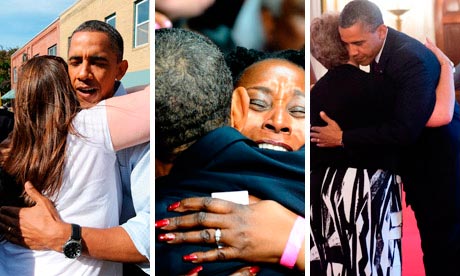
Barack Obama hugs composite

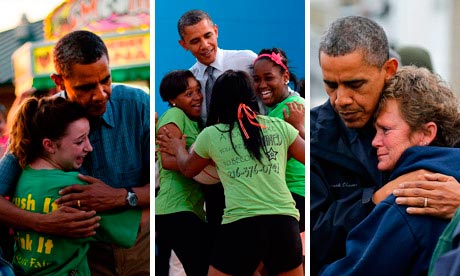
Barack Obama at the Iowa state fair; meeting girls from the Boys and Girls Club of Cleveland; and with North Point Marina owner Donna Vanzant after Hurricane Sandy. Photograph: Jim Watson/Jewel Samad/Larry Downing/AFP/Getty/Reuters

In 2011, researchers at the University of Chicago conducted a simple experiment to ascertain whether a rat would release another rat from a cage without being given a reward. The answer was yes. After several sessions, the rats learned intentionally and quickly to open the restrainer and release the caged rats. The rats also repeated the behaviour even when they were denied the reward of reunion. Even more astonishing, when the rats were presented with two cages, one containing a rat, the other chocolate, they chose to open both cages and “typically shared the chocolate”.

For the researchers, the conclusion was inescapable: the rats were displaying empathy. Announcing the results in Science, the lead researcher, Peggy Mason, explained: “There is nothing in it except whatever feeling they get from helping another individual.”

Neuroscientists are not the only ones to see empathy – or its absence – everywhere these days. According to Barack Obama, the “empathy deficit” is a more pressing political problem for America than the federal deficit and holds the key to the success of his second term as he seeks to build bridges with Republicans and tackle the wave of horrific shootings that last year disfigured American communities from Colorado to Connecticut. On this side of the Atlantic, meanwhile, George Osborne’s enthusiasm for welfare cuts is explained by the coalition cabinet’s “lack of empathy” for the poor.

But can the solution to violence, cruelty and the divide between liberals and conservatives really be a matter of promoting a trait that we appear to share with rats? And are scientists and politicians talking about the same thing when they invoke empathy in these different experimental and social contexts?

One of the problems with using the same word to describe the pro-social behaviour of rats and similar behaviour observed in humans is that people are infinitely more complex and reflective than rodents. It also confuses the different psychological and philosophical meanings of empathy.

Thus modern-day neuroscientists and social psychologists, drawing on the Scottish Enlightenment philosopher Adam Smith’s notion of a “moral sentiment”, have come to regard empathy as intrinsically pro-social. When we empathise, they argue, we mirror the distress of an “other” and, unless our brains are damaged or we are developmentally abnormal, we are moved to alleviate their suffering.

The result is that, like other modern moral sentiments such as trust and altruism, empathy is increasingly seen as a “social glue” and the evolutionary basis of human co-operation. But what if this notion reflects nothing more than the current vogue for connectedness that permeates the post-Darwinian sciences and our internet-obsessed times? What if, instead of empathy being the basis of modern social life, it is merely a product of changing scientific fashions?

Obama hugs compositeBarack Obama in Boone, North Carolina; at a campaign event in Chicago; and with Rose Mary Sabo-Brown, who received a medal of honour for her late husband, US army specialist Leslie H Sabo, Jr. Photograph: Jewel Samad/Saul Loeb/AFP/GettyAlthough empathy has become something of a political buzzword, it is surprisingly difficult to define. Moreover, a survey of the scientific and historical literature reveals that its meaning has shifted significantly over time.

The word first appeared, misspelled as enpathy, in a 1909 lecture by the Cornell psychologist Edward B Titchener, and in a translation credited to the Cambridge philosopher and psychologist James Ward the same year. Inspired by the German aesthetic term Einfühlung, meaning “feeling into”, Titchener compared empathy to an enlivening process whereby an art object evoked actual or incipient bodily movements and accompanying emotions in the viewer.

This made it very different from the far older term sympathy, or Victorian notions of the “sympathetic imagination”, which novelists such as George Eliot considered a cognitive act in which readers learned to extend themselves into the experiences, motives and emotions of fictional characters.

For empathy to become more like sympathy, it first had to transit from aesthetics to interpersonal psychology and the new brain sciences. The key shift came in 1992 when a group of Italian researchers observed neurons in macaque monkeys that fired both when they picked up a raisin and when they saw a person pick up a raisin. A few years later, similar “mirror neurons” were identified in humans.

Since then, neuroscience has greatly expanded our understanding of the “empathy circuit”. The key brain regions appear to be the amygdala, which is involved in the regulation of emotional learning and the reading of emotional expressions, and the anterior cingulate cortex (ACC), which activates when people experience their own pain or observe others in pain. Another important area is the anterior insula (AI), which lights up in response both to one’s own pain and a loved one’s pain, as well as to other emotional elicitors, such as disgusting tastes and images.

But perhaps the most important region of all is the medial prefrontal cortex (MPC), also known as the prefrontal lobe. A “hub” for social information processing, the MPC modulates self-awareness and our awareness of other people’s thoughts and feelings. It also appears to play an important role in “marking” certain emotional experiences so as to provide us with emotional shortcuts to actions that are positive and therefore likely to be rewarding.

The neuroscientists Antonio and Hanna Damasio have shown that patients with damage to the ventromedial part of the MPC – the section closely associated with self-awareness – typically have great trouble learning from previous emotional experiences or making decisions, seeing equal merit in every course of action. Such patients also show less of a change in their heartbeat and other autonomic responses when shown distressing images. In this respect, their response mirrors that of sociopaths who may have suffered no medical trauma.

For some writers, these discoveries show that empathy is hard-wired and that we are primed for morality, hence the writer Jeremy Rifkin’s claim that these circuits are the source of humanity’s desire for “intimate participation and companionship”.

Jeremy Rifkin on humanity’s desire for ‘intimate participation and companionship’ – videoHowever, as Simon Baron-Cohen, an expert on autism spectrum disorders, has shown, this is frequently not the case. Psychopaths, for instance, tend to be very good at reading other people’s emotions while remaining emotionally unmoved themselves. Adolescents with a history of violence and diagnoses of “conduct disorder” exhibit similar traits.

By contrast, people with autism and Asperger’s syndrome are very poor at reading non-verbal emotional signals and other social clues, but, once they become aware of how others are feeling, they are capable of sharing those emotions intensely. The result is that, while both psychopaths and people with Asperger’s could both be characterised as having “zero degrees of empathy, only psychopaths are capable of extreme cruelty.

Where Baron-Cohen and others run into difficulty is in accounting for emotions such as schadenfreude. Far from being a form of counter-empathy, schadenfreude appears to involve empathically mirroring another person’s distress and taking pleasure in that distress at the same time. Indeed, in role-playing games involving “altruistic punishment”, brain researchers have found that both the ACC and the dorsal striatum – the brain’s pleasure/reward centre – are activated.

Neuroscientific approaches also tend to give too little weight to the cognitive dimensions of empathy. A horrific illustration of this was the cold-blooded shooting of 69 Norwegian Labour activists by Anders Behring Breivik in 2011. At his trial, Breivik argued that he was fully capable of empathy but had used a “meditation technique” to override his feelings. “If you are going to be capable of executing such a bloody and horrendous operation you need to work on your mind, your psyche, for years,” he explained.

As the German historian of emotions Ute Frevert puts it: “The fact that human beings are naturally equipped to feel what others feel does not mean that they always do so. They might just turn away and act indifferent.”

So how can we make it less likely that people such as Breivik or Adam Lanza, the 20-year-old responsible for the horrific shooting in December in Newtown, Connecticut, commit acts of mass murder in future?

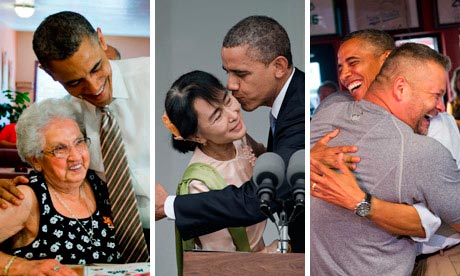
Barack Obama hugs compositeBarack Obama at a cafe in Pueblo, Colorado; with Aung San Suu Kyi at her residence in Yangon; and with Scott Van Duzer, owner of Big Apple Pizza in Florida. Photograph: Jim Watson/Nicolas Asfouri/Saul Loeb/AFP/Getty ImagesThe most common answer is by fostering greater perspective-taking. Decades of scientific research show that people are kinder to those they view as human beings. The reason is that, when we make the imaginative effort to step into the shoes of another person and see things from their perspective, we become less capable of ignoring their suffering. Indeed, brain imaging studies of Buddhists who use meditation exercises to contemplate compassion on a daily basis show increased activation of the amygdala and other parts of the brain’s empathy circuit.

Novels, television and the internet can also foster greater empathy by exposing us to the perspectives of people whose lives we would not otherwise consider. This is particularly the case when empathy is married with “humanitarian reason” – the force that Harvard psychologist Steven Pinker credits for the steady decline in levels of societal violence since the Enlightenment.

However, as the response last year to Invisible Children’s video about the Ugandan warlord Joseph Kony showed, this sort of empathy can be short-lived. Yes, nearly 100 million people shared Invisible Children’s video on YouTube, but the outcry against Kony was temporary and people quickly found new objects for their indignation.

Moreover, far from being a guide to what is right, empathy often leads us astray, as when judges go easier on white-collar criminals who share their social background, which is why we frequently invoke other values and principles to balance such tendencies. This is precisely the argument made by Jonathan Haidt in his book The Righteous Mind: Why Good People Are Divided by Politics and Religion. Haidt maintains that empathy, or what he labels the “harm/care” module, is just one of several emotional dispositions that undergird our moral outlook, the others being fairness, liberty, loyalty, authority and purity/sanctity. The difference between Democrats and Republicans is that, while liberals focus almost entirely on care and fairness, conservatives tend to give equal weight to all six dispositions.

In theory, this should be good news for Osborne as he seeks to counter perceptions that his austerity measures are “uncaring”, and even better news for Republicans, especially as something like 42% of the American electorate self-identify as conservative. However, as Obama’s response to Mitt Romney’s unfortunate remarks about the “47%” underlined, the perceived absence of empathy is a powerful weapon with which to browbeat a political opponent. Perhaps this is why, rather than defending his comments about the 47% on traditional conservative grounds, Romney spent the closing weeks of last year’s campaign desperately trying to persuade voters that he was just as compassionate as Obama.

Even before hurricane Sandy upset the candidates’ campaign plans, however, that was not an argument that carried much weight with the undecideds and, following the pictures of Obama embracing the victims of the storm damage in New Jersey, it was pretty much game, set and match to the incumbent.

Indeed, if there is a lesson to be drawn from the 2012 presidential election, it is that empathy is here to stay and that where candidates once talked about “the economy, stupid” they would now be well-advised to use a different E-word.

Altruistic punishers: when it feels good to act cruelly

Empathy is not the only “moral emotion” that is enjoying a renaissance thanks to social neuroscience. Scientists have also been probing the biological processes involved in trust and altruism.

One theory is that when we empathise oxytocin and other chemicals flood the brain’s pleasure centres, resulting in a “warm glow” effect. Similar surges occur when people are asked to play economic exchange games designed to elicit trust.

According to neuroeconomists such as Paul Zak, this suggests that empathy and trust are two sides of the same adaptive response – the idea being that our brains have evolved so that it literally feels good to empathise and to trust people.

Primatologists such as Frans de Waal believe that altruism may be the result of similar selection pressures. Spontaneous assistance has long been observed in apes, hence the adoption of orphans by wild male chimpanzees who may devote years of costly care to unrelated juveniles. And, as the Chicago experiment illustrates, rats also exhibit similar altruistic behaviour without their altruism being repaid.

In the case of humans, altruism is more complicated as over the course of a lifetime we will co-operate with thousands of genetically unrelated strangers with whom we are unlikely to interact again. In such societies, the advantages of forming a good reputation are minimal. At the same time, it is easy for unscrupulous individuals, known as “free-riders”, to exploit the “trusting” instincts of the majority.

To explains this, neuroeconomists posit that a unique form of co-operation has evolved in human societies in which social norms are learned, co-operators are altruistically rewarded and free-riders are altruistically punished.

This theory is supported by studies of economic role-playing games in which punishment is used to motivate two players to co-operate and a failure to show and reciprocate altruism leaves both players worse off.

However, such games also pose a problem for the notion that humans are hard-wired for pro-sociality and morality as brain scans of altruisitic punishers show that they both empathise with the free-rider and take an active pleasure in his or her punishment. In other words, as anyone who has experienced schadenfreude knows, sometimes it feels good to act cruelly.

December 30, 2012

06 ¿Se ha terminado el crecimiento?

Filed under: economía,future,política — fores @ 11:41 am
el país

¿Se ha terminado el crecimiento?

De las perspectivas para una prosperidad a largo plazo sabemos menos de lo que pensamos.

30 DIC 2012 – 00:00 CET1
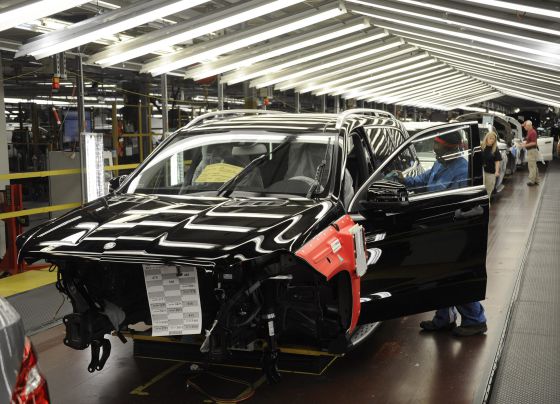
Planta de Mercedes en Vance, Alabama. / Bernard Troncale (Cordon Press)

La mayor parte de los comentarios económicos que se leen en la prensa se centran en el corto plazo: los efectos del precipicio fiscal sobre la recuperación estadounidense, las tensiones a las que se ve sometido el euro y el último intento de Japón de salir de la deflación. Esta atención es comprensible, dado que una depresión mundial te puede arruinar todo un día. Pero nuestros apuros actuales se acabarán con el tiempo. ¿Qué sabemos de las perspectivas para una prosperidad a largo plazo?

La respuesta es: menos de lo que pensamos.

Las proyecciones a largo plazo realizadas por los organismos oficiales, como la Oficina Presupuestaria del Congreso, por lo general dan por sentado dos cosas importantes. Una es que el crecimiento económico a lo largo de las próximas décadas se parecerá al crecimiento a lo largo de las últimas décadas. En concreto, se prevé que la productividad —el principal impulsor del crecimiento— aumente a un ritmo no muy diferente del de su crecimiento medio desde la década de 1970. Por otro lado, sin embargo, estas proyecciones por lo general dan por sentado que la desigualdad de ingresos, que se disparó a lo largo de las tres últimas décadas, solo aumentará con moderación en el futuro.

No resulta difícil entender por qué los organismos dan esto por sentado. Teniendo en cuenta lo poco que sabemos sobre el crecimiento a largo plazo, dar por hecho simplemente que el futuro se parecerá al pasado es una suposición natural. Por otra parte, si la desigualdad de ingresos sigue aumentando vertiginosamente, estamos ante un futuro distópico en el que se producirá una guerra de clases, y no es algo que los organismos gubernamentales quieran plantearse.

Así y todo, es muy probable que esta opinión generalizada se equivoque en uno o en ambos aspectos.

Si la desigualdad de ingresos sigue aumentando, se producirá en un futuro una guerra de clases

Recientemente, Robert Gordon, de la Northwestern University, provocó un revuelo al sostener que es probable que el crecimiento económico disminuya drásticamente y, de hecho, es muy posible que la época de crecimiento que se inició en el siglo XVIII esté tocando a su fin.

Gordon señala que el crecimiento económico a largo plazo no ha sido un proceso continuo: ha sido impulsado por varias “revoluciones industriales” específicas, cada una de las cuales estaba basada en un conjunto concreto de tecnologías. La primera revolución industrial, basada en gran medida en el motor de vapor, impulsó el crecimiento a finales del siglo XVIII y a principios del XIX. La segunda, que resultó posible, en gran parte, por la aplicación de la ciencia a tecnologías como la electrificación, la combustión interna y la ingeniería química, empezó en torno a 1870 e impulsó el crecimiento hasta la década de 1960. La tercera, centrada en torno a la tecnología de la información, define nuestra época actual.

Y, como señala Gordon correctamente, los beneficios, hasta ahora, de la tercera revolución industrial, aunque son reales, han sido mucho menos importantes que los de la segunda. La electrificación, por ejemplo, fue un invento mucho más importante que Internet.

Es una tesis interesante y un contrapeso útil frente a toda la sorprendente glorificación de la última tecnología. Y aunque no creo que tenga razón, la forma en la que probablemente se equivoca tiene implicaciones igual de destructivas para la opinión generalizada. El argumento en contra del tecnopesimismo de Gordon reside en gran parte en la suposición de que los grandes beneficios de la tecnología de la información, que solo acaban de empezar, provendrán del desarrollo de máquinas inteligentes.

La electrificación fue un invento mucho más importante, por ejemplo, que Internet

Si siguen estas cosas, saben que el campo de la inteligencia artificial lleva décadas rindiendo por debajo de sus posibilidades, lo cual es frustrante, ya que a los ordenadores les resulta increíblemente difícil hacer cosas que a todos los seres humanos les parecen fáciles, como entender palabras normales y corrientes o reconocer objetos diferentes en una foto. Últimamente, sin embargo, parece que se han derribado las barreras y no porque hayamos aprendido a reproducir el entendimiento humano, sino porque los ordenadores pueden ofrecer hoy día resultados aparentemente inteligentes buscando mediante patrones en enormes bases de datos.

Es verdad que el reconocimiento del lenguaje todavía no es perfecto; según el programa, una persona que llamó indignada me dijo que estaba “totalmente equivocado”. Pero eso es mucho mejor de lo que estaba hace solo unos años, y ya se ha convertido en una herramienta tremendamente útil. El reconocimiento de objetos está un poco rezagado: sigue produciendo emoción el hecho de que una red de ordenadores alimentada con imágenes de YouTube aprendiese espontáneamente a identificar a los gatos. Pero no hay un gran trecho desde esto hasta un sinfín de aplicaciones económicamente importantes.

Por eso puede que las máquinas estén listas dentro de poco para realizar tareas que actualmente requieren una gran cantidad de trabajo humano. Esto se traducirá por un rápido aumento de la productividad y, por tanto, por un crecimiento económico general elevado.

Pero —y esta es la cuestión fundamental— ¿quién se beneficiará de ese crecimiento? Por desgracia, es muy fácil sostener el argumento de que la mayoría de los estadounidenses se quedarán atrás, porque las máquinas inteligentes acabarán devaluando la contribución de los trabajadores, incluidos los trabajadores cualificados cuyas habilidades se volverán superfluas repentinamente. La cuestión es que existen buenas razones para pensar que la opinión generalizada reflejada en las proyecciones presupuestarias a largo plazo —unas proyecciones que determinan todos los aspectos de la actual discusión política— es totalmente errónea.

¿Cuáles son, entonces, las consecuencias de esta visión alternativa para la política? Bueno, es un tema que tendré que abordar en una futura columna.

Paul Krugman, profesor de Princeton, es premio Nobel de Economía de 2008

© New York Times Service 2012

December 29, 2012

06 Dennis Kucinich: With 2 Parties Failing U.S.

Filed under: economía,future,política — fores @ 9:33 am

Friday, December 28, 2012

Outgoing Rep. Dennis Kucinich: With 2 Parties Failing U.S., It’s on Us to Build a “Culture of Peace”

Democratic Rep. Dennis Kucinich of Ohio is serving his last week in Congress after eight terms in office. Since 1997, Kucinich has been a leading progressive voice on Capitol Hill, known for actions including the bringing of articles of impeachment against George W. Bush for the invasion and occupation of Iraq, voting against the USA PATRIOT Act, advocating for ending the war on drugs, challenging U.S. warfare from Afghanistan to Libya, and pushing for single-payer healthcare to replace the patchwork, privatized U.S. system. Kucinich ran for president in 2004 and 2008 with a vow to create a Department of Peace. “The two-party system itself is failing the American people,” Kucinich says. “We have to look at the culture of violence that we have in America and … build a culture of peace.” [includes rush transcript]

Guest:

Rep. Dennis Kucinich, Democratic U.S. representative from Ohio, serving his last week as a member of Congress.

Rush Transcript

This transcript is available free of charge. However, donations help us provide closed captioning for the deaf and hard of hearing on our TV broadcast. Thank you for your generous contribution.Donate >

Transcript

JUAN GONZÁLEZ: While the so-called fiscal cliff has dominated the news headlines, the Senate is also preparing to vote today to continue a controversial domestic surveillance program. In a blow to civil liberties advocates, the Senate rejected three attempts Thursday to add oversight and privacy safeguards to the Foreign Intelligence Surveillance Act.

AMY GOODMAN: Dennis Kucinich is still with us, outgoing Democratic congressmember. This will be his last week in Congress—at least for this term of his political life. Congressmember Kucinich, the issue of FISA—what is this bill? What does it mean?

REP. DENNIS KUCINICH: Well, what it reflects is a breakdown in trust in this country. The attempt is to give the government even more powers to spy, and that is really being translated into domestic, quote-unquote, “intelligence,” even though it’s called the foreign intelligence bill.

We have to ask questions. You know, why, for example, was—did you have the Occupy Wall Street movement being spied upon? What is this? What’s going on in our country, where we don’t have oversight of the activities of the government when it comes to domestic spying? And what are we doing in America, where the privacy concerns of Americans are swept aside?

We’re entering into a brave new world, which involves not only the government apparatus being able to look in massive databases and extract information to try to profile people who might be considered threats to the prevailing—to the status quo. But we also are looking at drones, which are increasingly miniaturized, that will give the governments, at every level, more of an ability to look into people’s private conduct. This is a nightmare. And the FISA bill is just one example of how America is going in a direction that undermines the expectations of not just the right to privacy, but the right to be free of unreasonable search and seizure, the demand that any action that’s taken to get information about people should be subject to a warrant, that it not be subject to just any FBI agent determining that this is information they want on that person. This is bad news.

AMY GOODMAN: Congressmember Kucinich, not just what do you say to your natural opponents, the Republicans in Congress, but to your allies, Democratic congressmembers, who you almost, in many of these cases, from drones to FISA, oppose as much as the Republicans? What message do you have for them as you leave Congress?

REP. DENNIS KUCINICH: Well, actually, you know, we’ve seen a bridge here created between Democrats and Republicans on the issue of liberty and being free from the all-seeing eye of Big Brother. Congressman Paul and I worked together on many of these issues relating to the government seeking increased powers to surveil the American people. You know, it’s really no longer a Democrat or Republican issue. It goes much deeper than that. And in a way, Amy, these debates that we’re having right now in Washington show the limitations of our two-party system, that the two-party system itself is failing the American people, that there really aren’t enough choices, of not just individuals, but of policies reflecting the direction America should go in.

When we find in a post-9/11 America that we are mired in a condition of fear; when we see the massive amounts of spending that’s gone for war and increased military buildups and for expansion of spy agencies like the Domestic Intelligence Agency, which is just adding another 1,600 spies so that the Pentagon can have their own spy agency to compete with, what, the CIA abroad; when you see the interventions that have fallen flat and have been disastrous, such as Libya and Benghazi; when you see al-Qaeda growing in strength because of our own misapplication of force, you have to ask, if this is about Democrat and Republican, this system is failing. And we’re seeing an evidence of it on fiscally, but we’re seeing another evidence of it in foreign policy, and we’re seeing an evidence of it domestically, when you can see a surveillance state arising under the noses of both political parties.

AMY GOODMAN: You talk about your alliance with Ron Paul. Both of you are leaving. This is your last days in Congress, at least this time. So who are your successors, who you see in Congress right now, who will carry on these struggles for privacy, against drones?

REP. DENNIS KUCINICH: Well, you know, I would hope that people who I’ve worked with in the past, like Barbara Lee, Alan Grayson and others, would continue the efforts. You know, there are people on both sides of the aisle who have expressed concerns. You have to remember that we put together a very powerful coalition in challenging the war in Libya that was a coalition between Democrats and Republicans, that reflects a new concern about where is America going. Why are we letting the president or the White House determine that we should expand war? We don’t even involve Congress anymore.

I think that you’re going to see, you know, a continued effort. The question is the strength of it. And the question is, as a function of the work of political parties, why political parties have essentially been outside of this debate over civil liberties. Why have the parties watched as there’s skirmishes that go inside Congress that really are not emboldened by the support of either side of the aisle in some official party structure? That’s what I’m saying.

You know, as we look towards a new year, we may be looking at two things. Number one, within each party, you may see more primaries. So, you know, we may see people decide that instead of being independents, they want to be party animals and bring the challenge right inside the Republican and Democratic parties. Or, on the alternative, you may see a third political wave movement that arises from disgust with the inability of parties to address the economic aspirations of the American people. So, we’ll see.

JUAN GONZÁLEZ: Congressman, I’m wondering now, as this is 16 years now in the House, prior to that as the mayor of Cleveland, any misgivings about things that you were not able to accomplish, or, in the same way, pride in things that you were able to accomplish, especially in the House, all these years that you’ve been seen as the conscience of the House?

REP. DENNIS KUCINICH: Well, I will say that it’s really unfortunate that the—that the Democratic leadership in the House did not support an impeachment effort to challenge the Bush administration, and Mr. Bush and Mr. Cheney, on the lies that took us into war in Iraq. That was a pivotal moment for this country. And instead of choosing the Constitution, our leaders chose politics. Bad choice. The fact is that today, after a decade of war, we are looking at an eventual bill for that Iraq war of $5 trillion. We’re looking at perhaps as many as a million innocent civilians perishing—for war that was based on lies. People have to remember this. This isn’t just because it’s, you know, forget about the past. No, you cannot forget about the past. We went to war based on lies.

And so, you know, I did my part, which was to alert the Congress back in October 2002: Look, we’re headed into a war, and there’s no proof that Iraq has anything to do with 9/11 or had weapons of mass destruction; what are we doing here? But we were pulled into that by the Bush administration, driven by neocons and the Project for the New American Century. All of us who were following it know exactly what happened. And, you know, that set the stage for where we are today. We’re at the—you know, if there is such a thing as a fiscal cliff, we’re at the edge of it because of trillions of dollars that will be spent for wars based on lies. And there was never any accountability.

If there’s one thing we have to do, we have—America needs a period of truth and reconciliation, if we’re ever going to get—put the country back together again and achieve a level of national unity that we’re capable of. But right now we’re living on a lie. And the lie is that—that this whole national security infrastructure is necessary and that it’s necessary for us to keep expanding war around the world, it’s necessary for us to have these big spy agencies, which also interact domestically. All of this stuff shouldn’t have happened. And we made the wrong choices. And this is a problem for both political parties to resolve. You can always try to fix things, but you have to look at the severe impact that our inability to act, to challenge the lies that took us into war—you have to look at where it’s left us.

AMY GOODMAN: Congressmember Kucinich, why is it that it seems like so few tea party Republicans can control the Republican Party in Congress, and yet the largest caucus of the Democratic Party in Congress, the Progressive Caucus, has so little effect or say?

REP. DENNIS KUCINICH: Well, I think, first of all, for those who are doing the daily work inside the Progressive Caucus, they should be appreciated. Raúl Grijalva and Congressman Ellison, you know, they’ve done a decent job of keeping a progressive agenda out front. However, you know, some members will choose affiliation with the Progressive Caucus as kind of a social function more than a political function. So the membership of the caucus belies the fact that once Democrats are voting on the floor of the House, you know, it doesn’t matter what caucuses they’re involved in. It’s like a social thing. What matters is they’re responding to the aspirations of their—of their constituents.

And that’s why—you know, I go back to what I said a moment ago. You know, it may be that instead of people going outside the party and saying, you know, “A curse on both your houses,” that you come—that we get people coming back inside the party and start to bring primary challenges forward on both sides of the aisle to shake up the political equation so that parties really do reflect a little bit more of the involvement and the aspirations of people at a local level. I mean, the tea party knew what they were out to do. But the Democratic Party hasn’t shown the same kind of discipline or willingness to take a stand on some of these basic issues that ought to describe who we are, like Social Security, like single-payer healthcare, like keeping people in their homes, like a full-employment economy, like ending the military buildups and the war machine. I mean, you know, there’s still plenty of room for us within the party to negotiate that, if people feel there’s still a chance to do that.

AMY GOODMAN: Congressmember Kucinich, very quickly, news just in of another shooting, this in Camden County, New Jersey, three police officers shot. It looks like there are no deaths at this point. The shooting happened around 5:45 this morning, Eastern time. The power of the NRA? And also, do you see yourself getting involved with third-party politics; as you leave, what your plans are?

REP. DENNIS KUCINICH: You know, I’d love to be involved in two-party politics, but we don’t really have that right now.

I think that this ubiquity, ubiquitousness of violence in our society isn’t just about guns. We have to look at the culture of violence that we have in America and deal with it in a way that isn’t about beating ourselves up, but we have to look at the spectrum of violence—domestic violence, spousal abuse, child abuse, violence in the school, gang violence, gun violence, racial violence, violence against gays, and the police community challenges that come up. And in doing that, that’s why I called for, years ago, a Department of Peace, not to simply create another federal department, but to have an organized approach nationally to deal with the violence in a society, to help families deal with the tensions that they have at home, to deal with some of the fundamental attitudes people have, boys might have about girls, and, you know, through education. We need to take a new approach.

And frankly, you know, we can get rid of all guns; we’re still going to have violence. Now, I have never supported the NRA. I probably have, you know, a zero rating with them. But the fact of the matter is that we have to take a much broader view. Again, the debate is too narrow here. It’s—we need to look at the cultural issues, that are real. And when you talk about gun control here in America, and at the same time you’re talking about gun expansion across the world, about not only the United States exporting arms to the world and engendering wars everywhere, but our own efforts proliferating wars, that’s kind of a mixed message that inevitably is not easily reconciled.

So we need to build a culture of peace in America. Is it possible? Of course it is. You know, violence is a learned response. So is nonviolence. And so, through education and through creating a social health safety net, I think that we can meet the challenge. And that’s one of the things I’m certainly going to be involved in as I leave the Congress, to try to broaden the debate, to look at this in a way that’s compassionate and at the same time not blaming ourselves, but recognizing that we have a culture that is very violent and that affects Americans at every level. And if we address that in a systematic way through an organized approach, using the resources and assets of government at all levels, I think that we could find a way to change from where we are today with this dismal record of one shooting after another and all the, you know, innocent people and public servants constantly being under attack.

AMY GOODMAN: Congressmember Kucinich, we want thank you very much for being with us. Dennis Kucinich, eight-term congressmember from Ohio, serving his last week as a member of Congress. We will look forward to talking to you in your new capacity, whatever that will be.

REP. DENNIS KUCINICH: Thank you.

AMY GOODMAN: This is Democracy Now!, democracynow.org, The War and Peace Report. When we come back, we look at the Wilmington 10. Why are so many calling on the North Carolina governor to pardon them. We urge you to listen. Stay with us.


Creative Commons License The original content of this program is licensed under a Creative Commons Attribution-Noncommercial-No Derivative Works 3.0 United States License. Please attribute legal copies of this work to democracynow.org. Some of the work(s) that this program incorporates, however, may be separately licensed. For further information or additional permissions, contact us.

December 28, 2012

06 “The Reagan Restoration” para descerebrados y amnésicos.

Filed under: archivo personal,economía,future,política — fores @ 9:06 pm
Dollars and Sense logo Donate to D&S

UAWSJ logo


Ronald Reagan’s Legacy

His destructive economic policies do not deserve the press’s praise.

John Miller


ShareThis
issue 254 cover

This article is from the July/August 2004 issue of Dollars & Sense magazine.

“The Reagan Restoration”

Mr. Reagan’s … agenda of tax cuts and deregulation ignited the boom that restored U.S. confidence. … [His] economic policies get less credit than they deserve because of the budget deficits and the 1982 recession.

Mr. Reagan’s unique contribution was to stick to his economic program, and to support Federal Reserve Chairman Paul Volcker, in the face of enormous political pressure to turn tail on both. Growth resumed as he expected, and tax revenues actually increased faster than GDP from the low point in 1983 through 1989. As for the deficits, they did finally vanish once defense spending fell after the Cold War ended and a GOP Congress slowed the growth in other spending for at least a couple of years in the mid-1990s.

In the broader historical sweep, the Reagan tax cuts saved America from following Western Europe into welfare-state decline. In addition to igniting growth, his tax cuts put a brake on the expansion of government that had seemed unstoppable.

When Mr. Reagan took office, the top marginal U.S. tax rate was 70%. When he left the top rate was 28%; it is now 35%, and even John Kerry has conceded with his proposal to cut some corporate taxes that the marginal rate of tax matters. Today Americans may disagree about what tax cuts are needed, how deep they should go, and what they ought to target. But the debate itself reflects Mr. Reagan’s central premise: that people respond to incentives, and that high taxes interfere with natural human creativity and drive.

—The Wall Street Journal, June 7, 2004

Two days after his death, the Wall Street Journal ran a lengthy editorial tribute to Ronald Reagan, in the editors’ estimation the most important president since FDR. In their paean to the fortieth president, Reagan gets credit for everything from winning the Cold War to renewing a sense of optimism at home. Oh, and he gets extra kudos for doing it all with that famously sunny disposition.

On economic policy, as the Journal tells the story, by tying the hands of meddlesome government bureaucrats and cutting taxes, Reaganomics ignited an episode of miraculous economic growth that restored prosperity to the U.S. economy. But like much of what Reagan had to say while he was president, what the Journal offers is just so much happy talk that masks a mean-spirited, economically unsound, and socially destructive policy agenda.

First off, claims that Reagan’s economic agenda restored prosperity are overblown. The so-called Reagan boom was in fact a rather middling episode of economic growth. Shorter than either the 1960s and 1990s expansions, the 1980s economic expansion was still the third longest on record. But it was hardly robust. The economy grew much more slowly in the 1980s than during the 1960s, more slowly than the postwar average of 3.6% annual growth, and no faster than in the 1970s or the 1990s. Nor did Reagan administration regulatory rollbacks unleash a productivity boom. Productivity gains in the 1980s failed to match those in the decades before and after, and couldn’t hold a candle to the productivity gains of the 1960s boom. (See “Economic Indicators by Decade.”)

Economic Indicators by Decade
Average Annual Change 1960s 1970s 1980s 1990s
Real GDP 4.4% 3.3% 3.1% 3.1%
Productivity 2.9% 2.0% 1.4% 1.9%
Employment 1.9% 2.4% 1.7% 1.3%
S&P 500: Real Returns 6.6% Ð0.5% 12.9% 15.9%
Real Weekly Wages 1.45% Ð0.27% Ð0.72% 0.28%
Real Median Family income 3.21% 0.76% 1.01% 0.95%
Average Level of Inflation 2.3% 7.1% 5.6% 3.0%
Average Level of Unemployment 4.8% 6.2% 7.3% 5.8%
Note: S&P 500 refers to inflation-adjusted total returns. Real median family income is calculated from annual data; the remaining figures are calculated from quarterly data.
Sources: Cletus C. Coughlin and Daniel L. Thornton, “Yes, the ’90s Were Unusual: But Not Because of Economic Growth,” Business Week, April 24, 2000; Census Bureau; Economic Report of the President.


The Reagan years showed mixed results on a number of other economic measures. The “great American jobs machine,” missing in action since George W. Bush took office, was up and running during the Reagan administration. The rate of job growth was higher in the 1980s than in the 1990s—but lower than in either the 1960s or the 1970s. In addition, unemployment rates remained quite high throughout the decade: 5.2% at the boom’s end in 1989, well above the 3.5% and 4.1% rates achieved at the end of the 1960s and 1990s booms. The 1980s economy did more to improve the purchasing power of the median family than the 1990s boom. But again, those gains were extremely modest compared to what the 1960s boom did for that representative family.

None of this speaks to the lopsided distribution of the benefits of Reagan-era economic growth. Investors made out during the 1980s, while workers lost out. After seeing their investments lose value during the 1970s, shareholders enjoyed real returns (i.e., adjusted for inflation) in the 1980s that rivaled those of the next decade’s stock market bubble and far outdistanced the returns of the 1960s. Real weekly wages for nonsupervisory workers, on the other hand, took a beating, declining even more quickly than they had during the 1970s. Today, the average real earnings of nonsupervisory workers remain far below those of 30 years ago, despite healthy wage gains in the second half of the 1990s expansion, when unemployment rates dropped toward 4%.

Nor did Reagan era growth do much to alleviate poverty. The poverty rate in 1989 at the end of Reagan’s two terms was still 12.8%. That was just one percentage point lower than at beginning of his administration. In contrast, the 1990s boom knocked three percentage points off the nation’s poverty rate, while the 1960s boom nearly cut it in half.

Reagan administration economic policies did not result in a 1960s-style prosperity, when workers’ real wages went up in tandem with the value of stock holdings—just the opposite. Since 1980, the gains from U.S. economic growth have gone overwhelmingly to the well-to-do, and economic inequality has steadily worsened. By 2000, the ratio of the family income of the top 5% to that of the bottom 20% stood at 19.1, a dramatic rise over the 1979 ratio of 11.4. Reagan’s economic policies ushered in the return of levels of inequality unseen since the eve of the Great Depression.

In one area the 1980s boom did post genuinely outstanding numbers: reducing inflation. But Federal Reserve Board chair Paul Volcker, not the Reagan administration, administered the fight against inflation. Volcker’s tight monetary policy induced the 1982 recession and helped keep a lid on wage growth. Thus the credit for breaking inflation goes more properly to the workers who endured a decade of declining purchasing power administered in the name of price stability.

But what about the particulars of Reaganonomics (or supply-side economics), which in practice meant large tax cuts targeted at the rich, a military buildup, and slashing social spending? That too is a disturbing story.

The tax cuts came in 1981, Reagan’s first year in office. The administration’s plan slashed corporate and individual income tax rates, with the biggest cut in the top rate. The Reagan team promised that their tax cuts would jolt the economy back to life because, as the Wall Street Journal’s editors put it, “high taxes interfere with natural human creativity and drive.” And the true believers went so far as to suggest that the economy would grow fast enough that tax revenues would actually rise, making the tax cuts painless.

The results never came close to measuring up to the supply-side rhetoric. For starters, the tax cuts busted the federal budget. The federal deficit ballooned from 2.7% of GDP in 1980 to 6% of GDP in 1983, the largest peacetime deficit in history, and was still 5% of GDP in 1986. Tax revenues did pick up, especially after the 1983 payroll tax increase kicked in, reducing the deficit somewhat. Still, tax revenues grew far more slowly over than the 1980s business cycle (2.5% from 1979 to 1989) than they did in the 1990s business cycle (4.1% from 1989 to 2000).

Nor did the claim that tax cuts would encourage work effort, savings, and investment, the central premise of Reaganomics, hold up. When mainstream economists, such as Barry Bosworth and Gary Burtless of the Brookings Institution, checked out the effects of the 1981 tax cut, they found that something quite different had happened. After the tax cut, men didn’t work much more at all; although women did work longer hours, their earnings failed to improve. And relative to the size of the economy, net investment declined and savings plummeted. The Economic Policy Institute, a labor-funded think tank, reports that the annual increase in real investment in the 1980s business cycle (2.5% per year) was less than half of that during the 1990s business cycle (5.9% per year).

Worse yet, most low-income taxpayers missed out on the Reagan tax cuts. The bottom 40% of households paid out more of their income in federal taxes in 1988 than they had in 1980. Increases in the payroll taxes that finance Social Security and Medicare, which made up a far higher portion of their federal tax bill than income taxes, swamped what little benefit these taxpayers received from lower income tax rates. For the richest 1%, on the other hand, the Reagan tax cuts were pure elixir. This group saw their effective federal tax rate drop from 34.6% to 29.7%, according to a recent study conducted by the Congressional Budget Office. As these numbers suggest, Reagan left a far less progressive federal tax code than he found.

While the Reagan military buildup kept overall government spending from shrinking, Reagan’s budgets slashed social spending. Domestic discretionary spending, which includes just about all nondefense spending outside of Social Security, Medicare, and Medicaid, was the special target of Reagan’s budget cutting. Relative to the size of the economy, one-third of domestic discretionary spending disappeared: it fell from 4.7% of GDP in 1980 to 3.1% in 1988. Hardest hit were programs for low-income Americans, which in real terms suffered a withering 54% cut in federal spending from 1981 to 1988. After correcting for inflation, subsidized housing lost 80.7% of its support, training and employment services 68.3%, and housing assistance for the elderly 47.1%. These programs have never returned to their pre-Reagan spending levels. In fact, under the Clinton administration spending on domestic discretionary programs continued to decline relative to the size of the economy.

Reagan’s economic legacy endures. Government continues to turn its back on social spending for the poor in favor of ineffectual tax giveaways for the rich, at same time that it finds unlimited monies for military adventures. Lopsided economic growth showers benefits on stock investors while doing precious little for workers or—not an entirely separate group—the poor. And today’s Depression-level inequality is not mitigated as much as it once was by the tax code

Ronald Reagan did profoundly alter the economic policy agenda of our nation. But the Reagan legacy ought to be condemned, not celebrated. And we continue to do battle with its crippling effects. Whether under a Clinton presidency, a Bush presidency, or now perhaps a Kerry presidency, it is up to us to restore all that has been lost since Reagan came to power nearly a generation ago.

John Miller teaches economics at Wheaton College and is a member of the Dollars & Sense collective.

« Previous Page — Next Page »

WPMU Theme pack by WPMU-DEV.