Forés @ UVPress


         Universitat de València PRESS -UVPress- weblog for research uses

January 16, 2012

05 The Perils of 2012 by Joseph E. Stiglitz

Filed under: archivo personal,economía,future,Holístico — fores @ 6:33 am

Unconventional Economic Wisdom

The Perils of 2012

English Spanish Russian French Czech Chinese Arabic
2012-01-12

The Perils of 2012

KOLKATA – The year 2011 will be remembered as the time when many ever-optimistic Americans began to give up hope. President John F. Kennedy once said that a rising tide lifts all boats. But now, in the receding tide, Americans are beginning to see not only that those with taller masts had been lifted far higher, but also that many of the smaller boats had been dashed to pieces in their wake.

In that brief moment when the rising tide was indeed rising, millions of people believed that they might have a fair chance of realizing the “American Dream.” Now those dreams, too, are receding. By 2011, the savings of those who had lost their jobs in 2008 or 2009 had been spent. Unemployment checks had run out. Headlines announcing new hiring – still not enough to keep pace with the number of those who would normally have entered the labor force – meant little to the 50 year olds with little hope of ever holding a job again.

Indeed, middle-aged people who thought that they would be unemployed for a few months have now realized that they were, in fact, forcibly retired. Young people who graduated from college with tens of thousands of dollars of education debt cannot find any jobs at all. People who moved in with friends and relatives have become homeless. Houses bought during the property boom are still on the market or have been sold at a loss. More than seven million American families have lost their homes.

The dark underbelly of the previous decade’s financial boom has been fully exposed in Europe as well. Dithering over Greece and key national governments’ devotion to austerity began to exact a heavy toll last year. Contagion spread to Italy. Spain’s unemployment, which had been near 20% since the beginning of the recession, crept even higher. The unthinkable – the end of the euro – began to seem like a real possibility.

This year is set to be even worse. It is possible, of course, that the United States will solve its political problems and finally adopt the stimulus measures that it needs to bring down unemployment to 6% or 7% (the pre-crisis level of 4% or 5% is too much to hope for). But this is as unlikely as it is that Europe will figure out that austerity alone will not solve its problems.   On the contrary, austerity will only exacerbate the economic slowdown. Without growth, the debt crisis – and the euro crisis – will only worsen. And the long crisis that began with the collapse of the housing bubble in 2007 and the subsequent recession will continue.

Moreover, the major emerging-market countries, which steered successfully through the storms of 2008 and 2009, may not cope as well with the problems looming on the horizon. Brazil’s growth has already stalled, fueling anxiety among its neighbors in Latin America.

Meanwhile, long-term problems – including climate change and other environmental threats, and increasing inequality in most countries around the world – have not gone away. Some have grown more severe. For example, high unemployment has depressed wages and increased poverty.

The good news is that addressing these long-term problems would actually help to solve the short-term problems. Increased investment to retrofit the economy for global warming would help to stimulate economic activity, growth, and job creation. More progressive taxation, in effect redistributing income from the top to the middle and bottom, would simultaneously reduce inequality and increase employment by boosting total demand. Higher taxes at the top could generate revenues to finance needed public investment, and to provide some social protection for those at the bottom, including the unemployed.

Even without widening the fiscal deficit, such “balanced budget” increases in taxes and spending would lower unemployment and increase output. The worry, however, is that politics and ideology on both sides of the Atlantic, but especially in the US, will not allow any of this to occur. Fixation on the deficit will induce cutbacks in social spending, worsening inequality. Likewise, the enduring attraction of supply-side economics, despite all of the evidence against it (especially in a period in which there is high unemployment), will prevent raising taxes at the top.

Even before the crisis, there was a rebalancing of economic power – in fact, a correction of a 200-year historical anomaly, in which Asia’s share of global GDP fell from nearly 50% to, at one point, below 10%. The pragmatic commitment to growth that one sees in Asia and other emerging markets today stands in contrast to the West’s misguided policies, which, driven by a combination of ideology and vested interests, almost seem to reflect a commitment not to grow.

As a result, global economic rebalancing is likely to accelerate, almost inevitably giving rise to political tensions. With all of the problems confronting the global economy, we will be lucky if these strains do not begin to manifest themselves within the next twelve months.

Joseph E. Stiglitz is University Professor at Columbia University, a Nobel laureate in economics, and the author of Freefall: Free Markets and the Sinking of the Global Economy.

Copyright: Project Syndicate, 2012.
www.project-syndicate.org

You might also like to read more from or return to our home page.

January 14, 2012

05 Many Americans gave up hope last year – 2012 will be worse

Filed under: archivo personal,economía,future,módulo básico — fores @ 4:55 pm
Posted by

Friday 13 January 2012 07.06 EST guardian.co.uk

Many Americans gave up hope last year – 2012 will be worse

The chance of realising the American dream is receding for millions as jobs are lost, savings run out and houses are repossessed


Jobseekers in new York

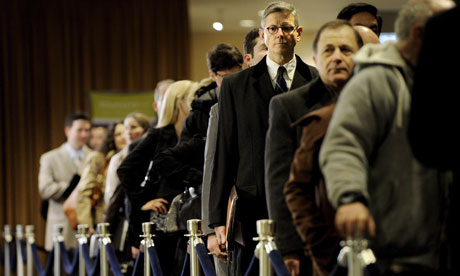
Middle-aged people who thought they would be unemployed for a few months have realised that they were, in fact, forcibly retired. Photograph: Justin Lane/EPA

The year 2011 will be remembered as the time when many ever-optimistic Americans began to give up hope. President John F Kennedy once said that a rising tide lifts all boats. But now, in the receding tide, Americans are beginning to see not only that those with taller masts had been lifted far higher, but also that many of the smaller boats had been dashed to pieces in their wake.


In that brief moment when the tide was indeed rising, millions of people believed that they might have a fair chance of realising the “American Dream”. Now those dreams, too, are receding. By 2011, the savings of those who had lost their jobs in 2008 or 2009 had been spent. Unemployment cheques had run out. Headlines announcing new hiring – still not enough to keep pace with the number of those who would normally have entered the labour force – meant little to the 50-year-olds with little hope of ever holding a job again.


Indeed, middle-aged people who thought that they would be unemployed for a few months have now realised that they were, in fact, forcibly retired. Young people who graduated from college with tens of thousands of dollars of education debt cannot find any jobs at all. People who moved in with friends and relatives have become homeless. Houses bought during the property boom are still on the market or have been sold at a loss. More than seven million American families have lost their homes.


The dark underbelly of the previous decade’s financial boom has been fully exposed in Europe as well. Dithering over Greece and key national governments’ devotion to austerity began to exact a heavy toll last year. Contagion spread to Italy. Spain’s unemployment, which had been near 20% since the beginning of the recession, crept even higher. The unthinkable – the end of the euro – began to seem like a real possibility.


This year is set to be even worse. It is possible, of course, that the United States will solve its political problems and finally adopt the stimulus measures that it needs to bring down unemployment to 6% or 7% (the pre-crisis level of 4% or 5% is too much to hope for). But this is as unlikely as it is that Europe will figure out that austerity alone will not solve its problems. On the contrary, austerity will only exacerbate the economic slowdown. Without growth, the debt crisis – and the euro crisis – will only worsen. And the long crisis that began with the collapse of the housing bubble in 2007 and the subsequent recession will continue.


Moreover, the major emerging-market countries, which steered successfully through the storms of 2008 and 2009, may not cope as well with the problems looming on the horizon. Brazil’s growth has already stalled, fuelling anxiety among its neighbours in Latin America.


Meanwhile, long-term problems – including climate change and other environmental threats, and increasing inequality in most countries around the world – have not gone away. Some have grown more severe. For example, high unemployment has depressed wages and increased poverty.


Good news


The good news is that addressing these long-term problems would actually help to solve the short-term problems. Increased investment to retro-fit the economy for global warming would help to stimulate economic activity, growth, and job creation. More progressive taxation, in effect redistributing income from the top to the middle and bottom, would simultaneously reduce inequality and increase employment by boosting total demand. Higher taxes at the top could generate revenues to finance needed public investment, and to provide some social protection for those at the bottom, including the unemployed.


Even without widening the fiscal deficit, such “balanced budget” increases in taxes and spending would lower unemployment and increase output. The worry, however, is that politics and ideology on both sides of the Atlantic, but especially in the US, will not allow any of this to occur. Fixation on the deficit will induce cutbacks in social spending, worsening inequality. Likewise, the enduring attraction of supply-side economics, despite all of the evidence against it (especially in a period in which there is high unemployment), will prevent raising taxes at the top.


Even before the crisis, there was a rebalancing of economic power – in fact, a correction of a 200-year historical anomaly, in which Asia’s share of global GDP fell from nearly 50% to, at one point, below 10%. The pragmatic commitment to growth that one sees in Asia and other emerging markets today stands in contrast to the west’s misguided policies, which, driven by a combination of ideology and vested interests, almost seem to reflect a commitment not to grow.


As a result, global economic rebalancing is likely to accelerate, almost inevitably giving rise to political tensions. With all of the problems confronting the global economy, we will be lucky if these strains do not begin to manifest themselves within the next 12 months.


Copyright: Project Syndicate, 2012

January 13, 2012

05 ‘Quixote,’ Colbert and the Reality of Fiction

Filed under: archivo personal,future,Holístico,módulo básico — fores @ 2:04 am

September 25, 2011, 6:00 pm

‘Quixote,’ Colbert and the Reality of Fiction

By WILLIAM EGGINTON

The Stone is a forum for contemporary philosophers on issues both timely and timeless.

In his contribution to The Stone last week, Alex Rosenberg posed a defense of naturalism — “the philosophical theory that treats science as our most reliable source of knowledge and scientific method as the most effective route to knowledge” — at the expense of other theoretical endeavors such as, notably, literary theory. To the question of “whether disciplines like literary theory provide real understanding,” Professor Rosenberg’s answer is as unequivocal as it is withering: just like fiction, literary theory can be “fun,” but neither one qualifies as “knowledge.”

Literature has played a profound role in creating the very idea of reality that naturalism seeks to describe.

Though the works of authors like Sophocles, Dante or Shakespeare certainly provide us with enjoyment, can we really classify what they have produced as “fun”? Are we not giving the Bard and others short shrift when we treat their work merely as entertainment? Does their fictional art not offer insights into human nature as illuminating as many of those the physical sciences have produced?

As a literary theorist, I suppose I could take umbrage at the claim that my own discipline, while fun, doesn’t rise to the level of knowledge. But what I’d actually like to argue goes a little further. Not only can literary theory (along with art criticism, sociology, and yes, non-naturalistic philosophy) produce knowledge of an important and even fundamental nature, but fiction itself, so breezily dismissed in Professor Rosenberg’s assertions, has played a profound role in creating the very idea of reality that naturalism seeks to describe.

We especially revere the genius of Shakespeare in the English-speaking world, but I’d like to focus on the genius of another writer, a Spanish one, Miguel de Cervantes, who shaped our world as well, and did so in ways that may not be apparent even to those aware of his enormous literary influence. With the two parts of “Don Quixote,” published in 1605 and 1615 respectively, Cervantes created the world’s first bestseller, a novel that, in the words of the great critic Harold Bloom, “contains within itself all the novels that have followed in its sublime wake.”

As if that were not enough, in writing those volumes Cervantes did something even more profound: he crystallized in prose a confluence of changes in how people in early modern Europe understood themselves and the world around them. What he passed down to those who would write in his wake, then, was not merely a new genre but an implicit worldview that would infiltrate every aspect of social life: fiction.

Leif Parsons

What is fiction? And how does reading fiction affect how we experience the world?

The literary historian Luiz Costa Lima has argued that prior to the invention of fiction, narratives were largely measured against one overriding standard: the perceived truthfulness of their relation to the world. That truth was often a moral or theological one, and to the extent that narratives related the deeds of men, proximity to an image of virtue or holiness would be considered worthy of imitation, and distance from it worthy of opprobrium.

Fiction is different.

For a prose narrative to be fictional it must be written for a reader who knows it is untrue and yet treats it for a time as if it were true. The reader knows, in other words, not to apply the traditional measure of truthfulness for judging a narrative; he or she suspends that judgment for a time, in a move that Samuel Taylor Coleridge popularized as “the willing suspension of disbelief,” or “poetic faith.” Another way of putting this is to say that a reader must be able to occupy two opposed identities simultaneously: a naïve reader who believes what he is being told, and a savvy one who knows it is untrue.

In order to achieve this effect the author needs to pull off a complex trick. At every step of the way, a fictional narrative both knows more and less than it is telling us. It speaks always with at least two voices, at times representing the limited perspective of its characters, at times revealing to the reader elements of the story unknown to some or all of those characters.

While writers prior to Cervantes deployed elements of this fictional template, he was the first to use the technique as a basis of a full-blown, extended narrative. In order to do this, Cervantes imported into the art of prose narration a ploy he learned from his favorite art form, the one he most desperately wished to excel at — the theater. Like a playwright including a play within a play, with characters dividing into actors and audience members on the stage, Cervantes made his book be about books, and turned his characters into readers of and characters in those books.

Cervantes is parodying our inability to suspend the judgment of truth and falsity that reduces all narrative to one standard.

In one of the many debates about literature that take place in “Don Quixote,” the canon, a staunch critic of the kind of reading that occupies his good friend, says, “For my part I can say that when I read the tales of chivalry, as long as I avoid thinking about the fact that they are all lies and frivolity, they give me some enjoyment. But when I realize what they are, I throw the best of them against the wall, and would even throw them into the fire if I had one close by, which they richly deserve, as false and deceiving and outside of the treatment required by common nature, and as inventors of new sects and new lifestyles, and as giving the common people reason to believe and accept as true all the stupidities they contain.”

One of the standard scholarly interpretations of “Don Quixote” is that Cervantes wrote it principally as a send-up and criticism of the romances that passed for literature at the time. But this reading fails to see how the book holds all positions, even that one, up to criticism. Cervantes is not parodying the tales of chivalry but rather the inability to suspend the judgment of truth and falsity that reduces all narrative to one standard.

Cervantes multiplies levels of authorship and readership from the first lines of his masterpiece. The front matter of his book is packed with poems of praise ridiculing the practice of packing books with poems of praise; the author’s place of authority is also quickly undermined, as the narrator claims the book to be the work of an Arab historian that he had translated by a market scribe.

In all cases Cervantes is playing with the previously established conventions of storytelling, and then incorporating that play into his work. The result is a world that mirrors our own, because it includes in its purview our representations of the world and how we judge them. His novel becomes a mise en abyme, with representations of representations of representations, creating characters whose blindness as to the perspectives of those around them becomes the central source of drama and laughter.

In one famous episode, Don Quixote and his squire Sancho encounter a barber from whom the Don had previously stolen a basin, convinced that it was the famous magical helmet of the legendary — and fictional — king, Mambrino. Sancho had also taken advantage of the fight to steal the man’s packsaddle, and when the barber accuses them of theft before a group of fellow travelers, Quixote responds by declaring him under the sway of an enchantment. When the barber turns to the other travelers to verify his version of the story, they decide to play a trick on him and pretend that they too see a helmet and not a basin. There is no question but that this is a joke, and that in “reality” the packsaddle and the basin have never been anything but what they are. In one of the book’s great comic moments, Quixote admits that, if they want his opinion, the packsaddle looks like a packsaddle, but that he is not about to take a position on that matter.

Political leaders have become remarkably adept at manipulating the fictional worldview to their own ends.

The point to stress is that the characters can argue about the nature of their perceptions only insofar as we, the readers, have a concept of reality that is independent of their various reports. In fact, the common notion of objective reality that most of us would recognize today and the one on which Professor Rosenberg’s defense of naturalism rests — as that which persists independent of our subjective perspectives — is mutually dependent on the multiple perspectives cultivated by the fictional worldview. It is not a coincidence that the English term “reality” and its cognates in the other European languages only entered into usage between the mid-16th and early-17th century, depending on the language. (In the case of Spain, the first recorded usage was two years after the first book of “Don Quixote” was published.) And it was not until Descartes wrote his “Meditations” at the end of the 1630s that a rigorous distinction between how things appear to me and how they are independent of my perspective entered the philosophical lexicon.

Related
More From The Stone

Read previous contributions to this series.

As readers of the novel, in which we must relate conflicting reports about reality to the independent reality required by the story, we divide ourselves into two, and momentarily forget to ask the question of how the fictional interior reality relates to our own. This division of the self was the active ingredient in the German Romantics’ reinterpretation of irony, which they often based on readings of Cervantes, and which they identified as the key trope of aesthetic modernity.

The fictional worldview, then, is one in which we are able to divide our selves to assume simultaneously opposing consciousnesses, and to enter and leave different realities at will, all the while voluntarily suspending judgments concerning their relation to an ultimate reality. This worldview has had an extraordinarily powerful impact on the modern world; in some interpretations it is the very epistemological signature of modernity, affecting equally our thought and politics as thoroughly as it does our art and literature.

Take the impact on politics. People in the modern, industrialized world tend to ally their identities with large symbolic bodies called nations, and then within those nations with other more intimate groupings — from religious communities to sexual orientations to nuclear family units. Political leaders have become remarkably adept at manipulating the fictional worldview to rally these various levels of identification to their own ends. But if the fictional worldview allows for such manipulation, it also gives us the tools to fight back — tools Cervantes already developed at the dawn of the modern age.

In an interview published in The New York Times Magazine in 2004, Ron Suskind quoted an aide to then-president George W. Bush who mocked him and other journalists for their allegiance to “the reality-based community.” The administration’s apparent nonchalance about truth, along with its skill at using the media to influence the public’s perception of world events, inspired the comedian Stephen Colbert to arm his right-wing alter-ego with lexical zingers like “truthiness” (“the quality of preferring concepts or facts one wishes to be true, rather than concepts or facts known to be true”) and that non plus ultra for all political debate, “reality has a well-known liberal bias.” When Colbert pushed his act to its extreme, roasting Mr. Bush and the Washington press corps in their presence, he was borrowing from Cervantes’ repertoire to cross swords on a battlefield at least in part of Cervantes’ making. The battle was over reality, and whose version of it would hold sway; the weapon was the irony that only fiction supports.

“The greatest thing about this man is he’s steady,” Colbert said, standing in front of the president of the United States. “You know where he stands. He believes the same thing Wednesday that he believed on Monday, no matter what happened Tuesday.” Colbert’s routine mocked the administration’s slippery relation to truth (what happened Tuesday), and identified the president’s famous “resolution” as the character trait that the administration relied on to sell their version of reality.

The brilliance of Colbert’s attack, though, lay in how it was delivered. Colbert’s body was inhabited by two conflicting realities, one in which “Colbert” was a right-wing pundit expressing his admiration for the president, and another that undermined the first by reveling in its inanities. Like Cervantes before him, Colbert used irony to sever his audiences’ conflated identities; the discomfort and hilarity of his act stemmed from our watching as fictions that had blurred into truths were expertly extracted and revealed for what they were.

As Cervantes realized in the context of the newly born mass culture of the Catholic, imperial, Spanish state, irony expertly wielded is the best defense against the manipulation of truth by the media. Its effect was and still is to remind its audience that we are all active participants in the creation and support of a fictional world that is always in danger of being sold to us as reality.


William Egginton is Andrew. W. Mellon Professor in the Humanities and Chair of the Department of German and Romance Languages and Literatures at the Johns Hopkins University. His most recent book is “In Defense of Religious Moderation.”

05 THE LONG-TERM IMPACTS OF TEACHERS

Filed under: archivo personal,economía,future,Holístico — fores @ 2:00 am

Harvard logo


THE LONG-TERM IMPACTS OF TEACHERS Columbia Business School
TEACHER VALUE-ADDED AND STUDENT OUTCOMES IN ADULTHOOD
Raj Chetty
Harvard University
John N. Friedman
Harvard University
Jonah E. Rockoff
Columbia University


FURTHER INFORMATION

» Executive Summary

» Complete Paper

» Video of Presentation

» Presentation Slides

» STATA Code


A teacher’s “value-added” is defined as the average test-score gain for his or her students, adjusted for differences across classrooms in student characteristics (such as their previous scores).
Is teacher value-added a good measure of teacher quality?
When a high value-added (top 5%) teacher enters a school, end-of-school-year test scores in the grade he or she teaches rise immediately…

… and students assigned to such high value-added teachers are more likely to go to college, earn higher incomes, and less likely to be teenage mothers. On average, having such a teacher for one year raises a child’s cumulative lifetime income by $50,000 (equivalent to $9,000 in present value at age 12 with a 5% interest rate).

The earnings gains from replacing a low value-added (bottom 5%) teacher with one of average quality grow as more data are used to estimate value-added. Discounting future earnings gains to present value, the gains are $190,000 with 3 years of data and eventually surpass $250,000 per class. If future earnings are not discounted, cumulative earnings gains surpass $1.4 million per class.

We conclude that great teachers create great value, and that test-score based value-added measures are one useful input into identifying such teachers.


Contact Web Designer

http://obs.rc.fas.harvard.edu/chetty/value_added.html


January 8, 2012

04 ‘Cerditos’ en la UE: ¿Son los países católicos manirrotos?

Filed under: archivo personal,economía,future,Holístico — fores @ 9:32 pm

‘Cerditos’ en la UE: ¿Son los países católicos manirrotos?

Arrecia el debate sobre la influencia de la religión en el desarrollo económico de los pueblos. ¿Por qué la crisis se ha cebado más en los Estados del sur que en los del norte, de tradición protestante?
Madrid 8 ENE 2012 – 00:13 CET371


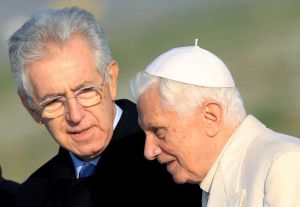
El primer ministro italiano, Mario Monti, junto al Papa Benedicto XVI.

¿Son manirrotos los católicos, e incapaces sus políticos de sostener una economía capitalista creíble? ¿Por qué la crisis se ceba más en los países católicos del sur de Europa que en los del norte, de tradición protestante? ¿Son anticatólicos los mercados? Como en la canción de Bob Dylan, la respuesta (y la pregunta) está en el viento. No es un debate nuevo, pero arrecia en los tres últimos años.

De rodillas, andrajosos, humillados, cinco sujetos aparentemente sobrealimentados piden limosna en actitud perpleja. Detrás, un muro. Enfrente, la nada. Un letrero dice que son miembros de la Unión Europea. Cada uno luce en la pechera la marca de su país: Italia, Portugal, Irlanda, España y Grecia, de izquierda a derecha. El dibujante Jim Morin sublimó así el viejo debate sobre la inferioridad económica de los países católicos. Su ya famosa caricatura se publicó en The New York Times para ilustrar un informe sobre los PIGS europeos, literalmente cerdos en inglés.

PIGS es el acrónimo despectivo con el que financieros anglosajones se refieren a los países del sur de la UE: Portugal, Italia, Grecia y España (Spain en inglés), para subrayar sus problemas específicos: déficit incontrolado, contracción económica, desempleo galopante, endeudamiento, burbuja inmobiliaria, derrumbe de sus emisiones de deuda y, sobre todo, mentira y falseamiento de las cuentas. Tras la crisis de 2008, se reemplazó Italia por Irlanda, pero ahora añaden a las dos, con el acrónimo PIIGS. Algunos de esos países fueron presentados como ejemplares por sus gobernantes, en el caso de España como una economía de “champions”, a punto de superar a Francia e, incluso, a Alemania (palabras de Zapatero hace tres años).

El calificativo PIGS ha sido usado incluso por el Financial Times, referido a los prejuicios habituales de un determinado pensamiento económico sobre países de la periferia europea, oponiendo su situación a los emergentes BRIC (Brasil, Rusia, India, y China). El periódico jugaba con las palabras brick (ladrillo) y pig (cerdo), con una sutil referencia a la frase hecha que designa en ese idioma la idea de algo inverosímil: flying pig (cerdo que vuela).

Otros teóricos han utilizado la expresión economía porcina. “Es un apodo peyorativo, aunque refleja la realidad. Hace ocho años, los cerdos llegaron realmente a volar. Sus economías se dispararon después de unirse a la eurozona. Ahora, los cerdos están cayendo de nuevo a tierra”, escribió Financial Times en septiembre de 2008. Los mismos calificativos han usado The Times, Newsweek y The Economist.

Pese a que las economías de los países donde más han arreciado esas críticas (Reino Unido y EE UU) también atraviesan por dificultades, los desprecios no han desaparecido. Todo empezó con las tesis del sociólogo Max Weber sobre la inferioridad del cristianismo romano respecto al protestantismo para construir economías capitalistas solventes.

Los cinco pordioseros del dibujante Jim Morin tienen esa característica religiosa. Son católicos romanos, salvo Grecia, que es ortodoxa, una religión prima hermana del catolicismo. Si hubiera un barómetro para medir el maridaje entre el Estado y la religión, Grecia se llevaría la palma confesional, por delante de Italia y España. La última demostración fue la jura del cargo del nuevo primer ministro heleno, humillado ante el nutrido grupo de prelados encabezados por el arzobispo de Atenas y primado de Grecia, Jerónimos II.

En España, los presidentes de Gobierno y sus ministros, incluso los tachados por el Vaticano de “laicistas furibundos” (como Rodríguez Zapatero), juran su cargo ante un crucifijo y la Biblia abierta por el Pentateuco, el llamado Libro de los Números.

Veamos las tesis del sociólogo alemán Max Weber (Erfurt, 1864-Múnich, 1920). Las expone en un libro que se hizo pronto famoso, La ética protestante del capitalismo, publicado en 1905. Dice: “El mundo protestante es más exitoso económicamente que el católico gracias al influjo de la religión protestante en cada uno de sus individuos: amor al trabajo, honradez, ahorro y apego permitido a lo material”.

Los protestantes llaman perezosos a los católicos. Replican los católicos que los protestantes son materialistas. Weber lo explica así: “El católico es conformista y prefiere la seguridad, mientras que el protestante se atreve con el riesgo. La Iglesia católica castiga al hereje, pero es indulgente con el pecador. El protestante pone el énfasis no en la confesión, sino en la conducta. Cualquier fabricante sabe que es la falta de conciencia de los trabajadores de países como Italia uno de los obstáculos de su evolución capitalista y de todo progreso”.

Los tópicazos del sociólogo de la religión se refiere aquí a un tema de rabiosa actualidad en la UE: la menor laboriosidad y productividad de los países del sur, y el escandaloso absentismo laboral. Según Weber, el protestante no considera el trabajo un castigo. Los católicos, en cambio, creen que el trabajo es el máximo castigo de Dios por el pecado original, y culpan a una mujer, Eva, de haber provocado la expulsión del Paraíso, donde no era necesario trabajar. Del protestantismo, perseguido con saña en España hasta 1966, escribió Menéndez Pelayo, desde su atalaya de católico a machamartillo: “El protestantismo no es más que la religión de los curas que se casan”.

Ahora, la protestante Angela Merkel se presenta capaz de arreglar las cuentas y las deudas de los Estados del sur, como se ayuda a un primo borrachín. Pero exige atenerse al cuento de los tres cerditos merendados por el lobo. No ayudará, a menos que los PIGS estén dispuestos a construir en cemento armado sus casas, en vez de con paja reseca, y a aplicarse el cuento de la austeridad, el rigor y los sacrificios.


San Isidro, las mujeres y los puentes de Rajoy

J. G. B.

Uno de los frenos del desarrollo en los países católicos es la tradicional aversión de los jerarcas romanos por la mujer. Ese talibanismo pervivió en la Europa de los PIGS hasta bien entrado el siglo XX, pomposamente llamado el siglo de las mujeres. Carlos Marx, muchos años antes, había advertido de que “el progreso social se mide por la posición que ocupa la mujer en una determinada sociedad”. En España, durante el franquismo, donde mandaban mucho los obispos, las mujeres no podían abrir cuentas en un banco ni obtener el pasaporte sin licencia del marido.

“De los innumerables pecados cometidos a lo largo de su historia, de ningún otro deberían de arrepentirse tanto las iglesias como del pecado cometido contra la mujer”, opina la teóloga Uta Ranke-Heinemann, compañera de estudios del actual Papa en la Universidad de Múnich.

Todo empezó cuando los primeros sabios cristianos tomaron a Aristóteles como pensador de cabecera. El griego fue quien primero teorizó sobre la inferioridad de la mujer. Esta debe su existencia a un descarrilamiento en su proceso de formación; es “un varón fallido”. San Agustín reforzó ese desprecio y Tomás de Aquino lo hizo teología de altura.

Respecto a la aversión por el trabajo (baja productividad, absentismo, etcétera), el símbolo podría ser san Isidro Labrador, patrón católico de Madrid. La Iglesia romana lo tiene en los altares como un hombre muy piadoso (tanto, que abandonó a su mujer para no disiparse), pero con fama de holgazán entre los vecinos. Su patrón, Juan de Vargas, quiso comprobarlo por sí mismo. Un día se escondió tras unos matorrales, a medio camino entre la iglesia y el campo. Al salir del templo, recriminó a Isidro el absentismo. Pero cuando llegaron los dos a la finca, los bueyes estaban arando ellos solos la parte que le correspondía al futuro santo y patrón. ¡Ángeles del cielo!

Otro cantar es la fama festivalera de los países del sur. El presidente Mariano Rajoy ha prometido que reducirá los puentes festivos para mejorar la productividad, pasando al lunes algunas fiestas de guardar. Lo tiene difícil. Ya lo intentó Felipe González en 1984 con la fiesta de la Inmaculada (8 de diciembre), para que no coincidiese con la de la Constitución (dos días antes). Los obispos casi se echan al monte.

Todo son dudas. Las medidas de austeridad impuestas a los italianos por el Gobierno del tecnócrata Mario Monti (bien arropado por ministros católicos, como Andrea Riccardi, hagiógrafo de Juan Pablo II y fundador de la Comunidad de sant’Egidio, uno de los nuevos movimientos del catolicismo romano), excluyen de todo sacrificio a la Iglesia católica. El plan de ajuste asciende a 30.000 millones de euros, de los que buena parte proceden de un nuevo impuesto inmobiliario. Si la Iglesia católica italiana lo tuviera que pagar, Monti tendría 2.500 millones más. Lo han evitado ministros considerados más súbditos del Vaticano que de Italia.

Han hecho lo mismo los nuevos gobernantes de Grecia. En España, ni siquiera se plantea lo contrario, pese a ser la Iglesia católica el segundo propietario inmobiliario después del Estado. En los tres países en crisis, las jerarquías católicas viven en un clamoroso paraíso fiscal.

Todo empieza en la educación sentimental. Los catecismos que aprendieron los españoles durante el nacionalcatolicismo franquista (el Astete, el Ripalda y el Catecismo Patriótico Español, sobre todo) enseñaban que el liberalismo era pecado, pero también el capitalismo, el socialismo, el modernismo, el darwinismo, el sindicalismo, el laicismo, el secularismo, y así hasta 14 ismos. “A todos los fieles, en especial a los que mandan, ordenamos con la autoridad del mismo Dios que trabajen con empeño en desterrar de la Santa Iglesia estos errores”, ordenó el Concilio Vaticano I.

“¿Es lícito a un católico llamarse liberal?”, preguntaba el cura en la catequesis siguiendo el texto de Nuevo Ripalda para la nueva España. Respuesta: “No, señor, por el escándalo que causa tomar el nombre de un error condenado por la Iglesia”. Pero había matices. El catequista ensotanado pregunta si “alguna vez no será pecado leer la prensa liberal”. “Sí, señor, si se leyeren las reseñas taurinas o el alza o baja de la Bolsa”.

Michael Burleich, historiador de Oxford, opina: “Para los protestantes liberales, los católicos personificaban el atraso económico y el oscurantismo cultural, mientras que el protestantismo era sinónimo de cultura, una identificación efectuada en parte para revigorizar el protestantismo entre una burguesía que ya no iba a la iglesia. Las personas modernas hacían sus propias elecciones racionales; los sacerdotes ejercían un dominio antinatural sobre las ancianas, los niños y las gentes del campo, que constituían la mayoría católica”.

Es como si Burleich hubiera escuchado al aristócrata Cayetano Martínez de Irujo, conde de Salvatierra y gestor de la Casa de Alba, que acaba de proclamar que “los jornaleros andaluces tienen pocas ganas de trabajar”. La misma idea ha expresado, con palabras más gruesas, el líder de los democristianos catalanes, Duran Lleida. Burleich añade, citando a Weber: “La resolución y la sobriedad características de los protestantes contrasta con una chusma indolente y beoda de campesinos controlados por los curas, que solo salen de su inercia para quedarse embobados con las trapacerías de las reliquias”.

Recientes investigaciones de Ludger Wössmann y Sascha Becker, profesores de Economía de la Educación en la Universidad de Múnich, señalan que las regiones alemanas protestantes eran (son) de promedio más ricas y desarrolladas que las católicas, y también tenían (tienen) mayor nivel de escolarización de mujeres.

En España, el atraso económico se concentra, con tasas de paro por encima del 30%, en las regiones más católicas, si sirve para medir la religiosidad el porcentaje de contribuyentes que coloca la equis en su declaración de la renta pidiendo que Hacienda desvíe el 0,7% de su cuota fiscal para pagar los salarios de obispos y sacerdotes. Andalucía y Castilla-La Mancha duplican el porcentaje de País Vasco y Cataluña. Además, la historia del mal llamado impuesto religioso es una demostración de cómo en el mundo católico la verdad puede convertirse en mentira con desparpajo. Sostienen los obispos que son sus fieles los que pagan ese impuesto. Pero el católico español, al contrario que en Alemania, no añade ni un euro en el IRPF para su confesión. Es Hacienda quien lo deduce de los ingresos totales del Estado, de manera que el sostenimiento del clero católico corre también por cuenta de ateos, protestantes, judíos, musulmanes y todos los etcéteras que quieran añadirse.

Italia confirma también las conclusiones de Wössmann y Becker, con un añadido: allí está demostrado que el norte, más rico pero menos religioso, es menos corrupto que el sur, donde la tradición católica está más arraigada y hay más pobreza.

Es difícil encontrar un historiador de las religiones que no se ocupe de las tesis de Weber. El último en hacerlo es Diarmaid MacCulloch, catedrático de Historia de la Iglesia en la Universidad de Oxford. Acaba de publicar una imponente Historia de la Cristiandad (Debate, 2.300 páginas) y, pese a señalar los intentos renovadores de Roma, considera razonables los argumentos del sociólogo alemán. “Los colectivos son más proclives que los individuos a pasar por alto algo que sucede delante de sus narices”, ironiza.

En cambio, la filósofa y escritora Reyes Calderón, decana de la Facultad de Ciencias Económicas de la Universidad de Navarra, desveló hace apenas un mes que está ultimando una investigación en la que desmonta con contundencia la idea de que las sociedades católicas sean más corruptas y atrasadas que las de tradición protestante. De momento, sostiene: “El problema es que tanto la metodología de la investigación como las bases de los estudios eran incorrectas. Valoraban, por ejemplo, que como en el catolicismo puedes robar y después confesarte para quedar libre de culpa, se tendía más al hurto. No valoraron que la religión católica obliga a devolver lo robado para ser absuelto. La muestra era muy sesgada”.

« Previous Page — Next Page »

WPMU Theme pack by WPMU-DEV.